I'll be writing, here, about TRILOBOATS, 'square boats' and our life on the water in SE Alaska. It's a blend of engineless, junk rig sailing, shoestring living and voluntary simplicity, with a few yarns thrown in for good measure.
Access to the net comes and goes, so I'll be writing in fits and spurts.Please feel free to browse the archives, leave comments where you will and write... I'll respond as I can.
Fair winds!
Dave and Anke triloboats swirly gmail daughter com
ARTHUR: I don't know. MERLIN: Shall I tell you what's out there? ARTHUR: Yes, please.
MERLIN:
The Dragon.
A beast of such power that if you were to see it whole and complete in a single glance
it would burn you to cinders.
ARTHUR: Where is it?
MERLIN:
It is everywhere.
It is everything.
Its scales glisten in the bark of trees.
Its roar is heard in the wind. And its forked tongue strikes like.... like lightning! Yes, that's it.
Folks back home say whoever sets out is a Fool. Ya don't know what's out there! It's dangerous! Whaddaya know about anything, anyway?
Folks back home say you can't do it without this or that. You're too young. Too old.
Sure, the world winnows both Dreamers and Seekers. The saddest tales are of those who Dream, but never set forth. Of those who do, some run home, tail between their legs. Some are lost along the way. Some fail their Ordeal. Some achieve great things, but never return to tell of them. Some drown within sight of shore. Some return home, having traded the cow for a handful of 'magic' beans.
Some few return with treasure. Of wealth. Of mind. Of spirit. Only these few are called Heroes... and the rest Fools.
Some win through by luck. By pluck. By persistence. By virtue. By True Love. Many of the storied Heroes are simply psychopaths... as monstrous as any met on the journey.
But all begin as Fools.
Why set out on this perilous Journey? What calls us out of our comfortable beds? Away from hearth and home? From the devil we know?
Some are driven by the sheer trauma of the life they leave behind. Anger, abuse or poverty can send a soul packing. Seeking something, anything better.
For others, it is discontent with law and order too ordered. Predictable, safe, empty and self-satisfied.
And then there's the call of the unknown. That far horizon. Adventure. Dreams. Great deeds to be done. Great treasure to be won.
Some of us long for the remains of the natural world. Our first home. The Wild.
For these Fools, the Hero's Journey has been turned on its head... it is the Wild, not the furrowed field that is the point of departure and return. The Wild that is, of its own being, the treasure. That is, itself, the Reward.
These Fools make friends with, rather than slay, the Dragon. Learn to ride the Dragon. Live to love the ride.
Until that day the Dragon consumes us, as it will, Hero and Fool alike. Whether at home or abroad.
For my money, it is Heroic enough to set out upon the Journey. To risk all on the Road. To risk the Dragon. The Abyss. Heck, I think it's heroic enough to stay home and live a life of quiet integrity.
Buck 684 (Top) and 135 (Bottom) Photo from Buck Knives
Ah! Sweet mystery of life, at last I've found you! - from Naughty Mariette by Victor Herbert
REVIEW: Buck Knives 684/135 Bucklite Paklite(R) Combo and Sheath!!!
A while back I wrote Good Knife, Bad Knife involving the carrying of two knives; a better quality 'good knife' for sharp, clean cutting and a lesser quality 'bad knife' for all the rest.
As usual, I'm putting up with two, inferior sheaths on my belt and putting off building a decent, double sheath.
And then... AND THEN...
Along comes Buck Knives' Paklite Combo. Two quite decent knives at - if you shop around - a quite decent price (about $45 at this writing).
Both knives are well made of good quality steel. Useful shapes. Jimping (notching) in the right places. Comfortable, secure grip handles.
I use the 684 hunting knife as my good knife. The rubber handle gives more control, power and comfort for fine work.
I use the 135 as my bad knife. I was concerned that it's hollow grind on a thin blade (0.1in... it's designed as a caping knife) wouldn't stand up to the rough use we require of it. But after a year of abuse, I can report that it has done very well. The edge is easy enough to touch up and holds quite reasonably well.
Should I lose one or several, I've found 135s for as low as $20, delivered. That's a little rich for my bad knife standards, but they fit their sheath perfectly. And a skeleton knife / sheath opens the door to many, many other less expensive options if I'm feeling cheap.
Showing my set, above and apart with Anke's, below and assembled
Now, knives that are both economical (cheap) and useful abound. What is in short supply, to my mind, are decent, inexpensive sheaths to hold them.
In every case, I've either endured the sheath supplied, or built my own. In all these years, I've worn two on the belt and never gotten around to building a double sheath to conveniently carry both knives.
These blades are better than cheap. But what's truly makes the Combo stand out is their supplied sheath system.
Somebody really thought this one out!
The system has two main components:
A sturdy, durable (and modifiable) polyester holster secures two separate but interlocking sheaths. Features include
Vertical and horizontal belt loops... loops are snug for a firm carry (not floppy).
Snap-down security flap... this may be folded back and tucked behind sheath when knives are being actively accessed.
Snap-down to sheaths... locks them securely into the holster.
The sheaths are hard polypropylene. Features include:
Symmetrical... sheaths hold their knife equally well either way, for left or right hand carry.
Slender, integrated design... together, they are less bulky than many of the single sheaths I've encountered.
Separable sheaths... they can be separated and slipped into a pocket.
Interlocking tips... these securely unify the sheath tips into a unit when used in the holster.
My only quibble is that the 135 skeleton blade fit just a bit loosely in its sheath. This allowed a slight rattle, and if working ass-over-teakettle with the flap open, could fall out.
Easy fix... a couple round turns of seine twine in the skeleton sheath provides enough friction to resolve these issues. More turns = more friction, so you can adjust to taste.
So I'm happy with this combo set of blades. I'm WAY happy with the sheath!
Down the road, I'm likely to modify the holster to accept a marlinespike.
Hey Buck! Hint, hint!! Howzabout a mariner's version?
As we sail into the wind with our leeboard down (on the lee side), the leeway we make presses it against the hull. It likes to slip forward but not sideways (LR for Lateral Resistance), so we don't make as much leeway as we would without it.
Ready about!
Helm down, we turn into the wind, sails flogging as the bow and boom cross the wind. We drop the leeboard on the new leeward side and raise the first one clear of the water. Sails fill, we heel over and off we go on the new tack.
If it sounds like allemande left and dosido, it is. A little choreography on what may be a heaving, wet deck and your partner is a big, heavy leeboard.
Lazy sailors that we be, our interest was aroused by Ida Little as she clamped a 2x2 outboard of her Bolger DUGONG's leeboards to form a slot, instantly converting them to OCBs (Off Center Boards).
No need to tend 'em between tacks! Just put 'em down and leave 'em. If you want to reduce drag sailing off the wind (no need for lateral resistance), you can raise 'em if you want to.
Years went by, and we transitioned to big view side windows. Problem is, with the boards raised (always the case at anchor), they block our view.
We wanted to haul and store them out of the way. We wanted a simple installation. We wanted it quickly and easily handled by one person.
So we scratched our heads and came up with travelling OCBs.
*****
Walk-through of set and stow
Please watch first for overview
The video above walks through from stowed aft to set forward and back. Notice that the stowed position is in the 'blind spot' below the pilot house.
Tour of system components:
Upper cable, eve guard and stop
This is one of our early prototype stops for the board. It's two purposes are to act as a stop at one of the board's two positions, and to shorten the span of the cable.
The traveling block (description to follow) travels along the upper cable until it hits the forward stop (set) or aft stop (stow).
Both functions will eventually be met by a shorter upper cable (shorter span) and crimp on swage sleeves (stops).
In the meantime, we currently tie a double sided rolling hitch around the cable, with the ends led up to a handrail post (i.e., the vertical part, and not the grip), rather than the arrangement shown.
That aft tail is just 'cuz I hate cutting line.
Aft lower guard, mounting plate, lower cable and slot
Forward lower guard, sheathed turnbuckle, mounting plate and slot Note the guard struts
The lower guard and lower cable - offset by mounting plates - form the slot.
The lower guard doubles as bearing for the OCBs and mounting steps fore and aft. Handy for boarding from the ground or a dock.
A rule of thumb for leeboards is to toe them in 2 degrees. This helps the vessel 'climb' to windward. We haven't done this on these lower guards, but plan to at the first opportunity.
On the lee side, the OCB acts like an ordinary leeboard. It bears up against the lower guard and pulls at the upper cable.
On the windward side, the lower cable prevents the board from winging out, and the upper board bears up on the eave guard.
We adjust cable tension to let them angle inboard, also at 2 degrees. Our thinking is that, when heeled, this produces a downward force at their Center of Effort, equivalent to someone hiking out, acting against heel. I mean, since we're leaving it down, why not?
Incidentally, since both boards remain down, we use only a little more than half the area one might in a leeboard (where one board handles all LR). This is cheaper, faster to build, lighter, and induces less stress.
There are big stresses on OCBs. I would like bigger and thicker mounting plates down the road, though these (1/4in aluminum) seem to be doing fine. I'm guessing the cables help to absorb and disperse some of the stress.
Bottom of OCB from aft
Here we see the retrieval line, its block and cleat. It is used to raise, lower and angle the board with 2 to 1 purchase (we're trying it out... may go to 3:1).
For stowing, the board is moved to the aft stop and raised clear of the water, but with its lower edge still in the slot. This prevents waves from clunking the board when stowed.
For sailing into the wind, the board is moved to the forward stop and tied, then the retrieval line is hauled in a bit to angle it back a skosh. This encourages it to kick back if we bounce it on the bottom in a swell, relieving stress all round.
For sailing off the wind, we haul the board to as near horizontal as possible. This reduces drag from the now useless boards (lateral resistance is not required off the wind).
Due to the relatively poor lead for the retrieval line, while deployed, we can't quite clear the water with the OCBs' lower edges. We're considering a snatch hook under the eave directly above the load... this would improve the lead, but requires awkward handling with low payoff. Still mulling that one over.
Note the upper mounting plates which were cut from aluminum angle.
Top of OCB from Inboard
These two pics show the hanging / travelling arrangement for the OCBs.
As seen above, an inverted block runs its sheave above and along the upper cable. A lanyard is fixed to the block, and passed through the board to the outboard face. The board pivots from the block when raising and lowering.
[NOTE: We've found Stanley™ Pulleys to be perfect for the job... cheap, strong enough, and the sheave pin is R-sprung for easy dis/mounting.]
Below, we see the lanyard emerge and tie off to a cleat. We pull the block as snug as possible, inboard to set the board as high as possible. This gives good landing on the eave guard. The eave has the dual function of bearing against the upper board, and keeping deck runoff from the windows.
The tail of the lanyard - stopper knotted at its end - is used to haul the boards fore and aft. In the forward position, we tie off to the handrail with a clove hitch to keep the board from pulling aft when raised in place for off-wind sailing.
Top of OCB from Outboard
A little miscellany...
There are two main criticisms of OCB/leeboards; clunking and picking up 'scultch' (seaweed Klingons).
We've only had board clunking issues in light winds and riptide conditions. Otherwise, the boards either immediately bear up and go silent or 'shuffle' along in no wind. In LUNA, we added firehose along the lower guard, which eliminated clunking, but it's seems only vaguely worthwhile.
We do pick up weed now an then, but it's easily dislodged by raising the board briefly.
As a frequent criticism of OCB/leeboards, I don't get it. Any LR device picks weed, and in most it's a LOT harder to ditch. I see plenty of fixed keelers dragging a garland.
OCBs are easy to construct and maintain, requiring no hull apertures or complex structures. Ventilation is most excellent!
Maintenance is a relative snap. To dismount, we uncleat the lanyard, which can then lower the board with 2:1 purchase. We temporarily hang the board by its cleat's lower horn hooked over the lower cable. We can leave it like that until ready to remount or take it ashore.
We shoot for a ballast load that floats them vertically, about a foot or so proud of the water when dismounted. We can easily tow them ashore on a 'leash' for whatever. Propped up flat, they make a great work bench, ashore.
We don't always sail with both boards down. Each significantly reduces leeway, but there are days we just don't need to be sailing at our best to windward (e.g., a short leg after a long run). In case we change our mind, the second is easy enough to set up, underway. If not, that much less to put away at the end of a pleasant sail.
Retractable LR is a given for ultra-shoal draft. It opens up a hundred sheltered spots for every reasonably deep anchorage. When the wind come on, it can save hours to the next hidey-hole.
*****
We've been sailing with OCBs, now, for 20 years, and travelling OCBs for about half of that. We sail year round in SE Alaska most years, across a considerable range of wind, weather and water.
I'd say it's working!
[NOTE: In SLACKTIDE we had windows along the entire cabin. To stow, we had to lift the boards clear of the slot and slide them dead aft. This complicated retrieval to brute force. Lighter boards are recommended.
There's a primitive ancestor of this post on SLACKTIDE's system, here.]
Going nowhere isn't about turning your back on the world;
It's about stepping away, now and then,
So you can see it more clearly
And love it more deeply.
-- Pico Iyer
Going Nowhere
It was a dark and stormy night...
Wait. No. It was bright and balmy day. We had turned the corner from Chatham into Peril Strait, cutting through Morris Reef as we've done a hundred times.
But this time, we were continuing the turn into Sitkoh Bay, intending to skirt the outlying reefs along the inside corner. We'd threaded the reef on the last of the rising tide, and it was now starting to fall. What's worse, it was now past top of springs (tides getting smaller for the next week and wouldn't be this high again for two weeks). Flat seas, that day, but forecast SE 20kts rising to 30kts (from the worst quarter) with seas 4 to 6ft for the next day.
We took bearings from the chart and gave ourselves some extra margin. Not enough as it turns out, and definitely given those italics above.
Anke had the good sense to think one of us should be at the bow (me saying, "Only if you like... we're well clear!"). She wasn't even all the way forward before she called out, "Hard to port!"
I duly put 'er over hard, but too late. We fetched up mid-ships against the only point in the whole durn area that could have caught us, a little 4in pinnacle standing atop a sunken hill.
In 30 years of sailing cheek on jowl with reefs, this is only the second rock I've hit. Ironically, the first was about a hundred yards away (broke my rule about running through unscoped kelp patches) and about a mile from where we spent a few memorable days on the beach.
This one was a doozy!
Initial assessment showed a couple knots of current held us pinned against that toe-stubber at about our Center of Lateral Resistance (side point around which a boat will spin... or not), so we:
Tried to spin off under sail... not enough wind to overcome current.
Tried to pole off... not enough strength at a steep angle.
Stepped onto the rock and tried to push off by hand... we were on a peak and I couldn't step far enough away from the CLR to gain leverage.
By now, we're starting to settle on whats showing as a small, thwartships ridge a foot aft of CLR. It's no longer just current we're fighting, but gravity.
Tried levering off... ditto.
Tried lever + handybilly... double ditto.
Rowed out a kedge... by now, we're settled too hard to shift, even with capstan assist.
Okay. At this point, we give up on trying to get off the rock, and turn toward stabilizing ourselves on it.
Luckily, that ridge was plenty long enough to support us across the bottom. No fear of tilting and falling sideways. But, being a ridge, it was like a teeter totter with the big kid at the bow. The bow started to settle, and our stern reached for the stars.
Our first impulse and effort was to lash some fenders under the bow for a cushion. But it soon became clear that even with their extra height, we would be dangerously bow-down by the time they fetched up. At worst, we'd nose-dive down the hill and fetch up hard.
Sooo. We had plenty of firewood... we were able to post two pieces on end - one on each side, about 4ft forward of the fulcrum point, standing on the rock and shouldered under the bottom. Further settling of the bow was stopped, and we could breathe a little easier as the water ebbed away.
Fortunately, we could move freely around the boat without our weight being an issue, though we were pussy-footing, to be sure. Didn't want to shake ourselves off those posts!
We rested a bit and had a meal. What a view! The sun was getting low over two of SE Alaska's great waterways. First snows on the peaks all round. Us in the high bleachers, looking down upon it all. Warm food, coffee and time to think out a plan.
Kinda like yoga. Doesn't really catch how high up we were!
First thing was to run the numbers. Check the tides, calculate ranges, apply the Rule of Tenths. Check it twice. Safe by a foot... we would float in the very early morning.
Next, we contacted the Coast Guard to let them know our situation (about which they would likely get some calls from passing traffic), and that we had it in hand.
We reset the kedge further out in sandy bottom, well off the port quarter (the free shot out). Set up a snatch block for the anchor line to lead it fair (from directly forward) to the capstan. This let us use nearly its full power.
Before calling it a night, we added two more rounds of firewood lying flat, aft of the fulcrum. Our thinking was that, as the bow lifted and stern lowered, we would rotate around those, lifting up and away from the stone fulcrum. Any wave-induced pounding would be on a more forgiving surface.
Oh. And I took a sledge to that 4in pinnacle and beat it flat. If we were going to bounce in the morning, we sure didn't want it poking up at us!
Approximate line of 'our' rock... Post and round drawn in brown.
In the wee hours, the tide duly came back, and as promised, lifted us free, aided by light chop. We waited until we were just quivering before hauling the kedge line bar taught.
Within a few minutes, we slipped free in two lunges. No grinding, no damage.
*****
As you may have noticed, there was considerable luck involve, good and bad, as is the usual case.
If we'd been half our beam in either direction, it would have been a close call but no contact.
If we'd hit that pinnacle a few feet from CLR, we could have spun off.
If the rock had been flatter (longships), we could have spun off.
If it had been too much of a steep rock, we could have slid off either forward or sideways.
As it was, we were reminded again how forgiving ultra-shoal draft boats can be, particularly those with flat bottoms.
We appreciate the virtues of girder construction. You can see how rigidly our stern cantilevers. The wide, flat, rigid bottom facilitated posting to limit rotation.
These two features most often mean that, even if a strong sea builds up, we can get out with little harm from a scrape like this. As the tops of the first waves lift us, the kedge pulls forward. Only a small drop and crunch are likely, and only a few of those.
All in all, however, we count our lucky stars.
*****
On Appraisal, we draw these reminders and lessons:
Always give extra margin on falling tides, especially falling from springs to neaps!!
Remember that reefs and shorelines are rarely accurately charted!
Pilots advise traffic keep whopping distances off visible landmarks. We run reefs all the time, but when skirting need to be on full alert or follow the pilot. Extra wide margins! Lookout at the bow!
Set a kedge early!
We dillied and dallied too long, partly as it was a foul spot; easy to lose an anchor. Still, anchors are cheap relative to risking the boat, so delay was a poor choice. For ultra-shoal, it's not usually the first response, but shouldn't be delayed long. It's our heavy lifter.
*****
We met thirty some years ago at the Pioneer "P" Bar in Sitka, AK. Its walls are covered with photos of boats on the rocks. Not exactly a Hall of Fame, but rather a Wall of Infamy.
Spirit of place! It is for this we travel, to surprise its subtlety; and where it is a strong and dominant angel, that place, seen once, abides entire in the memory with all its own accidents, its habits, its breath, its name. - Alice Meynell
Where We Been
Well, life has been a whirlwind but is now settling down to another winter caretaking at Baranof Warmsprings Bay. And that means some steady signal (barring the technological demise of our iPhone 4).
Last winter (2018-19) we spent in Sitka, AK, touching bases with old friends and making new ones. Among other things, we installed a new, full-sized foremast. Our original was undersized and therefore temporary, but come spring, we were poised for full strength sea trials. This summer, we sailed roughly 500nm as the crow flies.
In short, WAYWARD sailed well on and off the wind over a wide range of conditions. We were able to sail, short tack to windward, luff up and 'tread water', sail backwards, on and off the anchor... in short all we asked of her.
Our route took us from Sitka Sound to WarmSprings Bay, Tenakee, Haines, Juneau, Hoonah and WarmSprings Bay again. But ah! The reaches between!!
So here's a few images from along the way:
We helped an injured juvenile sealion aboard for the night... It was spooked, injured, and we think avoiding orcas.
This little guy woke us by ramming his head against the hull as he tried to climb onto our narrow board guards. He was obviously panicked, but not by us. He tried and failed to get in the dory, so we tipped one edge up (to lower the other) and he flopped in. Stayed with us for about 16 hours. Turns out he had a lacerated flipper, which was badly swollen the next morning. Finally, the horseflies drove him back into the water, and he swam off with some other sealions.
Sari weather, or less!
New sculling oar blade Rocket Stove (EcoZoom) on bench to my right
I'd thrown together a vertical blade sculling oar for WAYWARD out of poor materials (grey blade to my left). It worked so well, it was our scull for almost two years. But the loom was giving up, and the blade was from a skinny plank. So time for new.
These were inspired by Douglas Martin's sculling oar for MOCKINGGULL.
Rocket Stove deck fire
Our little rocket stove let us cook outside on hot mornings, using just a handful of kindling sized sticks for a meal or popcorn. Afterwards, sunset and stars with a blaze and sumpin' sippy!
Fireweed Friendly
The islands with the fireweed had big stretches of thimbleberry, blue berry and blue- and red huckleberry. A little further on, we found great patches of skunkberry and rowanberry (mountain ash). Each made gallons of fine boat wine!
EcoTourism in action Note trail of smog... Starting to look like I-5 North along Lynn Canal / Chatham
Unfortunately, and despite promises from the industry, cruiseships emit pollutants rivaling those of any of the permenant, small cities in SE Alaska. Stack emissions and dumping in 'donuts' (a patch of inshore water three miles from any shore) are visibly altering the relatively pristine air and water of our archipelago.
Up a creek, got a paddle
Here we're in a tidal stretch about a mile and a half up from the river mouth. Salmon are running, but severely reduced in number due to drought. We're about a half mile downstream from where they pool to ascend the river.
Oops! Top o' the reef at about 18ft above low tide. 8/
Thereby hangs a tale for another post. Suffice it to say I could'a used a more generous margin of safety!
Anke and I met over 30 years ago at the Pioneer Bar, whose walls are adorned with pics of boats in similar situations. We've now joined that wall of infamy.
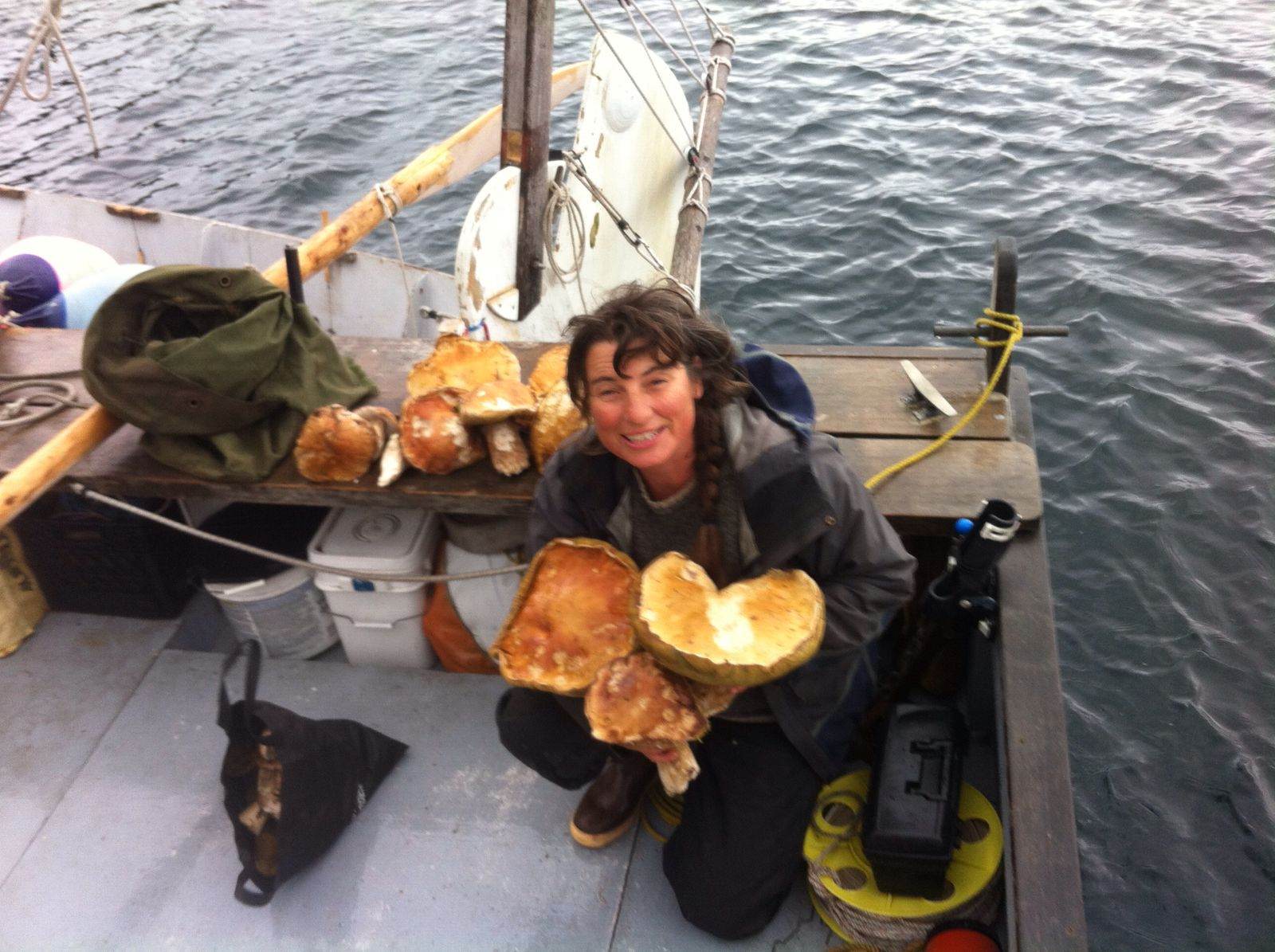
The Queen o' King Boletes
Once the rain started after months of drought, the mushrooms were fantastic! King Boletes, Chantrelles and Hedgehogs are our main staples.
Hiding from the wind
Paula Bunyan
Averaged 2kts in not much wind!
At the end of the season, workers from the Lodge replenish their wood supply. But that strips the local beaches of good beach logs, and Chatham is often a nasty place toward the end of the year. So we did our logging 20nm N of the bay and towed a raft S with us. Friends met us about halfway, so we got an engine assist for once.
*****
So there's a quick tour.
Hopefully the winter will be mild and uneventful and I can get back to writing!
You call this the future?? HA!! Where are the rocket packs? Where are the disintegration rays? Where are the floating cities? I mean LOOK at this! We still have WEATHER?! Give me a break!!
-- From Calvin and Hobbes by Bill Watterson
The 'Wiz': I Can't Come Back, I Don't Know How It Works!
SCENE: The Great and Powerful Wizard of Oz drifts heavenward in his hot air balloon, prematurely released by his assistants. Dorothy, arriving late for her ride home, implores him to come back!
“I can’t come back,” he replies, “I don’t know how it works!”
Sailing engine free is kinda like that.
In our case, we have a fair handle on how our vessel / balloon works. Its operation and more importantly its limitations. Yet we set forth into the unknown, with never more than our best guess at time spent underway to our destination.
We don’t understand Weather. And among ‘we’ I include the Great and Powerful Wizards.
One year, we sailed a whole September to go a measly hunnit and fiddy miles. That’s two long but easy days' sailing with a decent, fair wind.
Every day of that month, the weather reports were virtually perfect in their mirror image error. Predicted blow low; it would blow high, and the reverse. Fair winds promised, head winds delivered, or none. Rain; shine. Clear; fog. You name it. If they’d predicted ‘no Oobleck today’, we’d have been up to our Cubbins in it! [Dr. Seuss -- Bartholemew and the Oobleck]
The next summer, we met one of NOAA’s house wizards (NOAA attempts to predict weather in our parts). Trying to be sympathetic, Anke allowed as how ‘it must be hard to predict weather in Southeast (Alaska).
His reply? “No. Why? We’ve got models!”
In a day when satellites view weather systems from on high… when super computers crunch data in their super conductive teeth… when fluid dynamics enable undreamt of flights of fact vs. fancy… it’s still hard to beat a handful of weather wisdom sayings and a look to wind’ard.
This is not to disparage the wizards. Hubris is (when present) their humbuggery… certainty in their predictions and models not unhumbled by the surprise of rain in their face.
Weather is chaotic, a science and awareness born in meteorology. That famous butterfly, fluttering its wings in Beijing can indeed cause a whoofin’ headwind on our nose.
Chaos is only ever partially tamed by rules-of-thumb. And then, be sure of surprises.
Meanwhile, vast forces push and pull at one another. They fractalize into turbulent sworls along their intersections. Wind, water, land and cloud, tango in passionate beauty. Trading partners and cutting in. Sometimes fierce and violent. Sometimes soft as a Lover’s caress.
We look up in awe, sail on as best we can, and reef sooner than later.
PS. As I write, we hang in a lee that turns out not to be, in winds that are blowing opposite the forecast with triple the speed (about eight times the force). Nothing serious (yet), but it sets ya thinkin’.
When we sail out and away from towns, we generally like to stay out and away for a good long while. Our stores lean heavily toward dried goods; rice and lentils, wheat and beans, onions and garlic, fruits.
Fresh produce and meats are unavailable after the first week or so. In any event, we balk at their prices. Shipping costs and middle-men jack up the price of produce in Alaska. Locally grown foods often cost even more, due to economies of small scale, short growing seasons and cost of feed. We like to support local producers and businesses, but have to keep a close eye on our budget.
Our answer is wild foods. Wild plant forage, wild animal meats and fats.
Local plants have provided most of our greens for many years, now, with only a few dumpster-diven exceptions when in a town. We fish and beach-comb (some wierd stuff, here), and sometimes receive gifts of red meats (venison, bear and seal... often organ meats) or poultry (ducks or geese). Down the road, who knows? Grubs and insects aren't so far from wrigglers we eat from the beach.
To some degree, most of these are stronger in taste than domesticated foods. Wild plants have tastes which stray from the supermarket palette, and where similar, tend to be stronger and often with a bitter tinge. Wild meats can be 'gamey', depending on what the creature has been eating, and organ meats each have their own flavors.
So, to eat widely and in season from our locale, the acquisition of tastes is a real benefit.
Mostly, it seems, our tastes are matters of habit. One culture's delicacy can turn another's stomach, or at least their head. When we eat from off our beaten path, most of us approach with caution, and eat with 'long teeth'.
A famous Chinese subject of painting is The Vinegar Tasters... three men are tasting newly brewed vinegar. One represents Confucianism... his expression is sour... affronted by the taste. The Buddhist looks resigned... another shot of dukkha (trans. suffering, pain, unsatisfactoriness, stress) from which to detach. The Taoist smiles... this taste would go well with any number of others! Yum.
I can't say we're advanced souls, finding the yum in all that which does not kill us. But we aspire to it, relating to the Taoist's engagement with the world. In food, as in so many aspects of simple living, we seek Yum.
We try to approach each new taste with an open mind and the expectation of dawning deliciousness. Frequent exposure helps with acquisition, especially if blended with other tastes we already like. Or we might relate it to some positive value. For example, when a trophy hunter gives us bear meat that would otherwise be left for the birds and the beasts, reduction of human wastefulness and relating to the spirit of the bear appeals to us.
Over the years our tastes have broadened, and with them, our options.
The Vinegar Tasters by ???
PS. Not all plants or even animal (parts) are safe to eat... be sure to do your homework before venturing out into the wild!
*****
Bonus Story:
As a kid, one of our Tlingit friends went along as fishing crew for his Grandfather. These trips lasted about a week before returning to sell the catch, ice up and head back out.
Fishing, of course, is hungry work.
"Grampa, I'm hungry! What've we got to eat?", he asked.
"There's a grub box on deck, s'brd side. Help yourself to as much as you want," came the answer.
When our friend opened the lid, he was hit by a wall of... well... in the spirit of this post, let's say 'interest'.
The box was brim full with an old-time Tlingit delicacy. Stinkhead... fermented - some would say rotten - fish heads! And no reprieve from the catch... fresh salmon is as good as cash money, and ya don't eat that!
Our friend only lasted that one trip, and he said he lost 25 pounds, fasting except for the occasional unmarketable fish that took their lines.
Stinkhead is a powerful gustatory experience whose appreciation has dwindled with changing times. It vividly demonstrates the power of mind over manna.