Please visit our home site at www.TRILOBOATS.com.

Anke and I live aboard WAYWARD, and wrote about it's design and construction at ABargeInTheMaking.blogspot.com.

Access to the net comes and goes, so I'll be writing in fits and spurts.Please feel free to browse the archives, leave comments where you will and write... I'll respond as I can.

Fair winds!

Dave and Anke
triloboats swirly gmail daughter com

Saturday, January 25, 2020

Obstruction of Congress and the End of the Republic

Stand beside her
and guide her
Through the night
with the light
from above

The prosecution of them [impeachments][...] will seldom fail to agitate the passions of the whole community, and to divide it into parties more or less inimical to the accused. In many cases it will connect itself with the pre-existing factions, and will enlist all their animosities, partialities, influence, and interest on one side or the other.; and in such cases there will always be the greatest danger that the decision will be regulated more by the comparative strength of parties, than by the real demonstrations of innocence or guilt.

-- From the Federalist No. 65 The Powers of the Senate Continued... this passage by Alexander Hamilton


Obstruction of Congress and the End of the Republic

I am writing, here, as a Citizen. A member of We the People of the United States of America. I stand in defense of our Constitution and the Rule of Law.

While I realize this has little to do with sailing barge / scows, it has everything to do with our home waters.

President Donald J. Trump has been impeached in two Articles by the House of Representatives, who as I write, is being 'tried' in the Senate.

The case for Article I: Abuse of Power should, I believe be properly tried in the adversarial, partisan Senate and full, impartial Justice be done to the best of Senators' abilities. Yes, it's messy and passionate and blood runs high. That is the nature of politics, which the Framers understood and attempted to encompass in a just and practical system.

Our own friends are divided on the issues. What is accepted as fact differs widely, even among those who agree in the main.

But our Republic can survive abuses of power as we have since its founding.

To me, the crucial issue is Article II: Obstruction of Congress.

The facts of Obstruction of Congress are public and explicit. No procedural argument can be raised against the sole power of Impeachment reserved to the US House of Representatives by the Constitution.

Here's the problem; the integrity of our system of Government laid out in the Constitution relies on checks and balances between three, co-equal branches - the Executive, Congressional and Legislative. Each are granted power to check the other two. It is this opposition - antagonistic at times - which establishes the balance which has endured two hundred years and counting.

Subpoenas are the teeth of Impeachment inquiry and trial. These are essential to the check exerted by Congress over the Executive branch. Non-compliance with House or Senate subpoenas pulls those teeth. Without them, balance is lost.

It's like the game of Paper, Scissors, Stone. As any child can tell us, if Paper cannot cover, there is no Game.

To permit non-compliance for whatever reason by the Executive of any Congressional Subpoena - whether issued by House or Senate - is to create an unchecked Executive and initiate a Constitutional Crisis.

Paper cannot cover. Stone smashes scissors. And the Game ends for good.

Rome had such a moment. The Roman Republic ended under the popular Julius Caesar,  who soon became Dictator Perpetuo. It never recovered.

Speaking as a Citizen, the Executive cannot properly refuse to comply with Congressional inquiry and judgement. To allow it, even once, is to abandon the Constitutional system of checks and balances. To abandon the Constitution itself.

Without the power of Congress to force compliance on the Executive, that power is thereafter unchecked.

Whether under this President or some other, we would set ourselves on the road to Dictator Perpetuo, that Tyrant whom the Framers so feared.

The Republic will have fallen.


Now is the time for all good Senators to come to the aid of their country.

I urge a wide margin of tolerance for petty differences and trivial irregularities.
I urge a full and impartial trial (e.g., subpoena relevant witnesses and documents).
I urge that non-compliance with Congressional subpoenas not be allowed to stand.


*****

Since writing this, a similar conclusion is argued in this Atlantic article by Maya Wiley.

Saturday, January 11, 2020

Models and Mock Ups

Building it isn't TOO much harder
(a LOT more expensive, though).


Shall we have an adventure now,
  Or shall we have our tea first?
-- From Alice in Wonderland by Lewis Carroll

Mock Turtle Soup: Models and Mock Ups


If a picture is worth a thousand words, I'd say a model is worth a thousand pictures. I reckon that makes a model worth a million words!

It doesn't have to be a museum piece. Building in scale is important, so you can measure directly from the model. The more detail you build in, the more you'll solve and anticipate problems ahead of time. But TriloBoats are boxes... there's not so much to figure out on that score.

Note bulkheads, deck and framing lines...
almost all layout happens on sides or bulkheads.

We used doorskin (this time) and cardboard, held together by hot melt glue. Crude, but tells us all we need to know. A couple of scale models of ourselves (and a pet or two have since materialized) to picture lines of sight and boarding issues and there ya go.

We laid out the principle (side) component landings, and window cutouts.

Next step is to start marking it up with material counts:
  • Ply Sheets -- Sides, bottom, bulkheads and transoms, decks... each gets written up in place.
  • Copper Plate and Angle -- Sides and bottom; along both chines.
  • Framing -- Chines (bottom and sheer) and nailers, bulkheads and transoms, decks.
  • Nail Counts -- Parallel to framing, one or two sides... How long? How often?
  • Surface Areas -- How much for paint, sheathing, glue?
Writing our results in place beats a list by far... we can see at a glance what we've counted, and what not. Much less likely to over or under count. A different check mark for each pass through lets us check and recheck.

And we can just sit there and stare at it!


Amazing what cardboard and hot-melt glue can do!


*****

Mock-ups are different. The trick here is to be able to get the feel of a feature in full size.

We've got a collection of chairs, tables and counters picked out that we can go to for the feel of things. We might set up a mock 'gangway' to get a feel for how tight things have become in our present state of 'middle age spread'. And maybe a (literal) fudge factor? A strip of plywood simulates the overhead.

We like to look down (not just out) from our windows to see what's happening close up. This ability is affected by the height of the lower window opening and our distance from it (the closer we sit to the window, the lower we can look over the frame). Mocking up lets us see how our furniture height and location will interact with our view.

Window height has been a big issue for us. Here, we mock up the shortest windows in prospect, in their correct location on the sides.  If these are okay, the rest is gravy.

And it's okay.


Not a bad view for below-decks in a sailboat!


*****


Same table, different model.

Saturday, January 4, 2020

Fail Safer Hull Design


All of life is the management of risk,
  Not its elimination.

- Walter Wriston


I have two rules about winning in [...] life:
  1. You can't win if you don't bet.
  2. You can't bet if you lose all your chips.
- Larry Hite


Fail Safer Design for Barge/Scow Hulls

Life is risky.

Every act. Every step. Every beat of our hearts. Every breath we draw entails risk. To go forth upon the waters is in a sense 'unnatural' and carries risk.

Yet we act, walk and run. Our hearts pound and we suck in air. We sail forth in vessels of our own design and build. We live.

We manage risk.

To me, the mantra of risk management is fail-safer.

Not fail safe, which I believe encourages hubris, neglect and risks catastrophic failure.
Rather fail safeR, which I believe encourages humility, continued awareness and involvement with our journey.

Fail safer is a lens through which we can view the design of the hull (in this case, I'll include the decks and superstructures).

Many of the risks to a hull can be reduced at the design stage, and it's these I'll talk about, here.


Structural Integrity

A boat that cannot maintain its shape or watertight integrity in a seaway is on its way to Davey Jones'.

Robust construction - Always a plus, of course. Strongly joined components, especially along exterior angles (chines and corners) hedge your bets. Girder construction backs up and stiffens the entire structure. Consider well bonded girder furnishings and web-frame bulkheads throughout.

Thicker Bottoms and Lower Sides - Impacts with rocks - especially sharp ones - can pierce the hull. Adding material resists puncture. The extra weight is low in the hull where it doubles as ballast. If added to outboard of the bottom proper, its added volume floats its own weight, increasing displacement (if it soaks up water, however, wood approaches slightly negative buoyancy).

Protected Weak Points - In some conditions, a weak point (such as windows) can give before the storm. Shuttering systems with strong closures protect these. Closures, tie downs, dogs, and good storage of loose items are all design options.


Water Management

One of the main jobs of the hull is to keep water outboard. Water's uncontrolled weight - whether on deck or below - is one of the main factors pushing a situation from bad to worse.

Good Deck Drainage - Should green water come up and over the sides, its weight is high on the hull and precarious... like Santa standing on a rocking chair. It can be encouraged by design to drain quickly overboard. Large scuppers (drain holes), open edges, sloped decks, small footwells, inverted or covered dinghies (when carried) and watertight hatches help 'show water the door'.

Midline Openings - In a knock-down, mid-line openings stay as far as possible from the water. Those offset further outboard are that much more likely to take a swig. Companionways, hatches, vents, smokestacks, exhaust pipes and the like are all fail safer the closer they are located to the mid-line.

Secureable Offset Openings - Opening ports, vents, intakes, etc. which are offset from the mid-line can let water in. Consider gasketed, doggable arrangements.

Multiple, Water-tight Bulkheads - Should water get below - via hull breach, a lost hatch, getting pooped, leaks (from above or below), spray... - dividing the hull into separate water-tight areas maintains the flotation of intact sections, which can continue to float the vessel.

Multiple, Water-tight Longitudinal Dividers - Because...

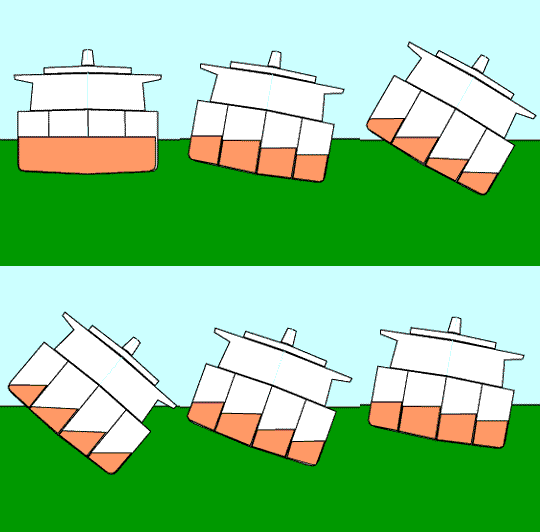
Free Surface Effect (slosh) is a boat sinker. Loose water or other shifting masses in the hull can slosh from one side to the other, transferring weight plus momentum. This makes a vessel roll dangerously and can capsize it. The cure is to keep it out of the hull when it doesn't belong, and minimize slosh once aboard.

For shallow hulls, this is a particular problem. Where a deep dead-rise hull (V shape) encourages water to remain low in the hull, a shallow hull can allow the free flow across the interior.


Longitudinal dividers, even if open at the top, can help manage this cross flow.

The girder structure furnishings, which contribute to structural integrity, can be arranged to reduce free surface effect.

NOTE: These GIFs from Free Marine.


Stability and Self Righting

The ability to automatically self right from a knock-down is a fine thing. From beyond a knock-down to a roll-over is also fine, but not an essential for most vessels plying inside or 'longshore waters. In looking toward this fail safer feature, consider the use and actual needs of your vessel

I cover this at some length in the post Where Ultra-Shoal, Square Boats Get Their Stability, so will keep it brief, here. 

Low Center of Gravity - A heavy bottom, secure storage for heavy items low in any hull and possibly ballast all contribute to the cause. While many barge / scows do not use any ballast (relying entirely on form stability), it's an option to enhance.

Longer and Beamier - Barge / Scow hulls are naturally form stable (their shape makes them harder to tip over, regardless of ballast). Lengthening a hull adds to its initial and reserve stability. Making it beamier does, too, but if it does flip, wider beam makes it harder to return to upright.

Higher Sides - These add reserve buoyancy, which kicks in later to resist roll-over. They also add to windage and raise the center of gravity.

Inversion-Proof Ventilation - This one, oddly, seems often overlooked. The principle is to create an air-lock when rolled, usually below-decks, between vent(box) and the interior which blocks water from passing from outside in.

A loop of large diameter (dryer?) hose works, or boxes can be arranged with overlapping baffles (the latter shown here). Hose is less compact, but works throughout a tumble.


Sea-going Features

Trailing Lateral Resistance - Most sailing at sea is downwind. As such, an aft area of lateral resistance (skeg, large rudder, board, etc...) aids downwind tracking. Think of the fletching on an arrow.

Strong Bitts - In a storm, lying to a sea-anchor or running with a drogue are vital tactics. But you need very strong bitts with good fairleads. To reliably deploy them. Don't want to be improvising in Force 10!

Secure Deck Storage - When it whumps up, you don't want loose oars, pike poles, dock-lines or other paraphernalia blowing about. Make sure there is a secure place for every item, and that they generally stay there.

Secure Mountings - Things like solar panels have incredible windage. At sea, they must be stowed in very high winds or have extra strong mountings. Plan for hurricane force winds.

*****

In all respects, better safe than sorry.

*****

In designing our own vessels, we have a free hand to nudge the whole toward fail safer. In acquiring a vessel, we can use the principle to guide our choices, and can further modify it as we may.

One last thought... so called safety-in-depth (many layers of redundant fail safers) is a concept used in such endeavors as a nuclear reactor.

I believe in and practice the approach.

Yet to think that we have magically conjured safety is that pride which goeth before a fall. Think Three Mile Island, Chernobyl and Fukushima. All were 'protected' by safety-in-depth design.

The World denies us safety. We are mortal. Human error is our lot. Entropy and what a friend calls 'depreciation' rule with universal jurisdiction. To imagine that we have engineered away the hard chance leads to betting more than we can cover.

Eternal vigilance is the price of freedom!

Saturday, December 28, 2019

Bushcraft Bits and Baubles

DILBERT by Scott Adams

The more you know, the less you carry.
- Mors Kochanski


Bushcraft: Bits and Baubles

One of the great ironies of our time is that low-tech bushcraft skills are being furthered and spread on the internet, a high tech platform.

Many traditional skills and approaches are being recovered, advanced, adapted, and more importantly, shared by people from around the world. Instead of going extinct or languishing in some small, isolated community, this wealth is being spread far and wide.

In this post, I'll present a few, choice bits I've recently come across.


Vertical Fire Logs

There are skads of videos on how to make and use these in several variations.

Max Egorov (Advoko MAKES) is producing bushcraft videos, often mixing high and low tech. His approach is both innovative and experimental. It's well worth checking out his other offerings.

Here, I'll present one that briefly covers several versions of vertical fire logs, vertical grilling and a great recipe! Great ideas come thick and fast, so I'll give a time guide of highlights:

0:00 - 0:27    Introduction
0:27 - 1:12    Digression (?) An interesting but more complex Log Stove
1:12 - 2:00    Split Log Stove and Tent Warmer
2:00 - 4:05    Digression (?) Frame Saw from blade and field materials
                        NOTE: Elsewhere, Mors Kochanski suggests carrying a saw blade around the waist 
                                     in a belt constructed as its sheath.
5:15 - 5:50    Log Dogs
5:50 - 6:15    Vertical Log Stove
6:15 - 8:30    Spiral Cut Potato with Sausage (vertically grilled)
8:30 - End     Getting fancy plus Vertical Slotted Grill


Pine Tar Extraction

Pine tar (aka Stockholm Tar) is a thick glop at the heart of many marine recipes for wood preservation. It's also medically useful as antiseptic (farm veterinarians still use it for treating wounds in stock animals).

Again from Egorov, his is the simplest and one of the more reliable methods I've seen (he calls it 'oil' in the video):


Flip-Flop Winch

Where's this one been all my life??

If you have line (and what boat doesn't?) this winch can be improvised in the field. It generates a huge amount of force that can move your vessel/vehicle, logs, rocks or even uproot trees.

Take care to stay out-of-line with the tensioned lines... should they break, whiplash can be deadly.

Other videos mention the use of stakes to stabilize the winding pole (perpendicular to the line of pull), but correct set-up (shown in this but not all videos) minimizes the need. Worth looking around, though.


Creek Stewart has a number of short, to-the-point videos covering a range of skills.

NOTE: A good piece of on-board gear is the Maasdam Rope-Puller. It's like a come-along, but uses a clutch to pull along a length of line for much less set-and-reset. Rated at 3/4 tons of pull.


Pole Compass

Here's a trick for those times we're caught out longer than we expected, perhaps without the durn compass. It's getting dusky going on dark and we've got to get through a stretch of woods or brush and end up near our boat. A bearing with a compass helps, but keeping true is tricky in the dark.

Hence, the Pole Compass, from the late, great Mors Kochanski... he has many offerings emphasizing a practical minimalism:


Note that this method only works when you know the direction you want to go. It's an aid, not a substitute, for orienteering!


Roycroft Ski Shoes

Snow shoes are extremely useful to us some winters, but a pain in the neck to stow the rest of the time. Not only do these Roycroft Ski Shoes come only when called into being, but they are just SO COOL!

This video starts with a comparison with other types of snow shoes before taking a closer look at their construction.


This one gives another take with a little more detail, and presents a binding system I find simpler and more intuitive:


Wood Shavings

Here's another one I missed despite a life out-of-doors:

When making shavings for a fire, one usually whittles away from one's self (safety first!), most often spraying them in a wide arc across the wet ground.

But I seen it done better in some video... DUH! 

Stick your knife by the tip into a log or plank with the blade facing away from you. Holding it firmly by the handle, draw your shaving stock toward you at an angle to the edge. Rotate - to catch an edge rather than a flat - and repeat. Shavings accumulate docilely around your knife's tip.

DUH!

NOTE: Hold your stock from the end toward you and keep your fingers your side of the edge.


Rules of Three

Rules of Three help prioritize your focus in survival situations.
  • You can survive three seconds without hope.
  • You can survive three minutes without breathable air (unconsciousness generally occurs), or in icy water (loss of motor functions generally occur).
  • You can survive three hours without shelter.
  • You can survive three days without drinkable water.
  • You can survive three weeks without food.
I consider the last three to be the most useful.


*****

Once you find a useful tidbit, chances are there are a hundred related approaches. It's easy to get lost in the wilderness of the internet. But oh, the riches it holds!

Let's make the most of it!

Friday, December 20, 2019

At Anchor in the Belly of the Beast


Jonah in the Belly of the Fish
By Eugene Ivanov


I was the blood in the water, and Oh!
  It felt so good to run so red.

- From Little Red 
by Ashe Vernon


At Anchor in the Belly of the Beast

There are places where it all comes together. Where sun and moon drag the sea over granite bones of earth, churning it to froth. Where life and death wrestle in an embrace older and more intimate than love. Where we have had the luck to find ourselves.

Where the World Beast may be glimpsed by we, who dwell in her belly.

At such a place. On such a night. We set anchor at the edge of it all.

We'd been trying to round a vast promontory which bends that send of sea into whorl within whorl of turbulent gyre. Nutrients are churned in stately violence to permeate the water column. Life blooms and feasts.

Wind had failed our purpose. A storm was coming, but there was a chance we might sail forward in the rising winds of its advance. We sculled into the growing dark and fog and the lee of the current and set anchor at the fringe of a kelp forest.

And oh - the waters ran red.

The hunters were round about. Whales and porpoise. Sea lions and seals. Otters of both land and sea. These, we could hear by breath and bark and song. And others working the web, inaudible to our ears.

Krill ate plankton who in turn lit the waters in auroral splendor, illuminating the kelp. Fish ate  krill, and were in turn consumed. Each moving thing leaving its trail of fire in the water.

And the birds, awake to this nocturnal gluttony, their excited cries piercing the fog.

We sat on deck in the midst of it all, silenced by Music.

A Music whose bass notes shook us to the core. Whose high notes 'most evade the ear. Whose every voice is sung by the very mouth which feeds. Whose every note choired a harmony unplanned, but resonant beyond human ken.

A Music which calls to our feral selves. To our selves before we sowed the field or built the walls. When we, too, sang our own wild song with our brothers and sisters 'neath the untamed moon.

To our selves before we dreamed we had a self, separate from the World.

*****

But I am a child of civilization, so called. Burdened with the gift of tongues, wagging ceaselessly in my head, I am cut off from direct experience of the World.

A note, or here and there a phrase, are all that is vouchsafed me.

Yet there is a joy in knowing - as perhaps no other animal can - that we are all related. In life. In death. Knowing our own mortality. That predator and prey are but organelles within a greater Beast.

That within our very own guts, legions of flora and fauna are wholly engaged in a microcosm of that give and take of life and death which surged around us that night. In our very cells, predator and prey are merged in symbiotic union. And throughout this ferment - underlying all - life's very cipher flows horizontally, grafting the branches of the Tree of Life.

We may call it struggle, red in tooth and claw. The survival of the fittest and the elimination of the weak. War. Our words hand us only what we know.

We do not yet know that all are One. Always have been.

I, for one, sail to find nights like ours,  in the dark and blood and seethe of Life.

For just a glimpse.


Friday, December 13, 2019

Hand Tools for the BOATYard

Our two tool boxes, vice and grinding wheel.

We carry a full array of hand tools necessary to build the boat from scratch. 

Timber tools to leverage our options with materials gleaned from beach and woods. An array of fasteners, wire, line, rod, plywood, 1x and 2x stock, aluminum plate and  flat-bar... enough to fix or fudge most anything. Goops, glues, paints and puckies. Enough sailcloth for a whole new suit. Heavy movers to lift, shift and haul the boat. Tarps to work under. 

Everything necessary for stop-gap measures or measured, permanent repair.

-- From BOATYard vs. B.O.A.TYard


Hand Tools for the BOATYard

 I wrote the above a number of years ago, about the distinction between a BOATYard - that 'yard' we carry with us - versus the B.O.A.TYard - The BringOnAnotherThousandYard we pay money to haul out into, somewhere in the Medean bosom of civilization.

Now it's winter and we're cleaning our tools... they look so pretty I thought I'd share.

Here's what we think of as a 'full array' of hand tools.

First, we have a general division:
  1. Small  'Twiddly Box' - This lives easy-to-grab under a companionway step. It contains all we need to handle about 90% of everything. 'Twiddly' cuz it's all the twiddly li'l bits.
  2. Large 'Big Box' - This lives out of the way, but as accessible as possible. It contains all we need to repair our vessel.
  3. Vice and grinding wheel - These live clamped at one end of the (galley) workbench until needed.
  4. Others (not shown) - These include a hacksaw, clamps, crow-, prise- and rockbar, sledge, jacks, hoists and pullers, crosscut and rip timber saws. Bowsaws and axe, Rigging, electrical, paint/glue and spare tools. These would (in theory) let us build a vessel from drift logs.

In this post, We'll take a closer look at the first two

Twiddly Box contents
.
Lessee...
  • Files - Mill bastard, feather, point, 4-in-1 rasp, rasp bits (rat-tail AWOL).
  • Blades - Bad Knife, razor, saber blades for the multisaw (right of tray), utility.
  • Drivers - Slotted, bit driver and angling bit driver with bits, offset phillips and slotted (top right of tray), allen wrench set, slotted brace drivers (lower right of tray).
  • Grippers - Nippers, pliers, vice grips, adjustable wrench, socket wrench and (universal+) sockets and adapters, 'universal' chuck wrench.
  • Miscellaneous - Multi-tool, saw wrest (set), raker guage, Clamptite, step drill set (lower left), knife sharpener, spark plug gapper, mini pipe cutter, zip-ties.


Main Tools

Our main tool box extends the Twiddly Box... we rarely use this one without the other:
  • Files - Mill bastard, feather, rat tails, round. 4-in-1 rasp.
  • Bits - Auger, spade, large twist, small twist drill set.
  • Blades - Good knife, drawknife, chisels and gouge, cornering tool, cold chisel, low angle block and bull-nose/shoulder planes, cross- and ripsaws (Japanese), hack-, coping- and keyhole saws, scraper.
  • Beaters - Carpenter's- and ball peen hammers, hatchet and small splitting maul (not shown... live at wood range).
  • Drivers / Drills - Large slotted (square shaft), long phillips, angling bit driver and bits, 'improved' Yankee style driver (uses bits), 'eggbeater' drill, brace, right angle drill adapter, large allen wrench set, punches.
  • Grippers - Large vice grips, adjustable wrenches, channel locks, tin shears, nibbler, clamps.
  • Layout - Quick- and leaf square, bevel guage, 12 and 50ft measure tapes, plumb bob/chalk line, compass, pencils.
  • Miscellaneous - stud finder, cutting angle guage (both to right of compass), sharpening stones, propane torch nozzle, glass cutter, small prise bar, red cedar for plugs and wire twist for threading, tongue depressors.

*****

Most of the better tools were acquired second hand. A few were bought at full, expensive price (e.g., the bull-nose/shoulder/rabbet plane). Others are lesser tools that only need work adequately once every many years. Yet others are the rare good tool at a reasonable price (e.g., 'disposable' Japanese saw blades.

Between yard and estate sales, flea markets, local and on-line auctions (like Ebay.com), hardware store back alleys and the occasional grit-your-teeth purchase, I'm guessing these tool kits can be put together for a couple hundred dollars or less.

How's your haggle hangin'?

Saturday, December 7, 2019

Phil Bolger's BIRDWATCHER Concept

Bob Larkin's WAVE WATCHER
ex Bolger BIRDWATCHER II
Photo by John Kohnen


A “bird­watcher” [is] a craft “in which one might poke through a marsh or backwater in search of nothing more than a pleasant lunch and a tan.”
-- Jack Dunn as quoted by Phil Bolger


Phil Bolger's BIRDWATCHER Concept

Phil Bolger introduced a true revolution in micro-cruiser design with his BIRDWATCHER concept.

A watertight, transparent super-structure is built upwards from the sheer of an ultra-shoal-draft, heavy bottom hull. Decks continue the water-tight integrity inboard to an elongated mid-ships companionway (which may be covered by removable fabric and/or hatches).

The crew is seated midships - the vessel's 'prime real estate', and low in the hull (vs. a raised cockpit) where their weight contributes to trim and stability. When standing in the 'infinite headroom' companionway, they are protected to well above hip level. 

The vessel is fully operable with excellent all-round visibility from the cabin where crew is protected from exposure. Dry shelter - whether at anchor or aground - is permanently available.

In a beam ends knockdown, such a hull floats all openings clear of the water, and is strongly self-righting from this position. A rollover is only possible when caught broadsides by a breaking sea.

A requirement peculiar to small, oar auxiliary boats of Birdwatcher lineage is that the “rig be quick enough to strike that one is not tempted to row with it standing.” Rowing via side ports is from within the cabin.

Core concepts:
  • Waterproof to above the knocked-down waterline (should float on its side without shipping water).
  • Long gangway running the length of the interior (mid-line security for standing crew).
  • Self-rescuing from inside the hull(!).
  • All operations possible from within shelter (no outside cockpit necessary).
  • Easily stricken rig (to reduce windage for rowing).
  • Reasonable performance under oars (eliminates expense, and weight of motor, and allows extended cruising away from fuel sources).

*****

All (prudent) small boat sailors learn to right their craft from the water in case of a full knockdown. Chances range from significant to assured that they will use this skill, sooner or later. And then, we'd better be trained and geared up.

Wind gusts up. Attention lapses. We're in the water next to a half swamped boat. If the water is cold, the clock is ticking. Fast.

If the water is cold, the situation can be dire. If your gear is poorly stored, the situation can be dire. If conditions are bad, the situation can be dire.

It's hard to overstate the quantum leap in safety that the BIRDWATCHER concept affords the micro-cruiser.

*****

Let's look for a minute at a full sized cruiser.

Can we sail (not just steer) the boat from within the pilot house? Are the lifelines substantial and higher than the hips? Can we recover from a full knockdown? Can we run it up on the beach? Trailer it? Row it at more than a knot or so? See out with an all-round view from belowdecks?

Maybe yes to a few of these, but seldom if ever to all.

Looking at micro-cruiser issues...

In micro-cruiser design, we juggle fixed shelter against the kind we must erect. Tent shelters are often high windage. They're often wet, hard to enclose and, once enclosed, to get in or out of. If we have to leave in a hurry, they're a bitch to strike.

If fixed shelter, we juggle against cockpit needs. Both compete for space. Both are pushed to the (usually tapering) ends of the hull. Crew weight pops up the bow or stern, depending on which end we're using. Certainly, we won't be steering, rowing or handling our rig from a cuddy.

And yep, if they blow over, we're back in the water.

*****

In my Triloboat adaptations of the concept, the box barge foundation simplifies construction in the usual ways for the hull, and also for the window to hull interface (no bevels).

Oars present a challenge. When in use, the watertight ports must be open (risking flooding in a knockdown). They must be dismounted from inside or outside the cabin; both awkward. When let go, it's convenient to let them trail aft (Bolger solved this neatly with his port placement on BIRDWATCHERs' curved hull... but this limits rowing stations to one).

My solution to these issues is bent oars... they needn't be dismounted (stow in position), can be booted waterproof and trail alongside when let go.

Other designers - notably Jim Michalak - have employed BIRDWATCHER concepts in highly successful designs.


Full knockdown flotation and recovery test
in TRILOBYTE (T16x4)


SCUTTLEFISH, inspired by BIRDWATCHER


NOTE: The BIRDWATCHER approach isn't the only successful one. Matt Layden and Sven Yrvind, among others, have successful designs (ballasted) for micro-cruising that answer 'yes' to the wish-list line items. These are ingenious balances of more traditional approaches.