Please visit our home site at www.TRILOBOATS.com.

Anke and I live aboard WAYWARD, and wrote about it's design and construction at ABargeInTheMaking.blogspot.com.

Access to the net comes and goes, so I'll be writing in fits and spurts.Please feel free to browse the archives, leave comments where you will and write... I'll respond as I can.

Fair winds!

Dave and Anke
triloboats swirly gmail daughter com

Showing posts with label Food. Show all posts

Tuesday, December 5, 2023

A DIY Rocket Stove Smoke Hood


Eco-Zoom Rocket Stove with DIY Smoke Hood


Somebody who claims to speak for the ‘hood don’t need no private jet.

– Chuck D


A DIY Rocket Stove Smoke Hood


About half of the energy in wood literally goes up in smoke, and with it, a good deal of our own! If the smoke can be burned, efficiency nearly doubles. The corollary is that only half as much fuel produces a given amount of heat.


Rocket Stoves were developed as a low-tech solution. At their heart is an L shaped, insulated tunnel, wide open at both ends. Fuel is fed horizontally, oxygenation and combustion burn hot at the crux, and what little smoke is left is pushed vertically, up and out the top. Typically, a pot directly atop the stove absorbs heat from the hot, gaseous outflow for cooking.


We’ve been using an EcoZoom Rocket Stove for years as a nearly smoke-free, otherwise open deck fire for outdoor cooking in hot weather, an evening blaze in nice weather and to heat metals for various projects (it easily takes ferrous metals to red-hot). It runs on limbwood from about thumb to wrist size, the former for cooking and the latter for longer, more subdued heat. In short, perfect for easy wood-gathering, especially as we age..


In planning MUSTELID, we hoped to bring this marvel indoors for cooking and heating. It requires far less wood to gather, dry and store within her small volume. Being insulated, wood can be dried directly alongside the stove, warm but nowhere near wood’s flashpoint (we can touch the stove sides without burning!).


To bring it indoors, we must gather and direct combustion gasses outboard, like any other onboard stove. The solution is a smoke hood fit snugly over the stovetop with a stack, which has the extra perk of increasing the cooking surface area. We wanted one more feature… we wanted to easily install and remove the stove for outdoor use on deck or ashore. So we went for a swing-up, cantileverd variation.


This called for some head scratching…


Grate spacer for airflow under,

Ash tray…

Whole thing slides aft behind bulkhead lip

And between heat / splatter shields.


Removed...
Note black fire-retardant pad
protecting carpet from sparks


Swing hood upward to remove


A look under the hood...
a vertical ring fits closely over upper plate
for extra fume collection


*****


Smoke Hood Plan
Not to Scale


Smoke Hood Elements


At it’s simplest, the hood is a flattish box made from sheet metal (in our case, stainless steel from and old stove’s grease trap… a heavier top plate has better thermal mass for cooking, if available. A large hole in the bottom fits closely over the Rocket Stove top, while a smaller hole in the top has stovepipe fit into it, which leads to a standard deck-jack and smokehead. If you leave the stove in pace, this is all you need.


For a swing-up top – allowing removal of the stove – we broke the hood into two boxes, each with an open end:


  1. The far box is fixed (in our case to bulkhead and flanking heatshields), with the flue let into its upper surface. Its near end is open, with rounded shoulders and an under-lip. This part is female, slightly larger than the second part.

  2. The near box is cantilevered (stops may be additionally fitted to help support heavy pots). Its far end is open, with a partial rounded shoulder fairing to 45deg… extending an over-lip, while the angled section limits upward swing. This part is male, slightly smaller than the first part. Insert its open end into the female’s until their respective hinge-pin holes align.


Other parts:


  • The long hinge pin (alternatively, short, opposing pins) are let through paired holes centered on the shoulders. If it binds while swinging upward, grind away from the lower male shoulders till clear.

  • A vertical smoke collar can be used around the stove-top cut–out (not sure it’s necessary). We used a strap of sheet metal, its edges doubled over just short of its outer mid-line (result about one inch wide) and tabbed around its outer mid-line (tabs bent alternately, slightly away from cut-out). When pressed into place, it ‘snaps’ in to lock. It works best to cut the tabs before bending.

  • Rims, rails, bars and what-have-you may be added to secure pots while cooking underway. In our case, we added a low front rim and let that and tall heat / splatter shields along each side contain pots. Watch for swing-up clearance.


Notes:


  • Any gaps allow air to be drawn into the hood. The closer the fits, the more energy is available for cooking and heating. Once the stove is drawing (seconds) there appears to be no leakage, even from wider gaps. We didn’t use gaskets, but they can’t hurt.

  • We sized our male part to be 1/16in smaller than the female’s inside dimensions. Given our crude techniques, we managed between 3/32in and 1/8in. So long as it slides in without undue forcing and the gaps are small, it should work fine. Thermal expansion binding isn’t a problem as we only ever move it out once cool.

  • In both cases, the lips should overlap the opposite part to help close the gap and contain ash. Small tabs may optionally be bent along single edges to help minimize warping with heat.

  • Sizing can be more or less according to your available space. We sized around our frypan plus our small teapot, to cook and heat water at the same time.

  • The smokehead can be lower to the deck than is usual. Although it does induce some draft, Rocket Stove’s generate expansion in their combustion chamber, and actually push gas about 40ft. Still, an efficient draft smokehead hedges our bets in some gnarly conditions.

  • We didn’t have a brake (sheet metal bender), so clamped sheets over a piece of sharp-edged hardwood, then hammered it over. Cutting was with a thin-wheel grinder and touched up with a mill file. We used bent tabs with (copper/stainless) pop-rivets to join. Wear gloves, eye, ear protection and work safe!


Looking Ahead


One of the intriguing possibilities with Rocket Stoves is to make our own from a substance that insulates, absorbs and radiates thermal energy. In other words, which acts as a thermal mass or ‘sink’. Such are easily made from brick, firebrick, concrete, clay, cob and other materials. 


Perlite (pumice) is a light, inexpensive insulator, and can be mixed with concrete for a lightweight aggregate with decent thermal mass. The combustion chamber can be lined with refractory clay. A thick, steel cook surface is easy to install over a lipped smoke chamber for a full sized stovetop / smokehood. Sand makes a good gasket between plate and stove. Alas, this doesn’t sound very portable!


But we keep on thinkin’.


Friday, November 25, 2022

Foraging Ahead: Independence Along the Way

Our Go-to Guide

Good info; great pictures
We also use it to organize notes from other sources


Hunter-gathers by nature
Store information for use,
Understanding that there may be a time
When information is scarce.

― Brian C. O'Connor, Jud H. Copeland, Jodi L. Kearns


This sudden sweet loot appearing...

― Aspen Matis


Foraging Ahead: Independence Along the Way

Anke and I have been pursuing the know-how and means to stay out and away for longer and longer periods. At least to have the option. We've come a long way; still have a long way to go.

We recently spent half of a four month rowing / sailing trip experimenting with near hand-to-mouth forage. During this time we lived mostly from fish and wild plants. We took along our complementary rice / lentil mix (2:1 for complete protein), dried fruit and olive oil, using each very sparingly.

Result? We lost weight and felt great! 

We were hungry more often than we normally tolerate, but not to the point of discomfort, and were eating amply at mealtimes. We quickly learned to make up a 'salad' for the day (fish and berries mixed in)... this allowed us to snack as needed between two cooked meals a day. 

Of note, the 'super-carb' diet of vegetables, fish meat and oils, and fresh berries - the bulk of what we were eating - supported the heavy exertion of rowing up to 12 hours a day (well... mostly more like 6 to 8).

Meanwhile, we were cooking and heating with a rocket stove modified for indoor use. This let us gather wood every few days with ratcheting anvil loppers (quicker and easier than sawing), while drying it onboard as needed.

So we're pleased to find that our sloppy assemblage of skills has brought us near to the point that we could subsist indefinitely, if need be. 

*****

If we wish to venture away for any extended stretch of time - let's say months to years - from towns / resupply it helps to find werewithal along the way... shelter, water, food, fuel and materials.

Shelter is pretty easy, assuming we're sailors aboard our live-aboard vessels... they come with us as a matter of course. When necessary, shelter may be improvised from foraged materials (a big subject... maybe later?).

Water is nowadays only a little tougher. Offshore seawater desalinators are available in manual models and can be DIYed

'Longshore, especially in our rainforest, spring and groundwater flows provide plenty of fresh water, which can be easily filtered by compact, cheap and durable systems. These too can be DIYed with simple filtration systems, using home-made charcoal as the active principle. 

A plastic bottle filled with water and left in bright sun for a sufficient time will UV-sterilize its contents (SODIS: SOlar water DIStillation). Sadly, plastic bottles may be foraged along all the coasts of the world.

Food is foragable in hunter (fish, game, fowl) / gatherer mode. 

For sailors, fishing is the easiest, especially if you are willing to eat cod and other 'scrap' fish. I'll include other seafoods in this category, despite not being fish per se... crustaceans and molluscs  (grazing, single shell types are less prone to PSP (Paralytic Shellfish Poisoning) than bivalves).

Hunting and fowling are another deep subject I'll leave for another time. Consider salting, smoking, jerking and canning as longer term options for preservation without a freezer.

Most environments that are even marginally intact support a wealth of edible plants, and guides are generally available featuring local edibles and those to avoid.

Guerrilla gardens can help concentrate and enhance native plants, and add select, supplemental varieties. In our region, for instance, high-carb plants are few and far between... guerrilla potato patches are one way to add them. Alternatively, consider adopting a paleo-, neo-paleo- or neo-lithic diet... all three come much easier once you're out there.

NOTE: These diets are a little fuzzy. Generally speaking, paleo diet allows only wild grains (if at all), neopaleo diet adds early, cultivated grains, while neolithic adds 'modern' whole grains.

Plants can be dried (big weight and volume savings... just add water!), canned and fermented to preserve.

Fuel is used for heating, cooking and power (electrical and possibly propulsion).

Wood and other bio-fuels can be collected from land and shorelines along the way. 

We've had the most experience with wood, and supporting technologies are highly developed. A mild-steel stove or range, for instance, will work with driftwood, where cast iron will degrade. Rocket, gassifying and forced draft stoves are widely available, DIYable, and have the advantage of burning more efficiently and with less smoke. Less wood is necessary, and smaller pieces work well meaning reduced impact ashore, footprint aboard and gathering effort.

Materials are mostly wood in some form, and, nowadays, beach-combed trash. These can be used for repair, replacement and fabrication of new features.

Wood grows on trees, and spars of all sorts - masts, booms, battens, sprits - can be constructed with minimal shaping (especially when your vessel has been designed for tree shapes). Planks, knees and half-rounds (rails) take more effort, but can cover most any ship-board need. Wooden vessels take these materials in stride; resin based and composite vessels can be patched with them but may require further work once back in 'town'.

Beach combed garbage can often be repurposed to fill all sorts of needs. We're living in the neo-plasticene, after all. Planks, fasteners, containers, hoops, chafe gear, (PVC) springs, hose, valves, and so on can all be improvised from plastic garbage. There's an amazing assortment of metal this and that floating about, too, attached to wood or half sunk in sand. Repurposing rulz!

*****


Two additional aspects are key to all this; skills and tools.

Skills include the ability to identify, hunt / gather / process / preserve wild foods, tool use and maintenance. Is ingenuity a skill? Certainly of help! Ditto a sense of humor.

Tools run the gamut and are suited to your approach. Tools for mechanical, wood-working, wood-gathering and transport, fishing rods and reels, firearms, canning, drying, cooking and processing and maintenance are all possibilities to be tailored to your particular approach.

I lump into this category fasteners, wire, zip-ties and the what-have-you that lets you keep stuff from moving. Lubes to keep stuff moving. Consider generalist items that can be used flexibly in unexpected situations.

*****


The learning curves involved vary from low pitch to steep, and all are more or less life-long pursuits. That being said, the journey has rewards from the very first step, and the entire path is rich in satisfactions.

Foraged necessaries extend our time at large on the water, freed from return to the world of shopping and the cash economy with all its demands.

The reward is freedom!


PS. On our return, our first serious guerilla garden plot of potatoes had done well despite record heat early on, followed by exceptional wet! WooHOO!!

Sailing quietly, doing nothing, potatoes grow by themselves!


Spuds in Space!
Well... it's a Rocket Stove.


Saturday, July 18, 2020

Fishin'

One of many approaches to Hobo ReelsIs that a KIRKLAND Whiskey Bottle cork capping the bottom???

50 Best HOBO HANDLINE images | Fishing kit, Bushcraft, Hobo
Rigged with hook, line and keeper


Alive without breath, as cold as death;
Never thirsty, always drinking;
Clad in mail, never clinking.

-- One of Gollum's riddles from The Hobbit by J.R.R. Tolkein


I'm a-goin' fishin',
Yes I'm goin' fishin',
Baby goin' fishin' too!

-- From Fishin' Blues by Taj Mahal


Fishin'

I've got to say right off that I'm not a fool fer fishin'. In fact, if fish weren't an important part of our diet and livelihood, I'd never set a hook. Anke, on the other hand, you might say is 'avid'.

For me, I'm looking to maximize the efficiency and minimize the sport. To do as little harm as possible, both to those too small to keep and those whose life is taken for ours. To cultivate a spirit of humble gratitude for a fish's life. To console myself with the knowledge that they are fellow predators dancing in the web of life.

For many years, Anke and I have subsisted on smaller fish- rock cod, pink salmon, dolly varden (between a trout and salmon). Lacking refrigeration and unable to carry the weight of jarred fish, these are all we can eat while fresh. Now, however, we have the displacement and tools for jarring, and have our sights set on larger salmon, halibut and dogfish (a small shark).

But these still swim mostly in our future.

Our fishing rods and reels are accordingly very light. Usually the cheap-0 kid's reels. They live on deck, ready to hand, and last a few years. But they're seldom made for salt water and get cranky. And they tend to hang up on this and that at inopportune moments.

Recently, I stumbled across hobo reelsDIY, compact and effective.

Plastic container types offer near instant gratification and are very practical, since they take little or no modification and securely hold a lot of gear for any given size. Check out hobo reels made from PVC.

Wooden hobo reels - whether carved or turned on a lathe - are just plain beautiful. But first, a digression...
At a Renaissance Faire I was once enthralled by a fellow turning chair legs on a pole lathe. He used a living sapling bent over as a spring, sprung by depressing a foot plank. A line connecting the two turned around a pulley on the lathe, and as he worked the plank, spun the leg stock for shaping. 
Unfortunately, it was otherwise a more or less standard metal lathe and, they being generally large and heavy, I hung on to the pole idea but roundfiled the lathe.
Back to hobo reels... one of the vids shows a feller turning one on a home-made pole lathe! OOH... now we're talkin'. It was clear to see that I could dumb his full-feature lathe down to a mini lathe sized for the hobo reel. An hour of cobbling from materials on hand and this is the result:

Ever the Muse brings chaos in her wake!
A bungee has replaced the spring pole.

Stock is skewered between a fixed point (left) and an adjustable point (right).
Two turns around the stock and it rotates around the points.

Never having turned anything, I grabbed a rather funky piece of firewood to try it out. To my surprise, the result would have been a keeper if I'd used better material! On to HR2.0...

Go small, go simple, go fishin'!


My Spice Jar HR left
and Lathe-Turned HR right


*****

A few preliminary tips and tricks...

  • I've found that a single hook (vs. a treble) at the end of a line is easy to stow. Lure and / or bobber can be loop tied (pass a bight of line through a hole and around the item to form a cow hitch) as desired. Hook can be set into holes drilled around the spool base, or stowed in storage cavities with its line pinned by the cap.
  • Braided line (vs. monofilament) seems to work well, is much easier to handle and has enough friction for loop ties.
  • Instead of carrying one or more bobbers, an eye-screw can attach any found bit of flotsam with enough buoyancy.
  • For a bobber, consider a stick which can be thrown much farther than a typical bobber, hook and lure can be cast from a (rodless) hand reel.
  • If using a container, consider one with a pronounced flare (like one end of a spool) toward the casting end. This helps lift clear of the wound line while casting, reducing friction.
  • throat gorge (spine of wood, bone or metal sharpened at both ends and attached from the middle) is far easier to improvise than a hook. A fish swallows the baited stick which then toggles sideways to set. Size for target fish.


Our go-to fishing sources:

Indian Fishing Methods by Hillary Stewart
Living Off the Sea by Charlie White


A Coupla good, how-to vids:


And check out this guy's Rodless Reel!

Monday, March 16, 2020

COVID-19: Circle the Wagons

Important, but is it happening in time?
Treatment capacity lines seem optimistic, to me...
assumes healthcare is exceeded vs overwhelmed.

James gave the huffle of a snail in danger,
And nobody heard him at all.

-- A. A. Milne


COVID-19: Circling the Wagons

For those of you who don't know it, I've been huffling since the run up to Y2K about TEOTWAWKI - The End Of The World As We Know It.

Now I believe we're watching it unfold.

The basic factors are these
  • A fragile, Global Industrial Economy (GIE)... our tightly coupled, deeply indebted Complex Adaptive System (CAS).
  • A vast, overshot, human population which depends on a functional GIE for its livelihood.
  • Exponential spread of COVID-19 pandemic which will almost certainly overwhelm the healthcare system.
  • Failed containment and failing mitigation measures.
  • Exponential growth of associated problems.

Exponential growth of anything catches humans by surprise in almost every case. Windows of opportunity for meaningful action / preparation are snapping closed at a rate that's difficult for human beings to grasp intuitively.

NOTE: See here (~4 min vid... visceral impact of exponential growth) and here (~9min vid... exponential spread of COVID-19 vs flattening) to get a taste of the challenge.

David Korowicz lays out the general issues in his paper Trade-off (77 pages for the very interested) and specifically, pandemic based analysis in Catastrophic Shocks in Complex Socio-Economic Systems: A Pandemic Perspective (10 pages for the interested). Both are challenging reading, but, I believe, provide a foundation for viewing current events.

CAS's - such as the human body - have a range of stability. Within that range, they can be astoundingly resilient. But if events drive them beyond that range, a tipping point is reached and the whole system settles into a new equilibrium.

In the human body, an infection can lead to the loss of a critical function (breathing, say), and in a rapid cascade it collapses (and without rapid, correct intervention, dies). In a just-in-time economy, supply-chain interruptions block down-chain production and can rapidly paralyze the economy. In finance, disturbing the mountain of debt can bring currencies and institutions crashing down.

All of these are underway. [Or, for a less detailed and challenging glimpse of the problem, try this article.]

This is my long-winded way of saying that this is both serious and moving faster than we imagine.


 My Urgent Advice...

>>>  Get together with those you most love RIGHT NOW. Stay together for the duration.

>>>  Get together provisions RIGHT NOW (food, water, essential medicines, cooking/heating fuel) for a minimum of two weeks (CDC advice). Longer is better.

>>>  Make an isolation / infected plan and put it into action RIGHT NOW.

>>>  Don't panic, but GET MOVING.


Whether I'm right or wrong about larger consequences... even if the GIE manages to function beyond the crisis... even if your area has no known cases...  whether you are riding this out or hunkering down for trouble...

Containment and mitigation measures are shutting down travel and contact for unspecified periods. If flattening the curve is successful (our best chance), lockdowns will be in place for months, not weeks.

I say again, windows of opportunity are snapping closed.

Fair winds, health and happiness to all of us,

Dave and Anke


P.S. Here's some good advice from a guy who's been there.

Saturday, December 28, 2019

Bushcraft Bits and Baubles

DILBERT by Scott Adams

The more you know, the less you carry.
- Mors Kochanski


Bushcraft: Bits and Baubles

One of the great ironies of our time is that low-tech bushcraft skills are being furthered and spread on the internet, a high tech platform.

Many traditional skills and approaches are being recovered, advanced, adapted, and more importantly, shared by people from around the world. Instead of going extinct or languishing in some small, isolated community, this wealth is being spread far and wide.

In this post, I'll present a few, choice bits I've recently come across.


Vertical Fire Logs

There are skads of videos on how to make and use these in several variations.

Max Egorov (Advoko MAKES) is producing bushcraft videos, often mixing high and low tech. His approach is both innovative and experimental. It's well worth checking out his other offerings.

Here, I'll present one that briefly covers several versions of vertical fire logs, vertical grilling and a great recipe! Great ideas come thick and fast, so I'll give a time guide of highlights:

0:00 - 0:27    Introduction
0:27 - 1:12    Digression (?) An interesting but more complex Log Stove
1:12 - 2:00    Split Log Stove and Tent Warmer
2:00 - 4:05    Digression (?) Frame Saw from blade and field materials
                        NOTE: Elsewhere, Mors Kochanski suggests carrying a saw blade around the waist 
                                     in a belt constructed as its sheath.
5:15 - 5:50    Log Dogs
5:50 - 6:15    Vertical Log Stove
6:15 - 8:30    Spiral Cut Potato with Sausage (vertically grilled)
8:30 - End     Getting fancy plus Vertical Slotted Grill


Pine Tar Extraction

Pine tar (aka Stockholm Tar) is a thick glop at the heart of many marine recipes for wood preservation. It's also medically useful as antiseptic (farm veterinarians still use it for treating wounds in stock animals).

Again from Egorov, his is the simplest and one of the more reliable methods I've seen (he calls it 'oil' in the video):


Flip-Flop Winch

Where's this one been all my life??

If you have line (and what boat doesn't?) this winch can be improvised in the field. It generates a huge amount of force that can move your vessel/vehicle, logs, rocks or even uproot trees.

Take care to stay out-of-line with the tensioned lines... should they break, whiplash can be deadly.

Other videos mention the use of stakes to stabilize the winding pole (perpendicular to the line of pull), but correct set-up (shown in this but not all videos) minimizes the need. Worth looking around, though.


Creek Stewart has a number of short, to-the-point videos covering a range of skills.

NOTE: A good piece of on-board gear is the Maasdam Rope-Puller. It's like a come-along, but uses a clutch to pull along a length of line for much less set-and-reset. Rated at 3/4 tons of pull.


Pole Compass

Here's a trick for those times we're caught out longer than we expected, perhaps without the durn compass. It's getting dusky going on dark and we've got to get through a stretch of woods or brush and end up near our boat. A bearing with a compass helps, but keeping true is tricky in the dark.

Hence, the Pole Compass, from the late, great Mors Kochanski... he has many offerings emphasizing a practical minimalism:


Note that this method only works when you know the direction you want to go. It's an aid, not a substitute, for orienteering!


Roycroft Ski Shoes

Snow shoes are extremely useful to us some winters, but a pain in the neck to stow the rest of the time. Not only do these Roycroft Ski Shoes come only when called into being, but they are just SO COOL!

This video starts with a comparison with other types of snow shoes before taking a closer look at their construction.


This one gives another take with a little more detail, and presents a binding system I find simpler and more intuitive:


Wood Shavings

Here's another one I missed despite a life out-of-doors:

When making shavings for a fire, one usually whittles away from one's self (safety first!), most often spraying them in a wide arc across the wet ground.

But I seen it done better in some video... DUH! 

Stick your knife by the tip into a log or plank with the blade facing away from you. Holding it firmly by the handle, draw your shaving stock toward you at an angle to the edge. Rotate - to catch an edge rather than a flat - and repeat. Shavings accumulate docilely around your knife's tip.

DUH!

NOTE: Hold your stock from the end toward you and keep your fingers your side of the edge.


Rules of Three

Rules of Three help prioritize your focus in survival situations.
  • You can survive three seconds without hope.
  • You can survive three minutes without breathable air (unconsciousness generally occurs), or in icy water (loss of motor functions generally occur).
  • You can survive three hours without shelter.
  • You can survive three days without drinkable water.
  • You can survive three weeks without food.
I consider the last three to be the most useful.


*****

Once you find a useful tidbit, chances are there are a hundred related approaches. It's easy to get lost in the wilderness of the internet. But oh, the riches it holds!

Let's make the most of it!

Sunday, May 5, 2019

Acquiring Tastes

Image Source Here

There are only two mantras: 
Yum and Yuck.
Mine is Yum.

-- From Still Life with Woodpecker 
byTom Robbins


Acquiring Tastes

When we sail out and away from towns, we generally like to stay out and away for a good long while. Our stores lean heavily toward dried goods; rice and lentils, wheat and beans, onions and garlic, fruits.

Fresh produce and meats are unavailable after the first week or so. In any event, we balk at their prices. Shipping costs and middle-men jack up the price of produce in Alaska. Locally grown foods often cost even more, due to economies of small scale, short growing seasons and cost of feed. We like to support local producers and businesses, but have to keep a close eye on our budget.

Our answer is wild foods. Wild plant forage, wild animal meats and fats.

Local plants have provided most of our greens for many years, now, with only a few dumpster-diven exceptions when in a town. We fish and beach-comb (some wierd stuff, here), and sometimes receive gifts of red meats (venison, bear and seal... often organ meats) or poultry (ducks or geese). Down the road, who knows? Grubs and insects aren't so far from wrigglers we eat from the beach.

To some degree, most of these are stronger in taste than domesticated foods. Wild plants have tastes which stray from the supermarket palette, and where similar, tend to be stronger and often with a bitter tinge. Wild meats can be 'gamey', depending on what the creature has been eating, and organ meats each have their own flavors.

So, to eat widely and in season from our locale, the acquisition of tastes is a real benefit.

Mostly, it seems, our tastes are matters of habit. One culture's delicacy can turn another's stomach, or at least their head. When we eat from off our beaten path, most of us approach with caution, and eat with 'long teeth'.

A famous Chinese subject of painting is The Vinegar Tasters... three men are tasting newly brewed vinegar. One represents Confucianism... his expression is sour... affronted by the taste. The Buddhist looks resigned... another shot of dukkha (trans. suffering, pain, unsatisfactoriness, stress) from which to detach. The Taoist smiles... this taste would go well with any number of others! Yum.

I can't say we're advanced souls, finding the yum in all that which does not kill us. But we aspire to it, relating to the Taoist's engagement with the world. In food, as in so many aspects of simple living, we seek Yum.

We try to approach each new taste with an open mind and the expectation of dawning deliciousness. Frequent exposure helps with acquisition, especially if blended with other tastes we already like. Or we might relate it to some positive value. For example, when a trophy hunter gives us bear meat that would otherwise be left for the birds and the beasts, reduction of human wastefulness and relating to the spirit of the bear appeals to us.

Over the years our tastes have broadened, and with them, our options.


The Vinegar Tasters
by ???


PS. Not all plants or even animal (parts) are safe to eat... be sure to do your homework before venturing out into the wild!

*****


Bonus Story:

As a kid, one of our Tlingit friends went along as fishing crew for his Grandfather. These trips lasted about a week before returning to sell the catch, ice up and head back out.

Fishing, of course, is hungry work.

"Grampa, I'm hungry! What've we got to eat?", he asked.

"There's a grub box on deck, s'brd side. Help yourself to as much as you want," came the answer.

When our friend opened the lid, he was hit by a wall of... well... in the spirit of this post, let's say 'interest'.

The box was brim full with an old-time Tlingit delicacy. Stinkhead... fermented - some would say rotten - fish heads! And no reprieve from the catch... fresh salmon is as good as cash money, and ya don't eat that!

Our friend only lasted that one trip, and he said he lost 25 pounds, fasting except for the occasional unmarketable fish that took their lines.

Stinkhead is a powerful gustatory experience whose appreciation has dwindled with changing times. It vividly demonstrates the power of mind over manna.


Sunday, March 17, 2019

Hot Toddy, Hot Schnotty: A Cure for What Ails Ya

Vinegar over Honey
plus spices,
before topping off with hot Water

I will use those dietary regimens which will benefit my patients according to my greatest ability and judgement...
-- From the Hippocratic Oath


Hot Toddy, Hot Schnotty: A Cure for What Ails Ya

By sheer coincidence, these two recipes came to us within a week of the other. The former is recreational, while the latter is medicinal. And without further ado...

Hot Toddy (from S/V VALIANT)
Whiskey (start with a finger or two?)
Apple Cider Vinegar (a splash, to begin with)
Squeeze some lime or lemon (or leave a twist)
Water (to top off)
Honey (to taste)
Salt around the rim (if that's how you roll)

All ingredients adjusted to taste/tolerance.

This one does for the recreational end of the spectrum. The whiskey is 'rotgut' (aka cheap)... no point mixing 80 year old Scotch with vinegar. The citrus can sometimes be found in your local, neighborhood dumpster, but we buy concentrate by the quart.


Hot Schnotty aka Fire Cider (amalgamated from the internet)
1 part Honey
1 part Apple Cider Vinegar
1 part Water (hot)
Heavy squirt of Hot Sauce
Pinch of CinnamonPinch of
Ginger
Pinch of
Tumeric
(if ya have it)
Twist of Lemon (if ya have it)

This one's medicinal. Blasts snotty nose, sore throat and eases a cough. Useful stuff when sailing into the social proximities of civilization. Serve warm or hot for best effect, taking a sip every so often. I don't recommend drinking it down! Listen to your stomach. I find it works best when gargled for a bit. It settles, so stir or shake it before use.

Interesting overlap between the two recipes. Their taste definitely has a family resemblance.
Both harken to our (great?)grandparents' use of vinegar and honey as home remedies.

Vinegar is acidic (generally 7% acetic acid), so should be taken in moderation. It has been used to treat or ease many external conditions, and is anti-fungicidal. Taken internally, it has been considered a blood tonic (my G'parents said it 'thinned' the blood) and, especially in the throat, an anti-bacterial and anti-fungal agent. But be aware that acid has internal effects on the teeth and stomach. A cup or so is a very potent emetic (makes us puke).

Honey is high in sugars with all their pros and cons. Local honies, especially, help prepare the body for pollens, reducing allergic reactions. In the throat, it can (like any sugar concentrate) discourage bacterial growth via osmotic action. On the other hand, once it's diluted (by saliva), it's food for growth. I personally let it sit thick for a bit, and then clear it out.

Cinnamon, Ginger, Tumeric and Peppers are all traditionally medicinal along with many others you can experiment with, and considered to be anti-bacterial and anti-fungal. Cayenne has even been mixed in with cheap bottom paint to up its anti-fouling properties!

Whatever the case, it sure seems to help!


*****

Bonus Yarn:

My Mom used to make us honey lemon teas for a cough suppressant.

One night, I had it bad, but didn't want to wake anyone up. I was six, after all... nearly a man.

I filled a pot with honey and brought it to a boil, then added a squirt of lemon. I carefully decanted the mix into a mug.

Then burned the bejeezus out of my lips, waking all in the house with my wails. I suppose it could have gone so much worse.

An early lesson in the importance of proportion and expert advice!


Monday, April 2, 2018

(Almost) DIY 'Spun' Honey

DIY Spun Honey
Photo with recipe by hardlikearmour


"Well," said Pooh, "what I like best," and then he had to stop and think. Because although Eating Honeywas a very good thing to do, there was a moment just before you began to eat it which was better than when you were, but he didn't know what it was called.
― A.A. Milne, Winnie-the-Pooh.

(Almost) DIY 'Spun' Honey

I've always had a yen for 'spun' honey (aka whipped, creamed, churned, set and fondant honey).

Spun honey tastes just like regular, but behaves much better. It is generally much more viscous than liquid honey, so is much less prone to drip and run all over the place. This DIY version is even better behaved!

I was lauding spun honey's virtues to a cruising couple of friends, while lamenting its higher cost. They had a solution!

Turns out the 'spin' in spun honey serves to mechanically break down large crystals as they form. It may even be a structurally alternative crystal to that pesky kind that turns it into a gloopy glop of sugary chunks. This alternative crystal is smaller, and therefore uniform and much finer.

My friends take a wide mouth container and fill it with liquid honey, then seed it with a spoonful of spun honey (commercial, or from your last batch). Holding at about  57degF (14degC), stir every few days for about a week, until it has thickened to a lugubrious, uniform paste. Cap and use!

In many cases, we'll start by heating liquid honey in a double boiler to quite hot to remove all crystals of any kind, then cool it until it's warm (not hot) to the touch before adding seed. Too hot and you'll break down your seed crystal. Once converted, store in a cool place to keep it firm.

The result is a docile spreading honey that stays put.


Guilty Pleasure

Since I was a kid, I loved spooning honey and peanut butter. Powerful energy kicker for a cold day at the helm.

DIY spun honey is perfect for this... take a quarter dip of honey on a spoon, then a full dip of peanut butter.

Pop it in your mouth and bliss out!


Wednesday, October 12, 2016

Can Stoves Can Do

By Gary Larson

When you light a fire, you commit an act of magic...
What thrilling enchantment, 
What cunning sorcery, 
Has the work of your hands created?
-- Anthony Murphy


Can Stoves Can Do

Anke and I spent many a pleasant summer evening, this year, watching the sun go down in the company of a (tin) can stove. A hot meal and spruce tea with the smell of woodsmoke on the air...

Cans are amazing resources.They're to be found anywhere and everywhere. They can be bought brand new with a bonus load of... let's say olives. Recycling centers have dumpster loads of them in a variety of shapes and sizes. Paint cans and buckets can be bought new and empty. For the improvised galley, they can easily be worked into pots, pans, mugs, bowls...

And stoves! Biomass fueled stoves that last long enough to pay handsomely for the effort invested. Biomass itself is inexpensive and nearly ubiquitous... wood, weed, manure and peat. With a fire-proof base (e.g., a gravel box), they can be used aboard a boat of most any size.

Can stoves cost next to nothing, contain and enhance the efficiency of an open fire and are scalable to most any need. They're made from various combinations of cans, including those for canned foods, paint cans and buckets or even stove-pipe, various pots or ammo cans.

A 55gal oil barrel, anyone?

Can stoves do burn out in a season or so of use. While a can-opener, nail and rock are all the tools necessary, I recommend investing in a good set of tools - tin snips, pliers, drill and step bit, awl, file(s) - that let one replace as necessary. Each replacement is an opportunity to experiment with a new design or refine an old one.

Here, I'll present three types made from steel ('tin') cans (Hobo, Rocket and Gasifier stoves), and two made from aluminum 'soda' cans (Wick and Penny stoves).

These featured are starting point for the pyromaniacally mad scientist. Can proportions; hole sizes, placement and frequencies; cutouts; airflow channels; open top/bottom designs, pot/pan supports, handling... all afford plenty to dink with. It's a vast world of possibility with lots of info on the net. Here is a visual sampling.

Or you can simply copy a proven design. It's hard to go too far wrong.

Remember, cut cans are sharp and can generate nasty cuts. Wear gloves and eye protection when building stoves. Smooth the edges as well as practical, and stay alert when using. Also, fire is inherently dangerous. Use all precautions, including having extinguisher technology at hand while using.

Let the Flames begin!

*****


Full article at RemoveAndReplace.com

Hobo Stove

This is the simplest type, extensively field-tested during the Great Depression. They're not terribly efficient (though much more so than an open fire), and produce a fair amount of smoke. Be sure to breath as little of that as possible!

At minimum, it's a top-loading can with lots of air holes. Refinements limit and focus hole spacing, add fueling ports and pot/pan support. The one shown above is a decent model.

If the top is left intact (unopened end of a can positioned UP) it can be used as a cooking surface. But heat isn't easy to control, and I'd consider that a fall-back option.

*****


Full article here.


Rocket Stove

These are a big improvement in efficiency over Hobo Stoves.

They work by setting up a powerful draft blowing through a sharp-angled, insulated burn chamber. Oxygen is abundant and well mixed with combustion gasses at higher-than-normal temperatures for an efficient, low smoke burn. The roar of their draw gives them their name.

All sorts of non-combustible materials can be used for insulation, but the more air space is trapped, the better the insulation will be. The less its thermal mass, the sooner your chamber will reach its maximum temperature.
SQUARE BOAT NOTE: If, like me, don't like fitting curves to curves, combustion chamber/chimney designs can be adapted to cans that have been squared after cutting off their ends. They will meet at 45deg.

 *****

Full article at The-Knowledge.org
  
Gasifier Stoves

These are another set of efficient designs which first pyrolize their  fuel (i.e., using primary combustion heat to drive off combustible gases from the fuel and carbonize the remains) and then burn the gasses. This principle has been used to fire internal combustion engines for transport and electrical power production.

The link given above is for a simple model, used in a simple mode. Very similar alternatives include TLUD (Top-Lit UpDraft) Stoves. Despite their resemblance,  these work on a different principle. This one features a more precise build with high-end tips you may wish to apply to other stoves.


****

Aluminum can stoves burn alcohol, rather than biomass. They can be considerably more sophisticated (and finnicky) than those listed above. I've heard they don't work as well in very cold weather. But they are the last word in ultra-light stoves.

Here's a general principles article to get you started.


Can't find who drew this up... How-to article here.

Wick Stove (aka Soda Can Stove)

These work by saturating the wick with alcohol. It evaporates, and the gasses are burned. Some models feature a lid to snuff the flame and preserve fuel for later, others merely let the fuel load burn out.

Here's a variation that's a bit simpler to build, with some cool accessories.

*****


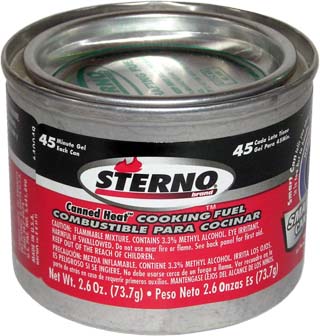
Zen Gelled Alcohol Stoves - Sterno-like Stoves

Gelled alcohol commercial product

Gelled Alcohol

Gelled alcohol is primarily used for chaffing dishes (serving dishes kept warm by the flame), but they're great for camping and micro-cruising. Stands are cheap, and easy to DIY (can even use a can... do the Can-Can!).

BTUs are somewhat low by volume, so they're slower. Many are methanol based for higher BTU. Methanol is poisonous, so don't cook directly over the flame, but use a pot (AND extra-good ventilation!).

The gel is nearly spill-proof, and better, can be made DIY. Best of all, the ingredients (shells, vinegar, alcohol) can all be DIYed in the field, making this a long-range option. Larger surface areas (bigger diameter cans) can help overcome lower BTUs/sq.in.. 

Check out this article for a recipe. 


*****


Can't find who drew this, either... Inventor's home page, here.


Penny Stove

This one uses a penny's weight  to regulate fuel flow rate. The how is simple but the why complicated.

When all is in good proportion, their flame jets are a thing of beauty. They're considered by many hikers to be the ultimate in ultra-light heat.

*****


There's something about an open fire. Something deep in the blood as we stare into the eyes of our companion of a thousand generations. Our worst enemy, it is said, and our best friend.

But something, too, in fire contained. Focused. Intensified.

We are apprentices of fire's alchemical magic. We seek its ways. Learn to feed it while avoiding its bite. Learning to excite its passions without being consumed by them.

Together transforming dull matter into heat and light.