Please visit our home site at www.TRILOBOATS.com.

Anke and I live aboard WAYWARD, and wrote about it's design and construction at ABargeInTheMaking.blogspot.com.

Access to the net comes and goes, so I'll be writing in fits and spurts.Please feel free to browse the archives, leave comments where you will and write... I'll respond as I can.

Fair winds!

Dave and Anke
triloboats swirly gmail daughter com

Showing posts with label Risk. Show all posts

Monday, September 14, 2026

Risk, Resources and the Risk Budget


Ducking out of Trouble


Check yourself before you wreck yourself. 

-- Meg Cabot


Risk, Resources and the Risk Budget

I think often about risk and its management. Our own lives and those of others in SE Alaska - anywhere, really - bring a stream of reminders lest I forget.

Risk is a fundamental aspect of life, and no amount of preparation brings it to zero. Hence, I write 'fail-safer' and 'saferty' to remind myself that safety is an ultimately unattainable goal however advisable its pursuit. I like to know my 'risk tolerance', on the one hand, but also keep in mind that mortal risk can and does reach past tolerance for those of us who brave the water. That awareness is both humbling and helps keep one alert.

Recently, I was introduced to a new-to-me framework for thinking about risk - the Risk Budget.  The idea is that we have several 'stocks' (in system terms)... accumulations of resources which provide us with various margins of saferty. As we proceed in a risky endeavor, we draw these stocks down, reducing the total margin of saferty. When one or more of these stocks becomes critically depleted, our risk skyrockets. The outcome of cascading, catastrophic failure becomes ever more likely with each further withdrawal.

In terms of sailing, these stocks cover quite a range, and interact in suites.

Personal energy, hydration, and warmth directly support stamina and mental acuity. Vessel integrity, stability, gear and stores support ability to keep the sea. Stability, distance off, fall-back options and generally defensive sailing fend off extremity. Knowledge, experience and practice help make our options visible.

Thinking of our resources in terms of a budget reminds us that they are finite, and to spend them wisely.

But even with all these, time constraints, season and climate change may increase situational risk and rates of depletion. Age, infirmity and entropy lower our personal and material reserves. 

What then to do? Make sure that...

  • We are well fed, hydrated, clothed and rested.
  • We have cultivated skills proportional to the risk.

  • Our vessel is robust and ready.
  • Stocks are ample, replenished, and rotated.

  • We sail in open windows of time and opportunity.
  • We sail defensively with plenty of margin and fall-back.

  • We favor fail-safer solutions.
  • We practice saferty-in-depth (redundancy).
  • We Keep It Simple, Sailor!

And before we exhaust our reserves? 

  • Take immediate action to restore our margins of saferty.
  • Head for shelter ahead of trouble when possible.

All in all, not too earth-shaking. Not too difficult. Most of the time.

We can't eliminate risk and, as sailors, aren't really looking to. We accept the inherent risks of being on the water. But we can manage it. 

We can hold ourselves prepared - as best we may - for the stitch-in -time.


Relevant Posts:

    https://triloboats.blogspot.com/2012/01/risk-management.html

    https://triloboats.blogspot.com/2012/01/rules-of-thumb.html


     https://thingstolucat.com/2024/02/29/highly-likely-low-consequence-learning/

         -- Excellent advice toward courting risk in pursuit of learning to handle it from Luc Mehl.

Friday, December 29, 2023

Buying or Selling a Vessel? Tips, Tricks and Traps


Illustration by Caroline Magerl of Queensland, Australia
From The Epoxy Book


Caveat Emptor (Buyer Beware)!


Buying or Selling a Vessel? Tips, Tricks and Traps


The market is a slippery, tricky place. Theory is that parties negotiate until they come to mutual agreement. Win-win. Everybody goes home happy. Another view is that it’s an adversarial contest. The seller wants the highest price, while the buyer wants the lowest. All’s fair in love and war.


One piece of advice I was given; Back off at the first whiff of adversity (pressure, hustle, prevarication, coercion). 


If we’re not dealt with in good faith, we’re likely to get cheated or stiffed. On the seller side, I’ve witnessed transactions which include hidden issues, false provenance (the seller didn’t wholly own the vessel), listed gear being stripped after sale. I’ve known buyers to skip payment/s, abscond with gear that wasn’t included in the agreement, wreck the boat and skip town.


Much better to negotiate amicably for that win-win. The waterfront is a small world, and it’s good business to make and keep friends.


Four Traps for Buyer and Seller


These traps don't themselves signal adversity. We’re all human, and these kinds of things often creep in somewhat below the conscious level.


  • Sentimental Value – Sellers often factor their sentimental feelings into a vessel’s price.  This, despite the fact that they are never-the-less unloading their Loved One on the market. No issues with their fond memories, of course, but those have zero market value.

    By the same token, our own sentimental attachments can likewise serve to jack up the price. We’re suckers for pretty, cute, trim, traditional and a host of other impressions which bias our neutral assessment. Rot, nail-sickness, blisters and other infirmities might be lurking… beauty is only skin-deep!

    They say one shouldn’t sleep aboard a vessel before buying, lest one fall in love. Not sure I’d go that far – we want to be in love – but keep a clear, cold eye on how much you’re willing to pay for it! Consider a professional survey as a reality check.


  • Sunken Costs – Closely related, seller’s often wish to make up previous expenses, which have nothing to do with the buyer. Dock and haulout fees, for example. Sellers often wish to recoup their costs, which often ends up on the buyer’s tab.


  • Issues – Just as in buying a house, issues may be dealt with before or after sale, with the price reflecting the agreement.

    Consider a well-written contract based on industry standard templates that spells it all out. Handshake agreements are well-and-good for simple cases, but a fully found vessel is complex by nature, with lots of room for mis-understanding and animosity.


  • Potential Value – Once you’ve fixed ‘er up, you’ll have doubled yer money! Um. Well. You might double the price when you come to sell, but that doesn’t automatically count the time, materials, labor and fees you’ll have supplied.

    The value of a vessel is ‘as is’, not ‘as it might become’.


  • New Prices for Old Gear – Yes, the price is high, but look at that gear list! Think of the replacement value…

    Hmm… that gear is not only used, but has been sitting around in the marine environment. It likely does have value (obsolete gear doesn’t count), but it won’t be the replacement value.


*****


Assigning value is extremely difficult. Supply-and-demand gets us started, but in the world of vessels, supply is very often low (unique or uniquely available vessels), while demand is… personal.


Cost is somewhat easier to calculate:


Consider the state of the vessel as is… take a goooood look!


Consider the time and energy required to repair and outfit to your standard.


Consider the time and energy required for long-term maintenance, including moorage.


Consider alternative options.


If your total cost from all the above plus the price you can negotiate is greater than you can afford or are willing to pay, it’s no-go.


Buyers, consider doing as much of this calculation as you can before starting negotiations… no point wasting the seller’s time and your own if it’s a non-starter.


Good luck, and win-win!


Tuesday, February 8, 2022

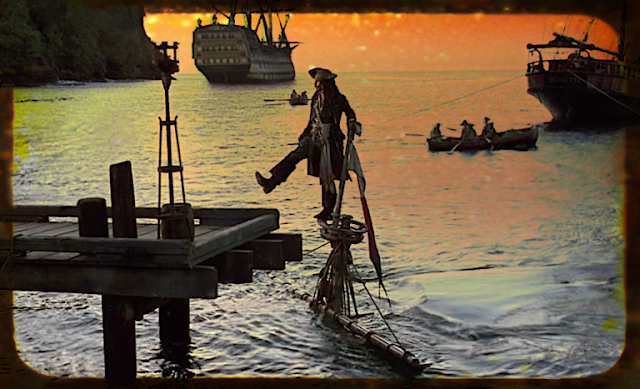
Feeling Buoyant


Don't let that sinking feeling get you down!
From Disney's Pirates of the Carribbean: Curse of the Black Pearl
via BroBible

You don't drown by falling into the water; you drown by staying there.

-- Edwin Louis Cole


Feeling Buoyant?


Here’ a tale of specific gravity I heard via Kevin Allred…


Seems a friend of his, living along one of the great sea-lanes of SE Alaska built him a small, open sailboat of cedar. 


For his first sail, he guesstimated what he’d need in ballast and accordingly threw a ten-count of sandbags onto the floorboards. Figgured he’d adjust as needed, then bolt in their equal in fixed, lead pigs sometime down the road.


Off he went, sailing along sweet as ya please, proud as punch of his new vessel.


Well, it was blowing pretty good and gustin’ up a little, but nothin’ to worry about. All the same, he made his sheet fast with a slipped hitch for easy let-go, just in case, which come along in due course. 


Up come a big gust. He gives the sheet a yank and whoops. The bight jammed. His new boat is knocked to her beam ends, throwing him overboard and cutting under sideways. He pops to the surface, sputtering and snatchin’ for breath (that cold water’s a shock, lemme tell ya!). He looks around and… no boat, with the shore a mile off! 


But waidaminit… there’s a few inches of vertical stick up and down a few yards away, which he recognizes as his masthead. Over he swims and is clinging to the very top of his rig, with - not much, but a little - time to think it over. But, y’see, he’s motivated. After due consideration…


Down his mast he shinnies, holding his breath and poppin’ his ears. He gets hold of a sandbag and heaves it over. Then another before he has to go back up for air. Gained him a few feet of mast!


Four trips and eight bags later, he’s bailing for his life and raises her up and high on her lines. Almost like nothin’s happened.


Straightaway he beelines it for shore and his last neighbor before a long, long downwind sail.


Neighbor hears a faint knock and goes to the door to find a jittery, blue apparition, soppin’ wet:


“Holy SMOKES! You okay???”


“C-c-c-c-c-c-old.”


*****


We get to see some principles in this story.


One, in small open boats - especially when gusty - hold the sheets in hand or wrap just enough turns to friction hold the load between gusts. 


A slipped hitch is better than a hitch, but no hitch (with ju-u-u-u-st right turns) is better than any hitch.


Two, positive buoyancy is a fine thing!


In boats, we think of buoyancy as one of negative, neutral or positive. Negative sinks. Neutral just hangs out (it may move up or down with momentum from wave action). Positive floats.


Those few inches of mast floating proud of the water mean there were just enough more floaty than sinky bits in the immersed portion ofboat to support the weight of protruding mast. A matter of a few pounds transformed this potential tragedy into comedy.


The moral? The more positive buoyancy, the merrier.


  • Keep sinky bits to the practical minumum (i.e., functional plus safety margin).
     

  • Add as much floaty stuff as is practical, preferably stowed so it can’t float away if immersed.

  • The goal is to float crew and maybe decks clear of the water when awash.


Think positive!


PS… Anke hears the yarn part of this post and says to me, “You don’t talk like this!” She’s referring to the many colloquialisms, such as, “Up come a big gust.”


On examination, it turns out, I DO talk this way, when relaxed, just not so ‘cogently’.


Mine is the local vernacular style on our waterfront, and I’ve spoken it all my life. Mixed with some East Coasterisms I’ve absorbed from nautical readings and songs along with other flip and foolery from over the course of 40-some years. Along with turns of phrase that resonate with me. Gordon Boklets, among others.


If I’m writing for technical clarity, however, as now, my training kicks in. Highly edited, fairly grammatical sentences are more common, though I hardly stick to Turabian. Not always successful, I know, but it’s my best shot.


What I’m not so good at is telling a story both verbally and well. What I hear in my head is soooo much better than what comes out of my mouth. But tongue pulls ahead of brain. Detours. Red herrings. Lost threads. Dead ends.


However, I’m a slow typist, and my brain can spill at that rate. Stories come out as I think them, for better or for worse. I only ever lightly edit this stuff. This is why what I write doesn’t always sound like me to Anke.


You’re getting my Voice, such as it is.


Umm… you’re welcome?

Tuesday, February 1, 2022

Winter Sailing

Think it's gonna snow?


Hope ain’t a tactic.

– From Deepwater Horizon (the movie)


Winter Sailing


Winter covers a lot of ground. Pretty much a whole hemisphere at a time. Arctic sailing techniques and equatorial call for radically different sets of tools!


Our home waters are the islands of the Southeast Alaskan archipelago. Very roughly from 55 to 58 degrees North. At this latitude, daylight hours grow short and the nights long.


We’re warmed by the Japanese current, which keeps our temperatures moderate relative to continental cold air masses. But this thermal energy, exacerbated by pressure gradients between offshore lows and continental highs, makes for some mighty winds. Worse, they can huff up from nothing at a moment’s notice. They can hurl down-slope from icefields and on high. They might blow out quickly, or they might settle in till spring.


We can get a lot of early snow, then warm abruptly with copious rain, causing flooding and freshwater outflows over the surface of denser, salt-water tidal movements. Things get lumpy.


Cold snaps can freeze any surface water holding still. Or can blow freezing spray which can cripple and sink the unwary. Lines can freeze stiff, refusing to run and resisting any handling, while strength drops to the snapping point. A warming turn can cause ‘break up’, which can strip anchors and carry a vessel from shelter. Skim ice can slice a boat along its waterline, clean through the hull.


And, y’know, it’s cold!


Winter Tactics


Winter sailing can be a different kind of a beast anywhere outside the tropics. All the hard stuff is harder. More fail-dangerous. More apt to sap our energy and mental acuity. Ice and snow are strident factors.


Warmer, moist maritime air carries a load of heavy water vapor, which packs a whallop; as much as X times the force in the sails. Cold, dry interior air has less of a punch, but dries and freezes exposed skin, even at low speeds. Both can lead quickly to hypothermia and bad decisions. Protect yourself!


Here’s a handful of the things we do in the face of winter. These are all considerations (despite all the DOs and DON’Ts)... they’re stated as imperatively as we observe them:


Clothing and personal gear:


  • Layer Up – Moisture wicking near the skin, then thinnish, lofty (air trapping) layers until warm, topped off by a waterproof layer (PVC isn’t breathable, but it’s impermeable). Have lots of standby clothes to trade out if they become wet or damp, and don’t put off getting dry!

  • Headgear – Lotsa heat leaves via the head. Hats, balaclavas, neck gaiters, scarves… these help keep it in.

  • Gloves and Mittens – Rubber gloves with inserts keep hands warm and dry while getting under way, but then sweat and chill. We switch to mittens, ASAP, so our fingers can huddle together.

  • Insulated Boots – Felt lined rubber boots are great for cold weather. They’re fully waterproof and, like PVC, non-breathing. Slipping plastic bags over (the first layer of) socks still gives damp feet, but preserves outer insulation for warmth.

  • Goggles – These warm your eyes and keep snow, ice and slush out of them. A swipe with mittens clears them pretty well, unlike glasses.

  • Sailing Harness with Lanyard, Clips and Jackline – A little insurance for slippery decks and surging hulls. We like our lanyards short with a quick release shackle inboard and caribiner to the jackline. Short enough to keep us bruised but on deck, should we stumble, rather than drowning in our own bow wake alongside.

    We like inflatable vest/harness combos with whistle, survival kit and strobe light attached.


A Hole in the Weather


  • Warm Interior – We like to keep our fire going for winter sailing. We trade off frequently and get warm below. A hot water bottle in the foot of a sleeping bag helps with toes.

    NOTE: Make sure ahead of season that the smokehead draws well in all winds and at all angles of sail!

  • Warm Food and Drink – Making up a stew ahead of sailing and keeping our vacuum bottle topped off lets us keep hot energy flowing.

  • Hot Stones – Warming in the oven, these make great hand and pocket warmers. Watch out for any that are too hot, and wrap as necessary. A larger, flat stone works great for feet. Water bottles work, too, but they're a little harder to keep renewing underway.


Weather and Sea States


  • Check the weather before heading out! – Forecasts are fairly accurate for big winds, but diminish proportionally. In winter, anything up to Force 5 could be from about anywhere. But check.

    And use our own eyes and knowledge! We are privvy to local knowledge the forecasters and their models can only infer. Doesn’t matter what the forecast tells us if actual conditions are shouting otherwise.

  • Avoid (Strong) Wind or Surface Outflows against Tides – These conditions cause the seas to stack short and sharp. Hard on us and our gear. Whatever else is going on is that much harder to handle.

  • Don’t head out into rising conditions – In winter, things that are getting worse don’t know when to stop. Even when the forecast calls for a moderate pick-up, things can get carried away. ‘Course, a calm going light gives some margin of error… I’m thinking more of 15 going to 25kts… we might well get 40kts!

  • Don’t head out into freezing spray – Of all the dicey conditions, freezing spray gives us the willies. A little can be tolerated; a lot can roll us under. But which it’ll be is a crapshoot.

  • Don’t anchor in the mouth of vertical valleys, avalanche chutes or off of windbroken trees – Williwaws and avalanches are no joke! Consider a topographical map (e.g., the state Gazetteers) to help spot wind holes.

  • Don’t Sail through Skim Ice – Our copper plating gives a big margin of safety, but ice is patient. Be aware that, if sculling, even a little ice will stop you in your tracks.

  • IceUp Calls for High Alert – We try to keep an ice free moat around the hull with breakout to the point our anchor lines intersect the water/ice. If possible, we neap out above the worst of it.

    Once the weather warms (or melt begins from below), we set a watch, and start breaking things up as soon as possible.

    Worst comes to worst and we are dragged out of shelter (never happened, but it could) prepare to sail. Run for shelter as soon as free of ice. Maybe even before?


Frozen Lines


  • Make Sure Sheets and Halyards are Running Free – This is tricky. If it’s very cold and dry, often iced lines will more or less sublimate free (solid ice evaporates with no intermediate liquid), aided by beating and working. Tails can often be brought below to thaw and dry. We don’t set out until we can raise and lower all sail. If in doubt, stay put when possible. If not, keep working on them once underway.

We start working the lines free as soon as it gets cold enough, even if we’re not planning to sail. It’s a slow process, and ya never know.

  • Install (Temporary) Downhauls – Sometimes our best efforts fall short, and a sail that can’t be lowered is positively dangerous. Downhauls are good insurance. We can usually haul a reluctant sail down by hand, but our winches are handy in case we need more pursuasion.

  • Anchor Lines – these are a skosh more forgiving… In our self-bailing anchor locker, they can be swashed down with seawater before deploying (salt water has a lower freezing point than fresh). Usually, this is a little less time critical, as they have no blocks to run and are gravity assisted. Still, take a look to check they’re not a block of ice before we set out.

  • Dock Lines – Double them up and use wider angles than usual. Where possible, get them working together, rather than one by one, to share loads. Try to minimize shock loading from a surging hull by reducing slack.

  • Fenders – Double them up, too (they can get brittle) such that, should one fail, the hull is still fended off. Consider some non-inflatables such as tires or rope fenders. Consider an off-haul system (anchor set abeam or strut ties).


NOTE: Recently, I’ve seen a type of loosely braided, synthetic line being used for docklines in winter conditons… It shrugs off water so doesn’t freeze so remains pliable and presumably retains strength. Haven’t yet been able to research. Might it be fit for sheets and halyards?


Rules of Thumb


  • Throw Away the Calendar – Scheduled sailing is dangerous any time of year. In winter, it can be deadly. Having to be somewhere pushes us to sail when we shouldn’t. Sailing when we shouldn’t can lead to pushing daisies.

  • Await the Opportune Moment – Wait for a fair wind, in fair amount, over a fair sea, with a fair prospect. This is our best shot at getting on down the road safely. Don’t fight conditions… long money’s on them!

  • Increase All Margins of Safety – Maintain more than ordinary room to deal with trouble. We’ll likely need it. Consider a winter set of heavier anchors.

  • Move in Short Hops – Winter windows are short and snap closed fast… go from one secure situation to the next with dispatch. Don’t long haul for distant shelter or dawdle daylight away.

  • Prepare for Night Sailing – Chances are, we’ll end up in the dark. Be ready with navigation, information, skills and lights.

  • Have Fall-backs and Be Ready to Engage Them – Should conditions change, be prepared to change with them. Even if it means giving up a whole difficult day to run back to where we started or worse. Better safe in a downwind anchorage, than caught out in a rising, night-time gale!

  • Be Prepared to Hunker Down – If we get weathered in, we want to have all the wherewithal to stay for an extended period. Like maybe the rest of the winter? Food, water, books. Some winters, may be best to catch up with friends in a town.


All this is on top of having our selves, vessel, gear and outfit in fine fettle. Winter is no time to let things slide. Of course, knowledge is imperfect so we can and will encounter the unexpected. But we do what we can…


... and don’t sail on hope.


Related Posts:


Tired is Stupid

Night Sailing


Friday, February 12, 2021

Love Among Mortals

Photo by Silke Schmidtchen


You think you have time.

-- From Buddha's Little Instruction Book by Jack Kornfield


Love Among Mortals

Facing Death is transformative.

Somewhere, in the back of our minds, we all know - in a general kind of way - that we are mortal. But then a moment comes when we look Death in the eye and know it for ourselves... for our Beloved... and that knowledge becomes both specific and immediate.

For me, such a moment marks the very beginning of our One Precious Life. 

As sailors in a wild and wooly place, Anke and I live with perhaps a closer view of Death than many. We often sail near the edge, and far from any hope of help should we fail dangerous.

This last autumn, we had a wild passage, where Death was grinning over our shoulders right along, breathing down our necks. It started with a small thing - a jammed block. So many deadly outcomes are the end of a series of small steps inching, then leaping toward disaster. We were able to manage our issues and all was, in the end, well.

But it was another reminder that - even in the mundane day to day - Death can come for us.

And now Plague walks all the lands of the world.

A time of pandemic binds us all in a moment of the awareness of our mortality. The last century has brought humanity a growing understanding of disease in its causes and cures. Yet we remain stubbornly mortal, and a tiny molecular machine - devoid of hope or malice - reminds us collectively of that fact.

For some, inevitable Death sucks all meaning from Life. For others - count me among them - Death is that dark background against which all life is luminous. It's proximity reminds us to live. NOW.

And what is the one thing worthwhile? That one thing to pursue with all the resource of our One Precious Life?

If you ask me, it's Love.

Power? Pffffft. Fame? Sic transit. Stuff? Can be useful but can also own us and weigh us down. Wealth? You know what it can't buy. 

We think we have time... let's assume we don't, and start living. Start loving.


Happy Valentines Day, all ye Young Lovers! 

(And that includes you, my fellow Elder Farts!)