Please visit our home site at www.TRILOBOATS.com.

Anke and I live aboard WAYWARD, and wrote about it's design and construction at ABargeInTheMaking.blogspot.com.

Access to the net comes and goes, so I'll be writing in fits and spurts.Please feel free to browse the archives, leave comments where you will and write... I'll respond as I can.

Fair winds!

Dave and Anke
triloboats swirly gmail daughter com

Showing posts with label WAYWARD. Show all posts

Tuesday, November 18, 2025

Live Aboard MacroEconomics: A Case Study


WAYWARD earning her keep


As you live your life aboard a vessel, be aware of the sea of life on which it floats and on which it moves forward.

— Ian Gardner (as remembered)


Whatever floats your boat!

-- Sailorspeak


Live Aboard MacroEconomics: A Case Study

LUTRA, the boat we're currently building, offers an as-of-today set of numbers to puzzle over.

Numbers, of course, are slippery li'l devils. What counts in or out? Round up or down? Will the future hold the course? Nonetheless, it's worth a look! Here, I'll take a bird's eye look at up-front dollar costs of our live-aboard vessel relative to rent. 

So LUTRA. Our labor is 'free' (ha!). Time is probably about 6 months of steady, optimal workdays... spread across a year and a quarter in our actual context. Let's say 3000 person-hours (2 persons x 8 hours/day x 180 days, rounded up). The time investment itself hurts less than time lost cruising at large!

When all the dust settles, we arrive at two figures for her out-of-pocket cost. For building site, construction and materials of the hull and furnishings, around $5K is pretty close. Mind you, this is still semi-remote, so costs are high. That's the easy part.

Where it gets complicated is in evaluating outfit, gear and copper we're carrying forward from WAYWARD (and earlier boats!). 

WAYWARD's copper plate was originally a whopping $10K in 2014 dollars. We figure that it paid for itself in about 5 years, saving a rugged alternative finish (e.g., fiberglass/resin), anti-fouling paint, haul-outs and associated costs, repairs, on-board insurance, etc.. After 10 years aboard WW, we used half of it and her chine angles for LUTRA.  Each half is worth around $4K as #2 scrap in 2025 dollars defraying the original outlay.

Similar calculations go for anchors, chain and rode, a pile of fasteners, piano hinges, coms, nav lights and other gear.

So... um.... I'm going to say $1K for these components. Neither replacement value nor market value, but a nod toward what might have been an expensive heap if it hadn't already paid for itself. 

That brings LUTRA's up-front dollar cost to ~$6K.

We're building in our home port of Tenakee, Alaska. Currently, property is well out of our reach. Rents are running around $1K/month for a studio-ish space, utilities included. IF you can find one open. There are only a handful and chronically occupied.  In a larger town, such as Juneau or Sitka, low-end rents average $2K - $2.5K/month, utilities NOT generally included. Tight there, too, but there're generally more openings coming and going.

So let's start with our local $1K/month. That's $12K per year. LUTRA's build is paid off in 6 months at large, a little more when tied to the dock. If we live-aboard for 10 years, we clear 'savings' - in dollars not spent - of more than $100K in village rent, ~$200K in town rent!

Cash money, unfortunately, doesn't grow on trees. 

Tenakee labor is compensated at $18 - $25/hour. It's not exactly 40 hour work weeks, so can also stretch wider over time. But let's say 200 person-hours ($5K x 1 person-hour/$25) to earn the $5K cash outlay for LUTRA. Let's add to that our 3K person-hours for construction and round up for a conservative 3.5K person-hours.

Still, it's easy to see that 10 years of rent would require at least 4K person-hours at present rates.

So... well, well!... looks like we save time, too, even when calculating the bare rental alternative to living aboard. An even better dollar deal if we had bought a vessel, rather than DIY.

That being said, while DIY construction plays a role in all this there are middle grounds.

Buying a modest fixer-upper and DIY from there will (most likely) drop your time investment considerably, and quite possibly your layout costs, so give that a good look.

But the big money is in living aboard! Sail away from the dock if you can.

***

In reality, all of this is vastly more complicated. We don't begin to examine, here, the costs of gainful employment (commutes, clothing, peer outings, etc. inherent in the alternative). We haven't calculated equity and resale value vs. zero for rentals. We don't know how to count our time entangled in town while building. We haven't considered costs of maintenance and repair. We don't know how to evaluate what we learn while building, and how that pro-rates over the years. We don't know if we'll get that 10 years ahead, much less the 20 or so we have fair reason to hope for.

We keep in mind that, at the end of ten years, we still own our vessel  / home ; it's just another rent-due month for the alternative.

I started this post musing in print. I'm pleased to see that the numbers appear to crunch in our favor in both money (I was pretty sure) and time (surprise!). My sense is that, given a simple, low-overhead lifestyle, living aboard and sailing remote, the numbers tilt even further in our favor.

So don't let a little thing like money stop ya!


Thursday, December 24, 2020

Storm Tactics: Inshore

Carved handrail from S/V TANTRA
by
Ried Stowe


You can't stop the storm, so stop trying.
What you can do is calm yourself.
The storm will pass.

-- Timber Hawkeye


If you think it might be time to reef, it's time to reef!

- Sailor's Wisdom


Storm Tactics: Inshore

In life and sailing, storms overtake us.

Most often, if we pay attention, we have some warning before their onset. In rare cases, they pounce like a cat upon a mouse. We're the mouse, at least in scale. Unlike mice, we have a range of tools to meet the storm.

NOTE: When I say storm, I'm speaking of high winds in general. Our standing policy is to NOT be on the water in full storm conditions or worse. Despite this, we occasionally find ourselves caught by surprise.


Foundation

These are things I recommend which underlie a successful response to storm conditions:

  • Prior Knowledge... Knowledge and skills acquired ahead of crisis are priceless!

    Learn what you can before exposing yourself to storm...

  • Trained Crew... and train up all who sail with you.

  • Sound Vessel... Robust construction and maintenance, uncluttered decks, capable and easily reefed rig, good anchors with ample rode.

    Without these, any ship is at risk in any weather. When Storm comes with its long boots on, meet it with all head and hands on a stout deck!
 
 
Rules of Thumb

We use a small heap of rules-of-thumb to help us along our way:
  • Fail Safe vs. Fail Dangerous
  • Preserve Options
  • Layer Redundancies
  • Maintain Margins of Safety
  • Act Decisively
  • Develop Standard Operating Procedures
  • Develop Communication Protocols
  • An Ounce of Prevention is Worth a Pound of Cure
  • Get Out of the Wind, Stupid!
  • Avoid Smug
  • Manage Fear and Panic
I go into these at more length here.


Storm Tactics

  • Batten Down - Secure your gear inside and out, dog down hatches, dress for the weather and clip in. MOB (Man Over Board) in storm conditions is a very long shot, no matter how well drills have gone. Stay aboard!

    NOTE: Make sure your harness clips are short enough to keep you out of the water. The USCG warns that a person being towed in the water cannot clear their head to breath from their own bow wake from about 4 knots. We lost an acquaintance that way... his crew didn't know to round up and stop the vessel.
     
  • Reef Early - Reduce power before you are over-powered. Sail handling is easier and you'll be more comfortable and safer on deck.

  • Reach or Run for Shelter - Shelter ranges from protected coves, to the lee side of islands or points, to mere outcroppings that break wind and especially waves. Consider heading into the best shelter available before conditions deteriorate.

    It's important to note that, while wind can be unnerving, it is wind-driven water - weighing a ton per cubic yard/meter - which can toss your boat dangerously. Interruption of seas driven over a long fetch (open stretch to windward) will give your anchors the best chance of holding. Reefs, spits, and even thick kelp beds can provide effective shelter even as the wind whips over them.

  • Consider Quartering the Seas - Quartering (angling across them at about 45deg) gives a much easier ride in large or closely spaced waves, both for boat and crew. This generally means sailing close-hauled or broad reaching.

  • Consider Heaving-To, Sailing Backwards and/or Drag Devices - These are more often used offshore, but they have their place inshore. They help keep the bow up to wind and waves. You can adjust position to a degree by crabbing (backing or balancing sail to edge to port or starboard) without re-establishing full sailing trim.

  • Look Around and Enjoy the Storm - I mean, they are magnificent! As long as we're fool enough to be caught out in one, we may as well enjoy it.
 
It Was a Dark and Stormy Night

We've just completed a winter passage - under press of calendar obligations - that pretty well kicked our butts and tried our mettle. So all this is pretty fresh.

A mere 80ish nautical miles as the fish swims, we started out with winds which, unforecast, edged into gale force. Turns out that our main halyard had jumped a sheave and jammed... we could neither raise nor lower sail. 
 
Fortunately, it jammed in deep reef position... low gear, as it were.
 
Unfortunately, before we had reached a place to pull in, the wind first died to nothing, then turned foul. 

Fortunately, we had shelter behind us and ran for it.

Unfortunately, that shelter had its own katabatic blowing from it over the ebbing tide with river outflow... with our short sail we couldn't sail in.

Fortunately, after heaving-to in a lee all night, the wind returned in our favor, and we again sailed for our destination.

Unfortunately, the forecast called for gale with storm force gusts due before we could possibly arrive.

Fortunately, there was a small hook of shelter right at hand. We know it from years back and call it Whoa Nellie Nook (Nooks protect from North). It has a good lee, a protecting reef and good holding. So we sailed in, set anchor and got our sail (mostly) working again.

Unfortunately, our lee was SO good that a back-eddy of breeze blew us toward the beach as we slept (contrary to the wind that was howling about four boat-lengths from our position)... we whunkered down onto a rocky bottom as the tide ebbed.

Fortunately, the rocks were pretty round. We buffered with some wood cut ashore and lifted off again after several hours and re-anchored.

Unfortunately, the next morning's wind was blowing into our nook (the opposite was forecast).

Fortunately, there was a bit of sand off our protecting reef and we could kedge out and sail on.

...

That was two nights and three days of a five week passage. I won't subject you to the rest, but will merely note that we only got two full nights of good sleep in peace and quiet in all that time.

Looking back in appraisal, we find the following:
  • We need to ditch time-bound commitments, especially in spring, fall and winter.

    Each time we commit to some deadline (for a job, for instance) our decisions become influenced by calendar pressures. We're reluctant to back-track and give back hard-won miles. We trim our margins of safety and head out into smaller, less reliable windows. We push fair winds, tides and daylight hours, which can erode our rest and recovery. All together, we take on higher risks to honor our commitments.

  • We need to increase redundancies in some areas.

    For instance, we have a spare block with halyard on our mizzen, but haven't yet arranged one for the main. This turned out to be an ELE (Exctinction Level Event) on this trip (the jammed halyard could possibly have set off a lethal string of consequences).

  • We need to be more skeptical of weather forecasts in high wind seasons.

    Time and again, we sailed or anchored in conditions which proved contrary to the forecast. In one case, this could have cost us the boat (our sheltered anchorage became dangerously exposed in a 180deg mis-forecast blow).

    Area forecasts cover large areas, and 'predominant winds' is a squishy concept. Worse, we were mostly sailing between one weather system that reaches up into the Yukon (Canadian) interior and another that opens on the Gulf of Alaska. We're learning to look up and take the whole chain into consideration, rather than rely on more local forecasts. This is especially true when updating forecasts flip-flop in wind direction and/or strength.

    NOTE: To be fair, SE Alaska is made up of what we call geographical wonders (local places which alter, amplify or diminish weather patterns). Forecasting the weather - both for pros and amateurs - is notoriously difficult.

    Weather data collection points are few and far between, and are often in sheltered or compromised locations (e.g., at points between two weather systems or in towns whose location was selected for sheltered weather). Models and forecasts based on these data are accordingly unreliable.


    Furthermore, a warming planet increases the discrepancies between models (based on historical data) and the real, emerging world. Winds are tending stronger and less predictable across the board. We need to increase our weather pessimism accordingly.

  • New technique for anchoring in marginal lees:

    Our problem at Whoa Nelly Nook was that, as the tide came in, our protecting reef covered and wrap-around waves sideswiped us badly. So we anchored in very close to the beach and ended up too close.

    The remedy for similar spots - now SOP - is to set two anchors aft against potential wind reversal and one or two high on the 'windward' shore. Tend the vessel with the tide to position close in the protected lee of wind and wave, then out as the tide falls and protecting reef uncovers.

    UPDATE: Given a more recent experience sheltering from Force 11 winds in which a backwind clobbered us briefly, we're now making sure to set our BEST anchors aft and lesser anchors/shoreties set into the lee!
     
  • We're approaching a decline in physical ability.

    This trip was physically demanding. Long hours on deck. Sails and (multiple) anchors up and down. Sculling long distances. Kedging. Swamped dory and recovery, and lots of bailing, often in rough conditions underway. Jury rigging gymnastics. And so on. Meanwhile, we're at the further end of middle age, and looking downslope.

    We're already planning a small, camper-cruiser for high mobility with less physical input. In coming years, we will be sailing WAYWARD less, and in less challenging windows. We are mulling adding an engine down the road (diesel/electric, possibly yawl-boat mount?).
*****
 
Sooo... we loved this trip for all its challenges. It kicked us hard, but there is no living like that at the edge in a gorgeous seascape of stormy wilderness. But all good things...

As Joan Baez sings the poem by Lord Byron:
 

So, we'll go no more a roving

  So late into the night,

Though the heart be still as loving,

  And the moon be still as bright.


For the sword outwears its sheath,

   And the soul wears out the breast,

And the heart must pause to breathe,

   And love itself have rest.


Though the night was made for loving,

  And the day returns too soon,

Yet we'll go no more a roving

  By the light of the moon.


Not there, yet, but we can see the storm ahead. Time to be thinking of shortening sail.

Sunday, June 21, 2020

Hunkered Down, Sorta

Peering over the berm near high tide


 Social distancing. I've been preparing for this moment all my life.
-- Emblazoned on a T-shirt


Hunkered Down, Sorta

For the last several weeks we've been hunkered down in one of our favorite spots.

It's a small tidal estuary, protected by a berm which has been thrown back by winter storms. We float for an hour or two as the tide floods and ebbs. The residents - including the bears - keep their distance as well.

We pulled in with the idea of seeing how the (COVID) 're-opening' will go. One of the peculiarities of this place is that, for all its remoteness, we have a decent cell signal. Thus, when we peer over our berm, our view is wider than usual.

It seems clear that we are nowhere near out of the woods.

No vaccine. The virus is now well-seeded, relative to those early months. Contact tracing and quarantine authority are inadequate. Global (and U.S.) case rates are rising at a 'flattened' but still exponential rate. Many, many Citizens of the World, I salute thee! But re-opening?? Early results don't look promising.

Meanwhile, we are knocking down a number of projects on and around WAYWARD.

Chief among them is paint, but as yet, we've had no day without at least some rain. We're working on a prototype Power Fin (Atsushi Doi concept dumbed down in our usual way... more to come on this). The new sails need to be grommeted and mounted. The rudder system needed some work (lacing just isn't standing up to WAYWARD's heavier forces... we're adding at least one gudgeon/pintle). Spring cleaning calls as summer begins.

You know... the usual.

So here's wishing all of you health and happiness and a happy Solstice!

Love,

Dave and Anke

Edge of NoWhere, Alaska


Sitting dry at low tide

Safe behind 'harbor' walls

Saturday, June 13, 2020

Buddy Boating: Cruising in Contrast

Bristol Channel Cutter


Yeah, but you sail where no sane people go!

-- Our Sailing Buddy


Buddy Boating: Cruising in Contrast


A dear friend lives aboard - and with his sweetheart sails - a Lyle Hess designed Bristol Channel Cutter (BCC). And we all went buddy boating for a bit.

Now, Lyle Hess cutters were my first nautical love. I fell hard through the writings of Lynn and Larry Pardey who sailed SERAFFYN engine-free around the world, back when the world was a wider place.

To me, these are the epitome of Curvy Dog. Fast, weatherly, seaworthy. And breathtakingly beautiful. Over a period of half a century, they have proven themselves outstanding cruiser / sailors.

Yet we ended up taking another road. Despite a general similarity of displacement, plan area and volume, our two boats represent near polar opposites. They take the high road; we take the low... and along either road, plenty of room for thought.

Where to start? Maybe at the beginning?

These cutters’ virtues make them difficult to build. Their fine waterlines, full bilges and firm buttocks… wineglass sections, tumblehome, sheer and sweeping keels… all add up to some serious boat wrightery. That comes at a cost in skill, time, effort, materials and outlay of filthy lucre.

Us? Box it up to go, please. Cheap, but with mucho bang-for-the-buck. Heavy on boat wrongery… let’s say we travel paths seldom trod.

Deep keels and a high proportion of ballast make Hess cutters fast. But shoal waters are only available if the tides run high. That heavy ballast takes away from what they can carry.

We skim the shoals and sit flat when the tide goes out. Without all that extra lead (we get our stability from the boxy shape) we carry a literal ton more books, tools and supplies (which means we can stay out for months if not years on end).

Sailing with the wind, we were the slightly faster boat (our waterline length is about 30ft to the other’s 28). We winced a bit at their pitching, yawing and rolling in the 3ft following sea… our ride is ‘shippy’ in comparison. Still, we were quite aware that if we’d been sailing into the wind, they’d smoke us. But they'd have to work for it (junk rig tacks with tiller over... no sheet handling).

As the wind dropped, we turned inshore… even less wind, but if we needed to scull, far less distance to anchor. They stayed further out (motor back-up), and reached our destination a bit ahead of us.

We skimmed into the shallows and dropped a pair of anchors, drying out between tides. The view of the the surrounding mountains was panoramic, and that of the tidal meadows (deer, bear, mustelidae and birds) was up close and intimate.

After the tide rose high enough to clear a shallow bar, they motored in and anchored in their favorite spot, relieved it had not been taken. It had just the right depth - not too deep for their all chain rode and manual windlass, yet deep enough to stay well afloat through all tides. They had protection from wind from any direction, at the expense of a view.

It doesn’t get any more reliable than that all chain rode. But I wondered if a second anchor with nylon / chain rode might not free up their preference for just-so anchor depth and all-round protection (to avoid having to re-anchor). Well… that pointy bow… it just doesn’t allow room for doing much more.

I suppose we might contrast our accommodations at this point…

The BCC is ingeniously but traditionally laid out. Her galley is, by our standards, cramped. Her salon is two facing benches… To port a fold-out double bunk, outboard, with lounging headroom. To starboard as single berth with locker and bookshelves. Together, galley and salon make up a space about 12ft long by a social 7ft (idle bunk and lockers squeeze the active space of their wider interior). Lighting comes from an overhead hatch and small portlights. Forward is a workshop / head, which one enters via a small gangway… well separated with full privacy and standing headroom under a raised hatch... this area sees relatively little use.

Our social space is 20ft x 8ft with a generous galley / workspace, bench seat opposite a dinette and a very generous double bunk / lounging area all of which are open to one another. Full headroom in the galley, Anke can stand (but not me) in the salon, and full kneeling headroom in the bunk. Lighting comes via two overhead hatches, large galley windows and even larger windows running along the sitting / bunk areas. The side windows, especially, open the interior into the wider world for a sense of spaciousness. Our head is a composting double bucket system with little to no privacy (which can be arranged below or found on deck if our guests are shy).

Poking around, their 7ft dinghy (which fits well on their cabin top) takes a few minutes to launch and retrieve. It does very well with one person, but drags a bit with two. Her beautifully fashioned oars really grab the water, but shoals - especially cobbly or rocky ones - threaten their exquisite varnish which is quite a chore to restore.

Towing our 16ft shorey costs as much as a knot to windward, but is ready to go any time, and rows fast and far, even when heavily loaded. Her oars are fugly; their simple ply blades are worn from years of grinding bottom and most of the paint has left them. But free for 20 years with no maintenance prorates pretty well.

*****

Looking across at one another’s boats and despite seeing the qualities of the other, we each, I think appreciated our own all the more.

Our boats very much reflect the way we roll, both on the front end - we choose a boat to match our purpose and style; and the follow on - our boats determine how we go forward.

Know thyself, my friends, and to thine own selves be true.

Saturday, January 11, 2020

Models and Mock Ups

Building it isn't TOO much harder
(a LOT more expensive, though).


Shall we have an adventure now,
  Or shall we have our tea first?
-- From Alice in Wonderland by Lewis Carroll

Mock Turtle Soup: Models and Mock Ups


If a picture is worth a thousand words, I'd say a model is worth a thousand pictures. I reckon that makes a model worth a million words!

It doesn't have to be a museum piece. Building in scale is important, so you can measure directly from the model. The more detail you build in, the more you'll solve and anticipate problems ahead of time. But TriloBoats are boxes... there's not so much to figure out on that score.

Note bulkheads, deck and framing lines...
almost all layout happens on sides or bulkheads.

We used doorskin (this time) and cardboard, held together by hot melt glue. Crude, but tells us all we need to know. A couple of scale models of ourselves (and a pet or two have since materialized) to picture lines of sight and boarding issues and there ya go.

We laid out the principle (side) component landings, and window cutouts.

Next step is to start marking it up with material counts:
  • Ply Sheets -- Sides, bottom, bulkheads and transoms, decks... each gets written up in place.
  • Copper Plate and Angle -- Sides and bottom; along both chines.
  • Framing -- Chines (bottom and sheer) and nailers, bulkheads and transoms, decks.
  • Nail Counts -- Parallel to framing, one or two sides... How long? How often?
  • Surface Areas -- How much for paint, sheathing, glue?
Writing our results in place beats a list by far... we can see at a glance what we've counted, and what not. Much less likely to over or under count. A different check mark for each pass through lets us check and recheck.

And we can just sit there and stare at it!


Amazing what cardboard and hot-melt glue can do!


*****

Mock-ups are different. The trick here is to be able to get the feel of a feature in full size.

We've got a collection of chairs, tables and counters picked out that we can go to for the feel of things. We might set up a mock 'gangway' to get a feel for how tight things have become in our present state of 'middle age spread'. And maybe a (literal) fudge factor? A strip of plywood simulates the overhead.

We like to look down (not just out) from our windows to see what's happening close up. This ability is affected by the height of the lower window opening and our distance from it (the closer we sit to the window, the lower we can look over the frame). Mocking up lets us see how our furniture height and location will interact with our view.

Window height has been a big issue for us. Here, we mock up the shortest windows in prospect, in their correct location on the sides.  If these are okay, the rest is gravy.

And it's okay.


Not a bad view for below-decks in a sailboat!


*****


Same table, different model.

Friday, November 8, 2019

Travelling OffCenterBoards (aka LeeBoards)

OCB in forward, sailing position
(Photo from Pete Frost)

OCB in aft, stowed position
Windows clear!
(Photo from John Herschenrider)

Truly, she doth block a staircase!
-- From 
by Wallace Tripp


Travelling OffCenterBoards (aka LeeBoards)

Let's start with a leeboard.

As we sail into the wind with our leeboard down (on the lee side), the leeway we make presses it against the hull. It likes to slip forward but not sideways (LR for Lateral Resistance), so we don't make as much leeway as we would without it.

Ready about!

Helm down, we turn into the wind, sails flogging as the bow and boom cross the wind. We drop the leeboard on the new leeward side and raise the first one clear of the water. Sails fill, we heel over and off we go on the new tack.

If it sounds like allemande left and dosido, it is. A little choreography on what may be a heaving, wet deck and your partner is a big, heavy leeboard.

Lazy sailors that we be, our interest was aroused by Ida Little as she clamped a 2x2 outboard of her Bolger DUGONG's leeboards to form a slot, instantly converting them to OCBs (Off Center Boards).

No need to tend 'em between tacks! Just put 'em down and leave 'em. If you want to reduce drag sailing off the wind (no need for lateral resistance), you can raise 'em if you want to.

Years went by, and we transitioned to big view side windows. Problem is, with the boards raised (always the case at anchor), they block our view.

We wanted to haul and store them out of the way. We wanted a simple installation. We wanted it quickly and easily handled by one person.

So we scratched our heads and came up with travelling OCBs.


*****

Walk-through of set and stow
Please watch first for overview

The video above walks through from stowed aft to set forward and back. Notice that the stowed position is in the 'blind spot' below the pilot house.


Tour of system components:

Upper cable, eve guard and stop

This is one of our early prototype stops for the board. It's two purposes are to act as a stop at one of the board's two positions, and to shorten the span of the cable.

The traveling block (description to follow) travels along the upper cable until it hits the forward stop (set) or aft stop (stow).

Both functions will eventually be met by a shorter upper cable (shorter span) and crimp on swage sleeves (stops).

In the meantime, we currently tie a double sided rolling hitch around the cable, with the ends led up to a handrail post (i.e., the vertical part, and not the grip), rather than the arrangement shown.

That aft tail is just 'cuz I hate cutting line.


Aft lower guard, mounting plate, lower cable and slot
Forward lower guard, sheathed turnbuckle, mounting plate and slot
Note the guard struts

The lower guard and lower cable - offset by mounting plates - form the slot.

The lower guard doubles as bearing for the OCBs and mounting steps fore and aft. Handy for boarding from the ground or a dock.

A rule of thumb for leeboards is to toe them in 2 degrees. This helps the vessel 'climb' to windward. We haven't done this on these lower guards, but plan to at the first opportunity.

On the lee side, the OCB acts like an ordinary leeboard. It bears up against the lower guard and pulls at the upper cable.

On the windward side, the lower cable prevents the board from winging out, and the upper board bears up on the eave guard.

We adjust cable tension to let them angle inboard, also at 2 degrees. Our thinking is that, when heeled, this produces a downward force at their Center of Effort, equivalent to someone hiking out, acting against heel. I mean, since we're leaving it down, why not?

Incidentally, since both boards remain down, we use only a little more than half the area one might in a leeboard (where one board handles all LR). This is cheaper, faster to build, lighter, and induces less stress.

There are big stresses on OCBs. I would like bigger and thicker mounting plates down the road, though these (1/4in aluminum) seem to be doing fine. I'm guessing the cables help to absorb and disperse some of the stress.


Bottom of OCB from aft

Here we see the retrieval line, its block and cleat. It is used to raise, lower and angle the board with 2 to 1 purchase (we're trying it out... may go to 3:1).

For stowing, the board is moved to the aft stop and raised clear of the water, but with its lower edge still in the slot. This prevents waves from clunking the board when stowed.

For sailing into the wind, the board is moved to the forward stop and tied, then the retrieval line is hauled in a bit to angle it back a skosh. This encourages it to kick back if we bounce it on the bottom in a swell, relieving stress all round.

For sailing off the wind, we haul the board to as near horizontal as possible. This reduces drag from the now useless boards (lateral resistance is not required off the wind).

Due to the relatively poor lead for the retrieval line, while deployed, we can't quite clear the water with the OCBs' lower edges. We're considering a snatch hook under the eave directly above the load... this would improve the lead, but requires awkward handling with low payoff. Still mulling that one over.

Note the upper mounting plates which were cut from aluminum angle.


Top of OCB from Inboard

These two pics show the hanging / travelling arrangement for the OCBs.

As seen above, an inverted block runs its sheave above and along the upper cable. A lanyard is fixed to the block, and passed through the board to the outboard face. The board pivots from the block when raising and lowering.

[NOTE: We've found Stanley™ Pulleys to be perfect for the job... cheap, strong enough, and the sheave pin is R-sprung for easy dis/mounting.]

Below, we see the lanyard emerge and tie off to a cleat. We pull the block as snug as possible, inboard to set the board as high as possible. This gives good landing on the eave guard. The eave has the dual function of bearing against the upper board, and keeping deck runoff from the windows.

The tail of the lanyard - stopper knotted at its end - is used to haul the boards fore and aft. In the forward position, we tie off to the handrail with a clove hitch to keep the board from pulling aft when raised in place for off-wind sailing.


Top of OCB from Outboard


A little miscellany... 

There are two main criticisms of OCB/leeboards; clunking and picking up 'scultch' (seaweed Klingons).

We've only had board clunking issues in light winds and riptide conditions. Otherwise, the boards either immediately bear up and go silent or 'shuffle' along in no wind. In LUNA, we added firehose along the lower guard, which eliminated clunking, but it's seems only vaguely worthwhile.

We do pick up weed now an then, but it's easily dislodged by raising the board briefly.

As a frequent criticism of OCB/leeboards, I don't get it. Any LR device picks weed, and in most it's a LOT harder to ditch. I see plenty of fixed keelers dragging a garland.

OCBs are easy to construct and maintain, requiring no hull apertures or complex structures. Ventilation is most excellent!

Maintenance is a relative snap. To dismount, we uncleat the lanyard, which can then lower the board with 2:1 purchase. We temporarily hang the board by its cleat's lower horn hooked over the lower cable. We can leave it like that until ready to remount or take it ashore.

We shoot for a ballast load that floats them vertically, about a foot or so proud of the water when dismounted. We can easily tow them ashore on a 'leash' for whatever. Propped up flat, they make a great work bench, ashore.

We don't always sail with both boards down. Each significantly reduces leeway, but there are days we just don't need to be sailing at our best to windward (e.g., a short leg after a long run). In case we change our mind, the second is easy enough to set up, underway. If not, that much less to put away at the end of a pleasant sail.

Retractable LR is a given for ultra-shoal draft. It opens up a hundred sheltered spots for every reasonably deep anchorage. When the wind come on, it can save hours to the next hidey-hole.


*****

We've been sailing with OCBs, now, for 20 years, and travelling OCBs for about half of that. We sail year round in SE Alaska most years, across a considerable range of wind, weather and water.

I'd say it's working!


[NOTE: In SLACKTIDE we had windows along the entire cabin. To stow, we had to lift the boards clear of the slot and slide them dead aft. This complicated retrieval to brute force. Lighter boards are recommended.

There's a primitive ancestor of this post on SLACKTIDE's system, here.]

Monday, November 4, 2019

Going Nowhere

Elev. ~20ft over low water

Going nowhere isn't about turning your back on the world;
It's about stepping away, now and then,
So you can see it more clearly
And love it more deeply.

-- Pico Iyer


Going Nowhere

It was a dark and stormy night...

Wait. No. It was bright and balmy day. We had turned the corner from Chatham into Peril Strait, cutting through Morris Reef as we've done a hundred times.

But this time, we were continuing the turn into Sitkoh Bay, intending to skirt the outlying reefs along the inside corner. We'd threaded the reef on the last of the rising tide, and it was now starting to fall. What's worse, it was now past top of springs (tides getting smaller for the next week and wouldn't be this high again for two weeks). Flat seas, that day, but forecast SE 20kts rising to 30kts (from the worst quarter) with seas 4 to 6ft for the next day.

We took bearings from the chart and gave ourselves some extra margin. Not enough as it turns out, and definitely given those italics above.

Anke had the good sense to think one of us should be at the bow (me saying, "Only if you like... we're well clear!"). She wasn't even all the way forward before she called out, "Hard to port!"

I duly put 'er over hard, but too late. We fetched up mid-ships against the only point in the whole durn area that could have caught us, a little 4in pinnacle standing atop a sunken hill.

In 30 years of sailing cheek on jowl with reefs, this is only the second rock I've hit. Ironically, the first was about a hundred yards away (broke my rule about running through unscoped kelp patches) and about a mile from where we spent a few memorable days on the beach.

This one was a doozy!

Initial assessment showed a couple knots of current held us pinned against that toe-stubber at about our Center of Lateral Resistance (side point around which a boat will spin... or not), so we:

  1. Tried to spin off under sail... not enough wind to overcome current.
  2. Tried to pole off... not enough strength at a steep angle.
  3. Stepped onto the rock and tried to push off by hand... we were on a peak and I couldn't step far enough away from the CLR to gain leverage.

    By now, we're starting to settle on whats showing as a small, thwartships ridge a foot aft of CLR. It's no longer just current we're fighting, but gravity.
  4. Tried levering off... ditto.
  5. Tried lever + handybilly... double ditto.
  6. Rowed out a kedge... by now, we're settled too hard to shift, even with capstan assist.
Okay. At this point, we give up on trying to get off the rock, and turn toward stabilizing ourselves on it.

Luckily, that ridge was plenty long enough to support us across the bottom. No fear of tilting and falling sideways. But, being a ridge, it was like a teeter totter with the big kid at the bow. The bow started to settle, and our stern reached for the stars.

Our first impulse and effort was to lash some fenders under the bow for a cushion. But it soon became clear that even with their extra height, we would be dangerously bow-down by the time they fetched up. At worst, we'd nose-dive down the hill and fetch up hard.

Sooo. We had plenty of firewood... we were able to post two pieces on end - one on each side, about 4ft forward of the fulcrum point, standing on the rock and shouldered under the bottom. Further settling of the bow was stopped, and we could breathe a little easier as the water ebbed away.

Fortunately, we could move freely around the boat without our weight being an issue, though we were pussy-footing, to be sure. Didn't want to shake ourselves off those posts!

We rested a bit and had a meal. What a view! The sun was getting low over two of SE Alaska's great waterways. First snows on the peaks all round. Us in the high bleachers, looking down upon it all. Warm food, coffee and time to think out a plan.

Kinda like yoga.
Doesn't really catch how high up we were!

First thing was to run the numbers. Check the tides, calculate ranges, apply the Rule of Tenths. Check it twice. Safe by a foot... we would float in the very early morning.

Next, we contacted the Coast Guard to let them know our situation (about which they would likely get some calls from passing traffic), and that we had it in hand.

We reset the kedge further out in sandy bottom, well off the port quarter (the free shot out).  Set up a snatch block for the anchor line to lead it fair (from directly forward) to the capstan. This let us use nearly its full power.

Before calling it a night, we added two more rounds of firewood lying flat, aft of the fulcrum. Our thinking was that, as the bow lifted and stern lowered, we would rotate around those, lifting up and away from the stone fulcrum. Any wave-induced pounding would be on a more forgiving surface.

Oh. And I took a sledge to that 4in pinnacle and beat it flat. If we were going to bounce in the morning, we sure didn't want it poking up at us!

Approximate line of 'our' rock...
Post and round drawn in brown.

In the wee hours, the tide duly came back, and as promised, lifted us free, aided by light chop. We waited until we were just quivering before hauling the kedge line bar taught. 

Within a few minutes, we slipped free in two lunges. No grinding, no damage.


*****

As you may have noticed, there was considerable luck involve, good and bad, as is the usual case.

If we'd been half our beam in either direction, it would have been a close call but no contact.

If we'd hit that pinnacle a few feet from CLR, we could have spun off.

If the rock had been flatter (longships), we could have spun off.

If it had been too much of a steep rock, we could have slid off either forward or sideways.

As it was, we were reminded again how forgiving ultra-shoal draft boats can be, particularly those with flat bottoms. 

We appreciate the virtues of girder construction. You can see how rigidly our stern cantilevers. The wide, flat, rigid bottom facilitated posting to limit rotation.

These two features most often mean that, even if a strong sea builds up, we can get out with little harm from a scrape like this. As the tops of the first waves lift us, the kedge pulls forward. Only a small drop and crunch are likely, and only a few of those.

All in all, however, we count our lucky stars.


*****

On Appraisal, we draw these reminders and lessons:

  • Always give extra margin on falling tides, especially falling from springs to neaps!!
  • Remember that reefs and shorelines are rarely accurately charted!

    Pilots advise traffic keep whopping distances off visible landmarks. We run reefs all the time, but when skirting need to be on full alert or follow the pilot. Extra wide margins! Lookout at the bow!
  • Set a kedge early!

    We dillied and dallied too long, partly as it was a foul spot; easy to lose an anchor. Still, anchors are cheap relative to risking the boat, so delay was a poor choice. For ultra-shoal, it's not usually the first response, but shouldn't be delayed long. It's our heavy lifter.

*****

We met thirty some years ago at the Pioneer "P" Bar in Sitka, AK. Its walls are covered with photos of boats on the rocks. Not exactly a Hall of Fame, but rather a Wall of Infamy.

We finally earned our spot!

Tuesday, October 29, 2019

Where We Been

April Showers

Spirit of place! It is for this we travel, to surprise its subtlety; and where it is a strong and dominant angel, that place, seen once, abides entire in the memory with all its own accidents, its habits, its breath, its name.
- Alice Meynell


Where We Been

Well, life has been a whirlwind but is now settling down to another winter caretaking at Baranof Warmsprings Bay. And that means some steady signal (barring the technological demise of our iPhone 4).

Last winter (2018-19) we spent in Sitka, AK, touching bases with old friends and making new ones. Among other things, we installed a new, full-sized foremast. Our original was undersized and therefore temporary, but come spring, we were poised for full strength sea trials. This summer, we sailed roughly 500nm as the crow flies.

In short, WAYWARD sailed well on and off the wind over a wide range of conditions. We were able to sail, short tack to windward, luff up and 'tread water', sail backwards, on and off the anchor... in short all we asked of her.

Our route took us from Sitka Sound to WarmSprings Bay, Tenakee, Haines, Juneau, Hoonah and WarmSprings Bay again. But ah! The reaches between!!

So here's a few images from along the way:


We helped an injured juvenile sealion aboard for the night...
It was spooked, injured, and we think avoiding orcas.
This little guy woke us by ramming his head against the hull as he tried to climb onto our narrow board guards. He was obviously panicked, but not by us. He tried and failed to get in the dory, so we tipped one edge up (to lower the other) and he flopped in. Stayed with us for about 16 hours. Turns out he had a lacerated flipper, which was badly swollen the next morning. Finally, the horseflies drove him back into the water, and he swam off with some other sealions.


Sari weather, or less!


New sculling oar blade
Rocket Stove (EcoZoom) on bench to my right
I'd thrown together a vertical blade sculling oar for WAYWARD out of poor materials (grey blade to my left). It worked so well, it was our scull for almost two years. But the loom was giving up, and the blade was from a skinny plank. So time for new.

These were inspired by Douglas Martin's sculling oar for MOCKINGGULL.


Rocket Stove deck fire

Our little rocket stove let us cook outside on hot mornings, using just a handful of kindling sized sticks for a meal or popcorn. Afterwards, sunset and stars with a blaze and sumpin' sippy!


Fireweed Friendly

The islands with the fireweed had big stretches of thimbleberry, blue berry and blue- and red huckleberry. A little further on, we found great patches of skunkberry and rowanberry (mountain ash). Each made gallons of fine boat wine!


EcoTourism in action
Note trail of smog...
Starting to look like I-5 North along Lynn Canal / Chatham
Unfortunately, and despite promises from the industry, cruiseships emit pollutants rivaling those of any of the permenant, small cities in SE Alaska. Stack emissions and dumping in 'donuts' (a patch of inshore water three miles from any shore) are visibly altering the relatively pristine air and water of our archipelago.


Up a creek, got a paddle
Here we're in a tidal stretch about a mile and a half up from the river mouth. Salmon are running, but severely reduced in number due to drought. We're about a half mile downstream from where they pool to ascend the river.


Oops!
Top o' the reef at about 18ft above low tide.
8/
Thereby hangs a tale for another post. Suffice it to say I could'a used a more generous margin of safety!

Anke and I met over 30 years ago at the Pioneer Bar, whose walls are adorned with pics of boats in similar situations. We've now joined that wall of infamy.


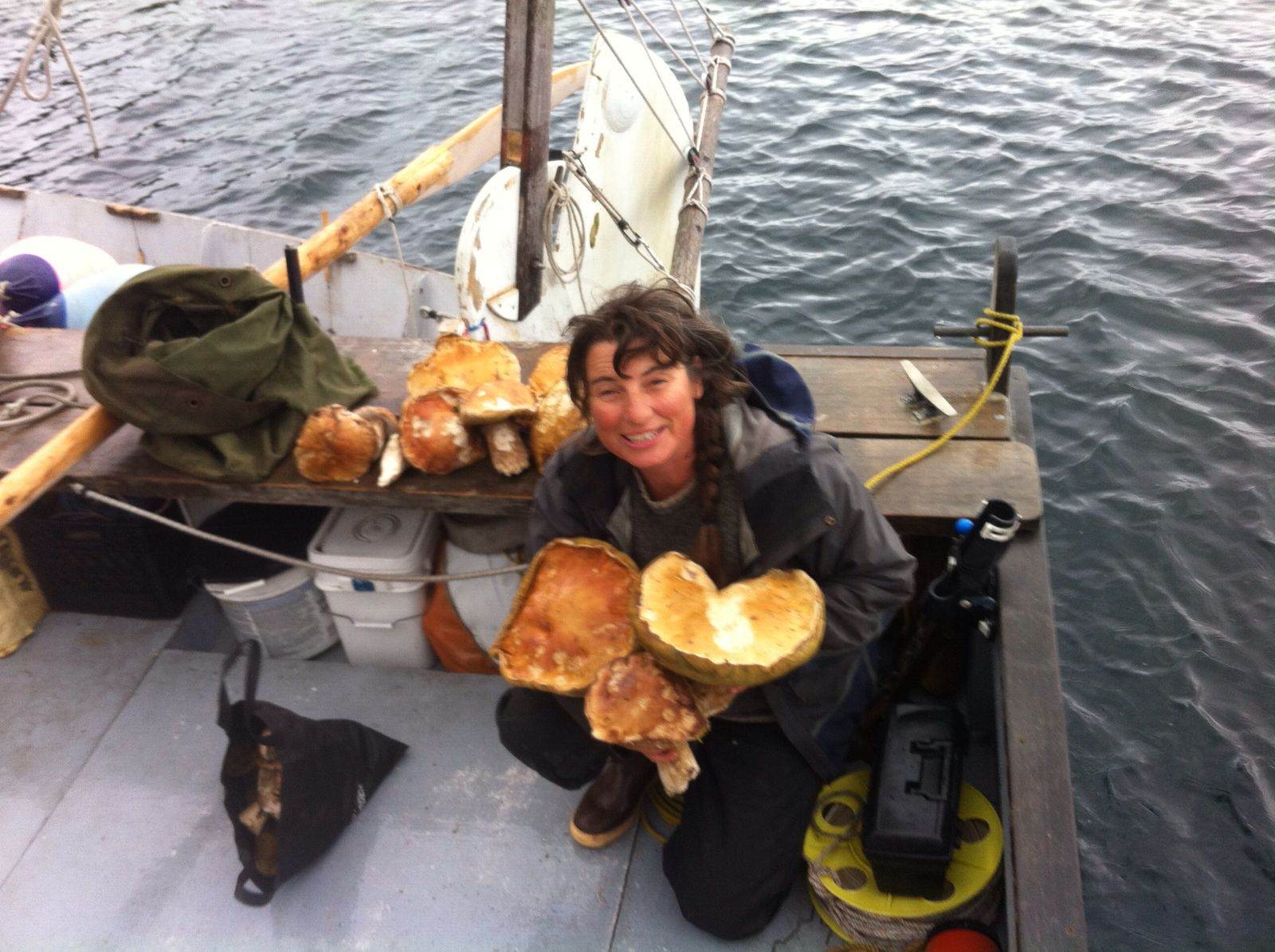
The Queen o' King Boletes
Once the rain started after months of drought, the mushrooms were fantastic! King Boletes, Chantrelles and Hedgehogs are our main staples.


Hiding from the wind

Paula Bunyan

Averaged 2kts in not much wind!
At the end of the season, workers from the Lodge replenish their wood supply. But that strips the local beaches of good beach logs, and Chatham is often a nasty place toward the end of the year. So we did our logging 20nm N of the bay and towed a raft S with us. Friends met us about halfway, so we got an engine assist for once.


*****

So there's a quick tour.

Hopefully the winter will be mild and uneventful and I can get back to writing!

Love,

Dave and Anke