Please visit our home site at www.TRILOBOATS.com.

Anke and I live aboard WAYWARD, and wrote about it's design and construction at ABargeInTheMaking.blogspot.com.

Access to the net comes and goes, so I'll be writing in fits and spurts.Please feel free to browse the archives, leave comments where you will and write... I'll respond as I can.

Fair winds!

Dave and Anke
triloboats swirly gmail daughter com

Showing posts with label Rigs. Show all posts

Thursday, July 30, 2026

Glide Rig: A Hybrid Rig for Rowing Sailboats


MUSTELID gliding along
Full Foresail - Roll Reefed Main - Driver


All I wanted was a tall ship
And a star to sail her by
  Through the night.
  Through the night!

-- Motherlode?


Glide Rig: A Hybrid Rig for Row/Sailboats

Why name a rig? Any technical description is a mouthful, and few people appreciate mansplaining. A good name is evocative, calling to mind traditional associations. Or suggestive, offering a clear clue to the nature of its subject.

Gaff Rig, for example, suggests the spar itself and the sail's quadrilateral shape follows. It evokes robust working sail standing against the gale. The more initiated might recall its ability to scandalize—dumping half its area in a sudden gust. They might recall peak and main halyards, running backstays, and the tack-to-peak creases that indicate a correct set.

So, here is a rig in search of a name...

But first, the mandatory get-in-the-door question from The Commitments: “'Oo are your influences??”

Phil Bolger (of course) observed that most of us aren't out to win a race or even do much sailing to windward if we have any choice in the matter. Outboards and engines mostly handle the windward hemi-circle, so why expend design effort, gear and $$$ on maximal windward ability? He accordingly started to offer simpler, cheaper rigs.

That got us thinking. For a rowing, mostly downwind sailboat, we want a long, slim hull. These  are easily driven but offer relatively low form stability. Ultra-shoal draft limits ballast stability. A snug, low-center-of-effort sail plan that is easily handled and reefed pairs perfectly.

On a row/sail craft, we primarily want the sailing rig to pull us down- or across the wind. Positioned well forward as a foresail—clear of a forward rowing cockpit—it should provide powerful lee helm and steady, balanced traction. For sailing upwind, however, the balance picture changes. We want the total CE moved aft to for weather-helm and good tacking.

Quadrilateral and spinnaker-like sails work, but don't transition easily between the two modes.

Enter Frederick Ljungström, inventor of Ljungström Rig a boomless, double Leg o' Mutton (LOM) triangular sail attached along a shared luff to a  rotating mast. Off-wind, it sets and handles much like roller-furling twin staysails, and like them, provides considerable upward lift.

Sailing into the wind, the sails are doubled, overlapping on the lee side and sheeted as one. This constitutes a half-reef, and a large aftward jump of its CE.

To reef, the mast rotates (we prefer righty-tighty, lefty-loosey), furling the sail snugly around the standing spar. No halyards, tack or clew downhauls, bunts, or nettles. Just roll it up and carry on! As a bonus, simple flat-cut LOMs furl tightly with minimal windage, forming conic sections similar to a Crab-Claw rig.

Since a slim hull cannot spread wide sheeting angles, we re-introduced booms along a loose foot. The result is a doubled variation of the Holopuni Quick-Rig (a great name!) which is similar to a setup offered on the SeaPearl 21.

Finally, three-masted junk schooners (e.g., CHINA CLOUD) inspired us with their fine control of their relatively low total CE, bow and stern maneuvers, and reduced area on each mast. Even on a smaller vessel (within reason), the advantages of multiple masts are striking.

Why Balance Matters When Rowing: Multiple sails give fine control over the balance of the helm. Especially when "motorsailing" (row AND sail), good balance leaves our hands free for the oars and reduces steering by stroke with ensuing fatigue. Even over a short haul, that makes a big difference! A driver - often set while rowing when the others are stowed - helps hold the bow up toward the wind. Where the bow want's to 'blow off' this is an asset.

A Problem on the Side—and a Solution

There is a catch with standard booms. They are fixed at the mast and sheeted toward their outboard end. As the sail is reefed, the clew moves inboard of the sheets, pulling laterally on the mid-boom, bending it toward the CE. Heavy spars and compromise arrangements are the usual fix.

Our solution? The Gliding Grommet.

We use a rope grommet that glides along a lightweight boom, with both the clew and sheets attached directly to it. A light clew/sheet outhaul is led through a turning block at boom's end, spreading the sail as desired.

When reefing, ease the outhaul, roller furl the sail as needed and make the outhaul fast. The grommet, clew and sheets are move inboard along the spar. The active, loaded portion of the boom automatically shortens, increasing relative strength. It absorbs the load purely in compression, avoiding mid-span bending stress. Cheap, DIY, and it works like a charm.

Glide Rig Specification

Mulling all this together, pulling out the main points and generalizing, we arrive at...

The "glide" emphasis is on downwind sailing and a strong balance shift for upwind sailing, supported by the working rig (I.e., without sail changes):

  • Foresail in 'cat' position (well forward) and,
    • Sets large area for off-wind sailing
    • Reduces area and moves CE aft for upwind sailing

  • Main near amidships and/or,
    • Backs up the foresail for downwind sailing
    • Becomes the driving upwind sail

  • Driver well aft
    • A smaller sail for balance and riding

"Glide" can be used adjectivally in the usual manner... where we would say "That's a junk schooner, ketch or yawl", we can say "That's a glide schooner, ketch or yawl" or combine them, "That's a glide junk schooner, ketch or yawl." 

Generally speaking, we wouldn't apply the glide adjective to schooners, ketches and yawls that don't pass drive from the foresail to main when switching from down to upwind sailing, and vice versa. Ditto cutters, sloops and catboats.

But any schooner, ketch or yawl is arguably a glide rig. It's a threshold, as is often the case. Boundaries are fuzzy and often the subject of over-heated tavern debate. Personally, I find it a simple matter of personal perspective... we each get one and to each their own.

With this in mind:

  • Two- or three-masted schooner, ketch, and yawl variants may qualify.

  • Main and driver with other planforms and rigging may qualify.

  • Rig particulars—such as specific sail planforms, unstayed masts, roller furling, the Gliding Grommet solution, and such—are handy but optional.


NOTE: We call the stern sail a driver... it seemed the better option among mizzen (confusing), jigger (???), dandy (too high-brow?) and spanker (let's not go there).

MUSTELID's Glide Rig

I would now call MUSTELID's a three-masted glide LOM ketch rig. Fore and main sails are of equal height. LUTRA's main will be slightly taller (also quadrilateral with a sprit in the mix), so I'd call her a three masted glide hybrid schooner rig.

We tested Glide Rig extensively in MUSTELID over a wide range of conditions, as documented in the video series, MUSTELID Venture.

MUSTELID's foresail is a Ljungström sail (double LOM) rigged and positioned as described above.

Her midships main is a single LOM boomed as described and set aft of the forward cockpit. In this position, it becomes the heart of any windward sailing we might do, with the foresail reefed (moving the combined CE aft) and doubled over to sheet as an LOM. We offset this one to clear the BIRDWATCHER cabin's mid-line companionway.

We set a small LOM driver dead aft for offwind sailing, to 'crank in' weather helm, hold the bow up when drifting and serve as a riding sail. It is a big help when rowing in headwinds, especially when we must row at an angle to the wind. This sail was offset opposite the Main to clear the rudder and tiller. In this position, it can be squared across the transom for a mid-line, downwind push.

It is sprit-boomed in pretty much the standard manner. The boom is longer than usual, extending forward of the mast. A U-sheet leading forward attaches one leg to the inboard end of the boom and one to the outboard. This gives us leverage to trim and make fast. The sail is fixed to the mast (no halyard)... to stow, we release the snotter and raise the outboard end of the boom alongside the mast. A light line fixed to the masthead is used to wrap and secure the boom and vertical, hand-rolled bunt of the sail.


Roll yer own and glide on, Friends!


Saturday, November 1, 2025

Rigged for Success: LOM/Ljungstrom + Quick-Rig Booms


MUSTELID's LOM Main and Ljungstrom Foresail


Live life as if everything is rigged in your favor.

-- Rumi


Rigged for Success: 
    LOM/Ljungstrom + Quick-Rig Booms

I'd like to share a suite of ideas toward a family of lesser known rigs for smaller vessels that I think show a great deal of promise. Part historical, part convergent evolution, part innovation, the result is a simple but versatile, robust rig that can be DIYed at low cost.


Leg o' Mutton (LOM) Sails

This tasty moniker simply means a triangular sail. They're commonly used for headsails (jibs, staysails, etc.), mains (often called Bermudan sails) and drivers (small sails set far aft).


Ljungstrom Rig (2 x LOM)

Ljungstrom Rig uses a pair of LOMs, joined along their luffs and set on a free-standing, rotating mast. No booms were used to avoid troublesome impacts with crew.

This configuration works similar to twin head sails off the wind. From a beam reach on up, the sails are doubled over to one side and sheeted as one.

Pros:

  • Boomstrike is eliminated (the rig's original focus).
  • Light, inexpensive spares and gear.
  • Quick set/reef, roller un/furling via the mast.
  • Sailing off-wind, one side can be jibed for 'instant' 50% reef.
  • Sail area aloft catches higher, upper wind-flows.
  • Low Center of Effort (CE).
  • Twin sails tend to center down the wind.
  • Potential for hands-free operation.
  • Sail steering is straightforward (haul to the side you wish to sail).
  • UV resistant fabric along luff and foot eliminate sail covers.
  • At least in smaller vessels, the furled rig is easy to set and strike, and compact for storage.

Cons:
  • Lack of a boom makes spreading sail difficult (especially on narrow hulls).
  • No clew outhaul or vang options.
  • In contrast to twin stays'ls (unless the mast is canted) it generates no bow lift.

Adding a Boom

The addition of a boom set under a loose-footed LOM allows spreading, a clew out-haul and vang, addressing the main cons.

Interestingly, this approach was taken by both the Sea Pearl 21 (adventurously sailed by Stephen and Ginny Ladd, among others), and is marketed as Holopuni Quick-Rig (by Holopuni Canoes). Convergent evolution?

Both of these designs lead their clew outhauls via track along the top of the boom and sheets to the end of the boom. When the sail is reefed, the upward pull of the clew at mid-boom is resisted by the end positioned on the mast and the downward pull of the sheets at boom's end. 

As a sail's belly is blown full, pulling the clew strongly toward the tack, the boom resists in compression. If it is deflected from straight by the perpendicular pull of the clew between mast and sheet lands, that strength plummets. Usual solution? A heavy boom or one made with expensive, exotic materials.

Hmm.

What if we oppose sheet and clew tensions by having them meet at the same point? They cancel out, unloading the mid-boom! The clew outhaul - led to boom's end, then turned back toward the mast to the clew completes the picture. A rope grommet - travelling along the boom - is the perfect attachment point... simple, cheap and DIY.


Principle parts of the rigging...
This platform and 'collar' are primitive but functional

How We Go About It

Rotating Mast and Gear

In our small-ish boats, we went with a thumb-sized dowel protruding from the rounded bottom of the mast. This is inserted into a hole in its step - a fixed plate of thick HMD (cutting board plastic). This secures the foot but it allows it to rotate with very little friction. The upper partners are simply a loose-fit, fixed square around the mast. The distance between step and partners should be between 10% (minimum) and 15+% (healthy) of the mast's overall length for adequate cantilever.

A gate can swivel open to free one face for raising/lowering or close and lock to contain it. 'Box' sides at the step hold the foot in place for lowering. A pin led through one side and into a corresponding hole in the lower mast prevents rotation against high winds or rock and roll.

Each boom requires an arrangement that fixes their height above the partners, yet allows the mast to rotate independently. 

Our solution is a platform affixed to the mast with a collar from boom's mast end, around the mast, set above the platform... the collar is not so loose as to slip below the platform, but not so tight as to grip the mast.


Booms

Booms can be quite light as compression span decreases as the sail is reefed, and diameter per unit of span increases - functionally speaking, reefing makes them stronger. Further, they are subject to no significant side forces along that span. Sea trials help settle in on a light boom with comfortable margins of safety.

Each boom has a rope grommet loosely fit around it (sized so it doesn't bind when pulled at a flat angle). 

We fix a pinch cleat for the clew outhaul at the boom's mast end, pinch horn down (10deg) toward the distal end. This allows the line to ride over the non-pinch horn (up and toward the mast), under control hands-free as it pays out while furling.

A ring seized to the distal end of the boom turns the outhaul back toward the grommet.

The outhaul leads from its cleat, through the grommet (helps control a slack outhaul) to the turning ring, and back to the grommet. We fix it to the grommet's upper side, allowing a tail which is tied to the clew. We prefer little play between clew and grommet.

The sheet is fixed to the grommet's lower side and led to deck level. A turning device (multiple or travelling for an improved lead?) leads it toward a clear, handy to the crew. We prefer enough friction on the cleat to hold in steady wind but ease in heavy gusts... no lock hitch.


Sails

We used light nylon fabric to build flat-cut sails. These are responsive, and furl neatly around the slightly tapered masts. They are stretchy enough to take on some belly (camber) when full of wind.

Downside is that camber can't be flattened easily in high winds. But reefing is so easy, we can reduce power that way.

For 2xLOMs we screwed the webbed luffs to the mast, but are now considering a pocket for easier installation and removal. Others have found that a simple lanyard from tack to mast is sufficient for furling.


Handling the Ljungstrom

We set the Ljungstrom sail well forward, where it can pull us bow down the wind. 

We don't typically vang our sails to flatten them. Instead, we vary the sheet leads and/or reef a little more than we might. This avoids extra gear, handling and the heavier booms required. Personal call, however. 

Furled Set Up

When furled, the sail is snugly wrapped around the mast. The boom(s), if any, are vertical. Sheets are left slack and hanging. One clew outhaul is marline-hitched once or twice along the mast, securing all the bits, then made fast at its pinch cleat (low).


Setting Sail

Unhitch the outhaul, then refasten to its cleat. Uncoil sheets and lead aft to their cleats. Both outhaul and sheets will go slack as the sail is unrolled. Unpin mast if locked.

Depending on wind, you might wish to round up. For downwind departures, you may have to work in stages, trimming sheets as you go.

Unroll the sail by rotating the mast (we prefer 'righty-tighty; lefty-loosey' as standard... we do this by hand, but various rope windings are possible).

Once unfurled as far as desired, haul the outhaul(s) for the curve you wish, then make fast. Trim sheets and fall off to heading. Backing sail is easy and effective. If you wish to open the sails, do so.


On the Wind

Here the sails are overlapped and are sheeted as one (outer one generally the focus of our attention). They handle pretty much as any boomed LOM.

Off the Wind

Sailing off the wind, the sail is typically balanced like a delta kite. All things being equal, it want s to hold the bow centered downwind. More belly is often a good trade-off against more area.

To steer using sail, haul the sheet on the side toward which you wish to turn (easy, now!). This shortens its force vector and directs it to that side. The opposite sail, now relatively stronger and with a longer lever-arm, works to rotate the hull that-away. Like the reins of a horse!

In a heavy gust, you have a 50% reef at hand. You can jibe one sail (lapping one over the other) or let it fly (this can be harder to retrieve... get a wide angle). But if this comes up, consider roller reefing ASAP. Consider that, in high winds, you don't have to set them wing and wing... they sail well as one.


Odd Situations

If a sudden squall has invited letting both sails fly (they're trailing down the wind from the bow), calmly roller reef until you can bring them in and under control.

If such a situation has reversed their usual sides, don't panic... just hand the sheets around the mast, or refasten them for a fair lead and carry on. The sails won't care.

The whole mast, sails and all, can be furled, hitched up and let over as a sea-anchor.

All in All

We found these LOM/Ljungstrom + Quick-Rig Booms to be simple, cheap, versatile and powerful. Each piece is DIY-able from scavenged materials. Nothing about them couldn't be made in the field, at a pinch.

The lightness of the spars is a BIG advantage, especially as we age. The masts should be manageable for as long as we're likely to be able to row.

In researching the history of the rig, the few who have used it are soberly impressed by its virtues. It is not the fastest rig out there, but its no slouch, and pays its way with easy handling and quick reefing.

I'm hoping to see more of these on the water in the coming years!


Full Ljungstrom / Reefed LOM
Sprit-Boomed LOM Aft


References

Sea Pearl 21 Review by Josh Colvin

About Holopuni Canoes by Nick Beck

Rigging MUSTELID and MUSTELID Voyage by Anke and Dave


Monday, April 21, 2025

Metronomics: Understanding Roll


Note the weight positions... higher = slower ; lower = faster


Now roll on, Buddy?
Why ya roll so slow?
I gotta roll slow
With my weight so low.

-- Adapting a Folk Song

Metronomics: Understanding Roll

Being an Old Fart, I had the privilege of growing up with mechanical metronomes. Mechanisms - as opposed to algorhythms - that set and keep the beat.

Metronomes keep the beat, adjusting their tempo by sliding a weight higher or lower along a bar. 

Higher Weight = Longer / Slower

Lower Weight = Shorter / Faster.

Puts me in mind of the dreaded short and snappy roll that fatigues and throws crew around if not overboard. Longer, slower roll periods are desirable. Up to a point. Beyond that point, they can become self-reinforcing and enter 'death roll' dynamics. We're with Goldilocks... we're looking for a sweet spot that's juuuuuust right.

Being a sailor, I can't help but see roll dynamics in the metronome.

Bar = Mast
Weight = Rig's Center of Gravity (CG)
Axis = Hull's Center of Buoyancy (CB)
Counter-Weight = Ballast CG

Tempo = Roll Period

The connection is easy to spot. We can adjust roll period (by raising and lowering the Rig's CG while all other points remain constant.

A baseline is established by weight distribution along the mast, most likely at construction time. Hollow masts offer lots of options for messing with distribution via placing of  internal weights. Choice of hardware (e.g., masthead fittings, blocks, spreaders, etc.) for weight placement all count. Designers aim for one-size-fits-most.

Junk Rig is interesting... as the sail is raised, more weight goes aloft. Typically the yard is heaviest at the top, while battens average out(?) along the mast. The total effect is that more sail slows roll.

This suggests the possibility of elective roll period manipulation via weight that can be raised and lowered to adjust for conditions. The challenge would be a 'doohicky' which would observe these Thou Shalt Nots...

  • Not be difficult to deploy
  • Not interfere with the rig
  • Not swing wildly
  • Not be difficult to dowse
  • Not be difficult to stow
While giving a seriously positive return cost/benefit ratio-wise.

Clearly, the need for roll control will all have a lot to do with the roll dynamics of the hull in question. Low form stability (/easily driven) hulls will benefit more; Form stable (/it's complicated) hulls will benefit less.

How do you roll?

Sunday, February 16, 2025

LUTRA: One More @%! Boat


LUTRA
30ft x 5.75/4ft x 1ft
...a Sampanic Shorpie?


LUTRA -- Genus name of otters, order carnivora, family mustelidae.

Sampanic -- Having a bow resembling a sampan.

Shorpei -- Sharpie / Dory / Shorey (as distinct from any one of those?).

Meso-Cruiser -- Bigger than a micro-cruiser, smaller than a full-sized cruiser?


LUTRA: One More @%! Boat

Well, here we go again.

A quick recap of our so-called 'retirement plan'... WAYWARD, our home of the last decade is capable and comfortable, but requires a deal of physical input to sail and maintain. As we age, we expect that it would become our less mobile live-aboard. To stay mobile for longer, we added MUSTELID to the mix as an easily handled camper-cruising forager.

MUSTELID's sea trials showed us that she is more than a fair weather sailor, and quite comfortable for longer term life aboard. We feel that we could, in a pinch, make her our sole live-aboard, though in spartan fashion. By nature, however, we lean more to hedonism than asceticism.

Got us thinkin'; always a dangerous activity.

Easy handling is optimal in the smaller vessel, but maintenance on the two vessels is more than WAYWARD's alone (duh). M's lack of insulation and light build puts her at the wrong end of the comfort spectrum... for about six months of the Alaskan, rainforested year, it's cool to cold living. Stowage is minimal (only enough for about four months if depending on food stores). Tools are limited to band-aid level repairs (not reconstruction). No copper plate.

Hmm.

We decided that an enlarged version of MUSTELID would meet our needs in one package. Easy handling, less maintenance, comfortable (and better organized) living aboard with enough displacement to carry longer term gear and outfit. When we're out cruising, with all eggs in one basket we won't worry about the boat left behind.

LUTRA vs MUSTELID

LUTRA is designed on the same general plan, but 6ft longer than M and twice as deep (1ft vs 6in for nearly 2x displacement). We've raised the cockpit sheer by a foot to allow self-bailing decks, wider footing and more storage in the T-locker. The resulting, higher (and widened bow) yields more lift over seas... this might be necessary to counter the increased momentum of a heavier boat.

  • 9ft rowing cockpit (vs 8ft) relaxes our spacing.
  • 3ft aft locker (vs 2ft) adds 'deep' stowage area and extends the aft deck.
  • 12ft cabin (vs 8ft) 
    • Adds room for a small 'chest of drawers' each (more efficient storage).
    • Allows bedding to be moved forward, clearing a space for cook and fire while one of us slugs abed (we call the doubled bedding 'Cloud-Nine'  😴 ).
  • Double displacement floats thicker walls and double windows (improved insulation), copper plate, extra stores and gear, and a thermal-mass rocket stove (design in the works).
A longer, deeper hull, heavy bottom and copper plate will increase form stability and add considerable ballast stability for an even stiffer boat. This allows a more powerful rig, though we'll keep it snug against the sudden williwaws to which our area is prone. Dimensions shown are about the max we might be comfortable with. Reefing is (supposed to be) a snap and sheets are very easy to release, so we'll see.

In particular, we're trying another possibly hare-brained idea:

 The mid-sail is drawn quadrilateral, spread by a sprit and boom inspired by Holopuni Quick Rig. First reef is to brail the sprit vertical (leaving a Leg O' Mutton, triangular sail standing) and rotate the mast one turn to wrap sprit and bunt. From that point, reefing is all roll-furling around the mast as .we've been doing. With luck, this will retain the easy handling of the simpler, LOM (Leg O' Mutton) sails from M.

This increases sail area and drive while moving the CE aft a ways. This will decrease lee helm from the forward sails and hopefully enhance windward performance. With luck, we'll get away with hanging the off-centerboards (which double as filler planks for a cockpit platform) from the forward end of the cabin in the blindspot at the chest-of-drawers.

We've widened the sampan bow which will allow us to use a foremast case. We'll be able to drop it without lifting it clear of the partners (a spooky operation when wind and water 'get up'!). It will be self-bailing and drain clear of the water.

Another departure is eliminating the cabin tumblehome in favor of one-piece sides. This simplifies construction, adds knockdown buoyancy in the BIRDWATCHER style cabin and helps reduce rain on the windows for better visibility.

Other than that, we'll be keeping most of M's features, only adapting as necessary.

The as yet open question is whether we'll be able to row LUTRA at speeds approaching 3kts. On the one hand, her longer waterline length affords about 7kts of Hullspeed (vs M's 6 1/3kts). On the other, we are doubling the underwater cross-sectional area and increasing wetted surface, both of which increase resistance. We'll be thrilled if we gain speed under oars; content to match speed; mildly disappointed to lose a little; chagrined to lose a lot.

Time will tell!


Getting Going

We were all set to build in a beautiful, remote location near Tenakee, but not too near (allowing us to concentrate on the build). Unfortunately, some friends suffered a series of misfortunes and we stepped in. We were glad to help out, but summer and a chunk of fall evaporated with no sure end in sight. We were offered a site in town, so moved back in and got started in late September of 2024.

It's cold and slow going. We're not as resilient as we used to be. Town life is lovely as always, but full of attractions and distractions. But we're chipping away at it.

At present, the hull is complete and we are about to copper the bottom with plate stripped from WW. It's well below freezing, at present, so we're prepping the plate and hoping for a few days of higher 30ºFs/low 40ºFs to render a waxy tape (sealant for the copper) more pliable.

Here's from a few days ago:


Sunday, December 11, 2022

Time's Winged Chariot. Hopefully.

MUSTELID
24ft x 5/4ft x 6in
~1000lbs dry / ~2000lbs loaded

Returning from the Venture

Photo by Bruce Simonson


Time keeps on slippin’, slippin’, slippin’

Into the future…


– From Fly Like an Eagle by Steve Miller


Time's Winged Chariot. Hopefully.


I’ve been musing aloud, as it were, in posts about sailing against the entropic wind (aging).


We want options for less demanding sailing. AND we don’t want to wait too long to get them in hand.


So we worked out a plan, built a vessel (S/V MUSTELID), and took it out for a spin. Four months and upwards of 500nm later we’re pleased with the results. Despite several stretches of conditions we wouldn’t have chosen to venture into, she took all in stride.


The trip included some big water passages with wind ranging from calm to about 35kts (in sustained gusts) and seas from flat to about 10ft (max, over 7ft predominant). Despite bouts of cotton mouth and some pucker factor, it felt safe and capable in every situation. 


Mostly, though, there was a lot of reasonably efficient rowing over flat water. At a relaxed saunter, we moved along at 1.5kts. A sustainable, all-day pace averaged about 2kts (longest day was about 14hrs rowing!). In a sprint we moved along about 2.75kts (we could keep this up for about an hour before falling back to sustainable). Accordingly, our strategy was - as expected - to generally row in light conditions or wait for a fair wind.


All told, the smaller vessel was able to take us faster / farther with less effort than our larger cruiser. Lost in trade were the full comforts of home for the adequate comforts of a camper-cruiser. Most of the trip we foraged hand-to-mouth with a backbone of carbs, which let us sail remote for extended periods, beyond what we could carry in provisions.


*****


Our priorities for the design were as follows:


  • Cheap and easy construction (‘cuz… well… we’re cheap and easy!)

  • Positive buoyancy (best way not to go down with the ship is don’t let the ship go down!)

  • Decent, high stability sailing (our waters are cold… we don’t want to flip)

  • On-board self-rescue (if we do suffer knockdown, we want to right it from on-board)

  • Good carrying capacity (to carry food and tools for extended trips)

  • Decent rowing (the wind is free; our hp ain’t)

  • Retractable rudder / LR (easy beaching)

  • Good offwind sailing (under easy to stow and handle rig)

  • Some onwind sailing (ditto… any windward ability is gravy)

  • Allowance for outboard motor (who knows?)

  • Shelter aboard without set-up (torrential rains after long days)

  • Wood-fire galley (dry heat, fuel gathered as we go)

  • Double berth (important for couples)


After much juggling and balancing, we came up with:


  • ‘Flattie’ hull (flat bottom, moderate flare, moderate full-length rocker)

    • Sampan bow (good foredeck, easy, secure beaching)

    • Parallel runs aft (easy construction above and below sheer)

    • Spread chines (increased stability, displacement, interior volume)

  • BIRDWATCHER aft cabin

    • Fixed shelter (no need to set up dry quarters, improved heat retention)

    • High reserve buoyancy (for knock-down recovery)

    • Telescoping hatches (mount large PV array)

  • Water-tight stowage fore, aft and in cockpit (positive buoyancy)

  • Double station rowing cockpit with rolling seats (efficient, open-air rowing)

  • Ljungstrom / Holopuni Quick Rig extensible hybrid (easy set, strike, reef, handling)


There’s a lot more - this boat got mutted with years of ideas accumulated over the years - but this’ll do for now.


The upshot is, we met or exceeded all of our expectations, and got some insights toward improving windward sailing (which was unexpectedly worth improving!).


At the design level, we were quite happy with trade-offs (compromise among opposing values).


The hull design is 'tightly coupled'. For example, increasing the carrying capacity (as we might wish), would ramify throughout the hull, impacting several other priorities. Deepening draft would exceed the 2ft side panel limit (materials savings) or reduce freeboard (reducing reserve buoyancy, changing oar angles), reducing forward flair and increasing sleeping platform curvature (hard on the back). And though we might wish to carry more on occasion, the half-ton we have proved ample.


In particular, the flared hull was a departure for us from vertical sides. But in this case, it allowed higher ends and rocker on a narrow panel, added spray deflection for the low sided, open cockpit and preserves reserve buoyancy despite narrowing toward the bow (reducing windage and wetted surface). It adds reserve buoyancy from about mid-ships aft, flaring as it does from the full, 4ft bottom. As a bonus, the flair is much more comfortable to lean against within the minimal interior, and gives extra elbow room at sheer level. All in all, we feel this paid for itself for this particular design.


If we were to change one thing, we would consider making the transom vertical. It's 12deg rake looks better (vanity) and accepts a square motor mount (marginal advantage). A vertical transom would allow aft beaching legs for leveling the boat on a sloped beach, increase the waterline length (marginal speed / displacement / stability increase) and simplify construction.


Rig-wise, we added a small driver aft to help keep the bow into stronger winds while rowing into them. This reduced steering effort from the sweeps, freeing them for the power stroke. Otherwise, the tendency was to blow flat, perpendicular to the wind.


Odd ideas that worked out well:


  • OffCenterBoards stow inboard, vertically against the sides. At anchor, they may be laid flat on cockpit cleats to form a large platform for outdoor workspace, sleeping or picnic.

  • A longitudinal locker / seat, cleated P&S, allows rolling seats for leg-powered rowing. These were DIYed ‘double-rolling’ style without bearings (which are vulnerable to salt water).

  • ‘Spacered outwales’ were built heavy to take ‘accessorized’ mounts for cleats, OCB hangers, whipstaff, and what-have-you.

  • Six identical sails are leg-o’-mutton (triangular) and join along luff and leech for a variety of sailplans, tarps or tipis. Worked well for the most part… might upgrade to a shaped mid-ship sail for improved windward ability.


*****


Looking back, the high count of cockamamy ideas not only worked individually, but worked well together. 


The fixed shelter eased the ends of long days and made a fine hang-out during the generally cool, wet summer, punctuated by several ‘atmospheric rivers’. It’s rocket stove heated the cabin quickly and safely and cooked many’s the delicious meal. While we never had to try its self-righting feature, it was several times reassuring to know it was at hand.


Our hope is that with this vessel as our older-age auxiliary, we’ll be able to use it as a forager for our cruising home which we expect in turn to become more sedentary over the years. This trip proved to us that  the smaller vessel gives us a high bar for adventure while we’re able, with plenty of room to downsize as ability declines.


Time will tell!


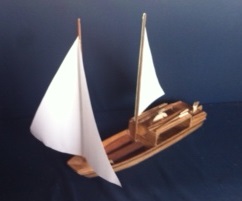
Plain sail Ljungstrom Ketch


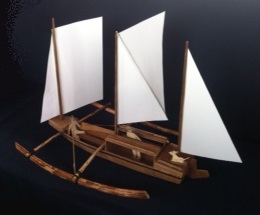
Long-haul tri-mode Schooner (As yet untried)


NOTE: Soon we'll tell you about the experience.

NOTE: Plans are being finalized... watch this space!

Friday, October 15, 2021

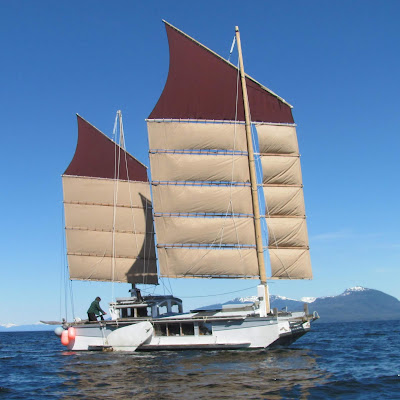
Cat Ketch WAYWARD's Prototype Split Junk Rig


S/V WAYWARD

Photo by John Herschenrider


In theory, theory and practice are the same.

In practice, they are not.

— Benjamin Brewster


It may work in practice;

But does it work in theory??

— Unknown


Cat Ketch WAYWARD's Prototype Split Junk Rig


General Approach


WAYWARD ex T32ft x 8ft x 1.25ft, is our box barge / scow, sailing live-aboard home. My wife, Anke Wagner and I sail engine free, year round in the archipelagos of SE Alaska.


Oh. And we’re lazy sailors.


Our cruising grounds are haunted by williwaws (sudden, fierce, katabatic or downdraft winds that roll off snow and glacier fields), and strong tidal flows that often entail sailing at night. Short, steep seas with plenty of fetch are common, as are swathes of water which can erupt on short notice into ‘dancing water’ riptides. ‘Haystacks’, fortunately, are rare. 


Long, narrow straits and ‘canals’ generally align the wind and seas.  Thus, we are usually sailing directly into it or with it. We find ourselves mostly close-hauled or broad reaching (to comfortably quarter seas).


Ultra-shoal draft, enginelessness and proclivity have us frequently sailing the poorly drawn and often rocky fringes of the chart. In these places, maneuverability and flexibility are much more important than optimal windward ability.


To meet these conditions, we have come to prefer a rather snug, Cat Ketch Junk Rig, ‘dumbed down’ to its bare essentials. 


We like ketch rig for its handiness. Its large sails toward the ends of the hull have several practical advantages:


  • Each sail strongly affects its end of the vessel, both while drawing and backwinded... this lets us turn on a dime in our own length, adjust balance and total CE as we please and sail backwards with ease.

  • Sliding backwards with mizzen backed and rudder reversed, we can reliably come to our chosen tack... this is useful sailing off close quarters anchoring, tacking or drifting (bow on), in about half a boat length, in all winds. Greatly reduces pucker factor!

  • The mizzen can be sheeted close or flat to hold the bow toward or into the wind… this is useful for treading water for a break, maneuvering or allowing traffic to pass.

  • Main sheets are clear of the cockpit and companionway… neither are swept when tacking or jibing.


  • Both masts are clear of the interior… elbowroom, and the bunk to ourselves!

  • The rig is redundant... Should we lose a mast, we can sail under main or mizzen alone (proven by experience), and jury rigging possibilities are much improved.

  • Each mast can be used as a crane for raising / lowering the other… this is very handy for hoisting one’s own petard.

  • Two masts can load cargo or an MOB at either end of the vessel… and we have holds at each end to match.

  • Two masts give a great place to hang a hammock...  8)


For years, we’ve flown flat cut, modified Hassler/McCleod sails. If twist is controlled to allow more in light airs and less in heavier winds, they performed quite reasonably well. We do need to sail somewhat broad on the wind when close hauled in order to sail well.


In our last boat, we reduced the HM upper panels to a single, mostly triangular panel with a deeply hollowed leech, emulating one of the many Polynesian crab-claw styles. 


These flat cut sailforms develop camber from their conic section under press of wind.. 


Pronounced leech hollow brings that panel’s CE (Center of Effort) toward the mast, easing weather helm. As the last sail standing in heavy going, this is an important feature (this will be enhanced by SJR’s greater balance).


Since the two sails enable adjustment of their total CE, there is no need to reposition either. This has a number of simplifying consequences.


  • Standing yard and batten parrels are sufficient to hold and position each sail on its mast. 


  • Our only running lines are one sheet and halyard per sail. 


The benefit is that we eliminate running yard-, luff- and boom hauling parrels, tack and sail downhauls. This significantly reduces handling, and minimizes potential fouling from loops of slack line when reducing sail. 


Sheets are single, aft led running lines of 6 and 5 part. Both are led to the cockpit from forward (we can maintain our forward lookout while handling all lines). Good mechanical advantage means no sheet winches necessary.


We sometimes clip temporary downhauls to batten parrels during heavy winds or special situations. The forward lift is running - to lift the forward end of the sail for visibility or drip control - and tied off on the boom, but is seldom used and may be considered standing for normal use.


In considering SJR and/or cambered rig, we were primarily hoping to improve our performance to windward, while staying within the same profile and priority on handling simplicity.


S/V POPPY

Photo from Slieve McGalliard

JunkRigAssociation.org


Split Junk Rig


Slieve McGalliard developed the Split Junk Rig (SJR).


In his approach, the balance of a junk sail (area forward of the mast) is ‘split’ from the remainder by a vertical gap. Forward are the ‘jibs’, and aft are what I’ll call ‘after panels’.


Upper panels may or may not be split.


All panels are generally cambered for improved aerodynamic lift. Camber is designed with an eye to, “a large entry angle to help produce high lift and a low exit angle to produce low drag” [from C and SJ by Slieve McGalliard]. 


In particular, jib panels are shaped especially full at their leading edges, achievable with the ‘angled shelf method’. 


Additionally, each jib airfoil is shaped with a lofted in sheeting angle relative to battens and after panels. This emulates the set of Bermudan style jibs.


The yard is generally drawn at a low angle, reducing vortex drag near the peak and stresses throughout the rig. The halyard and uppermost batten parrel fixes the upper panels’ position on the mast, letting the lower sail hang vertically.


Handling is limited to halyard, sheet and downhaul adjustment.


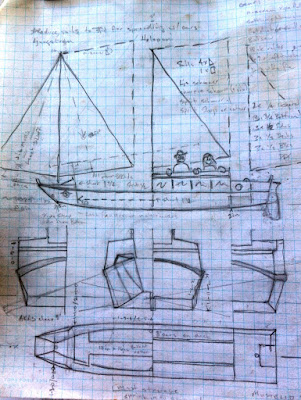
An early sketch with ‘vanity panel’ (didn’t make the cut)

 and triangular main heads’l...


Dumbing Down SJR for WAYWARD


We chose to test retaining a) flat cut upper panels (‘crab claws’), and b) a flat cut mizzen. 


Respectively, these likely, and surely detract from SJR and cambered performance enhancements. Yet for our situation, we consider the compromise to be attractive.


Flat Cut Mizzen (vs. Cambered Mizzen)


Flat cut sails are taut across their panels, so transfer stresses vertically along the whole panel, and do not allow diagonal movement. In contrast, cambered sails are slack across their panels, so transfer stress vertically along luff and leech (via roping) and allow diagonal movement.


Flat cut sails on canted battens develop positive batten stagger (upper battens overhang lower battens at their aft ends). Cambered panels have neutral stagger.


Flat cut sails do not flog when slack in the wind. Cambered sails do. When the vessel is tossed from side to side (e.g., when caught in a windless rip tide), cambered sails can ‘pop’ loudly from side to side.


Flat cut sails, when backed, get an immediate ‘bite on the wind’. In cambered sails, we suspected, the forward camber does not engage as soon when backed (later confirmed when backing the main), so require more deflection for a given effect.


In a flat cut mizzen, we value:


  • Extreme ease of construction with very little lofting… large spaces out of the weather are hard to come by and are usually only available for very short windows.

  • Positive batten stagger… this virtually eliminates sheetlet/block fouling. As our mizzen battens end flush with the transom and rather high, this feature is very helpful.

  • No flogging or popping… flogging is hard on the sail, our wa, and interferes with communications between crew. Popping is merely annoying as heck (to be fair, so are all the other aspects of being tossed about; that’s just one more).

  • Quick bite sail backing… small inputs to back mizzen and push the stern to port or starboard simplify and quicken maneuvers, which contributes to safety in tight quarter sailing.


Given where and how we sail, these features are worth quite a bit of enhanced, windward performance. Nevertheless, we prepared to experiment with a shaped mizzen.


All of these considerations apply to the main, as well, but for various reasons don’t weigh in as heavily. Flogging is only briefly tolerated, popping is further from the cockpit, fouling is more safely handled from the deck and backing of the main is seldom necessary.


Flat Cut Upper Panels


WAYWARD’s upper panels (‘crab claws’) raise the yard at a steeper angle than SJR standard. But their flat cut fabric transfers load along their entire run, from the yard to the uppermost batten.  


From There the lower sail (cambered portions) hangs vertically, supported by roping along fore panels’ luff (their leech is not roped) and after panels’ luff and leech.


We hoped, in effect, that yard, panel and batten work together as a very large ‘head board.’ 


As mentioned, the upper panels are the last sail standing. Their amount of camber can be reduced, when strapped down in heavy going, develop low but definite camber while completely avoiding flogging.


NOTE: This can be augmented by a temporary tack downhaul, working against the halyard to flatten the sail. To date, we’ve not felt the need.


Rigging


In most respects, we were able to rig as we have been doing (described above in ‘Background’).


To help top up the aft end of the yard, and encourage the forward swing of the sail, we placed the sling point slightly aft of center. 


Forward movement of the yard is limited by a short, standing yard parrel, which fetches up snug against the aft side of the mast, and runs long on the forward side.


Sail rotation is limited at the uppermost batten by a short, standing batten parrel. It fetches up snug on the aft side of the mast and short but loose ahead. In addition, this limits aft movement of the sail - even when deeply reefed - replacing a running yard hauling parrel.


Once the upper panel is in position, we tie short parrels at each batten. They may be short but loose as there is no apparent batten stagger whatsoever; once the upper panel is positioned correctly, reefing and set are purely vertical affairs. Their sole functions are to keep battens from blowing away from the mast, and as clip points for temporary downhauls.


NOTE: Most analyses of JR sail set focus on limiting sail position via the yard (sling point + yard hauling parrel) and the boom. This still allows the mid sail to rotate forward, which motion is often controlled by luff hauling parrels. It seems to me that limiting rotation at the uppermost batten of the parallelogram (rather than at the boom), controls the ‘high ground’. Everything hangs and mostly behaves below that point.


NOTE: There is a definite but finicky, optimal sling point… too far forward and the yard’s aft end sags; too far aft and the forward end dips below the sail bundle on lowering, presenting a danger to anyone on the foredeck. Look for that Goldilocks point!


NOTE: We had originally thought to hinge the yard and uppermost batten at their forward ends (see drawing, above). Together they would form a strut for better control of upper panel position, and yard dip when lowering. A model looked promising, but we decided to limit the number of new things we were trying at one time, and went with a more standard separation between the two.


Our Theory of Operation of SJR Main and Flat Cut Mizzen


In theory, a flat cut mizzen doesn’t point as high as SJR (or cambered).


This means that, if we point up to the SJR main’s optimum, we’ll pinch the close-hauled mizzen and lose its contribution to overall power. 


Alternatively, we can sail at the mizzen’s optimum and ease the main to match. This swings the main’s force vector forward, improving drive and reducing leeway, without sacrificing mizzen power. In effect, the main will be drawing on a close reach, while the mizzen is drawing close hauled.


Since our pointing was always acceptable to us, improved footing would be pure gravy. 


I’ll note again, however, that we have likely traded away potential performance for what we deem to be flat cut mizzen advantages for our situation.


Prototype Sails


We anticipate a three part main. Upper crab claws, stack o’ jibs and stack o’ after panels, each laced independently in place. But for the prototype...


We built our upper, crab claw panels as final. We laced them to yard and uppermost batten with marline hitches.


Materials are 8ozTopNotch for the upper panels (and eventually, final sails), and 8oz Weathermax. In retrospect, we would like to have made jibs and all lower panels from a lighter nylon, but TopNotch is already purchased and on hand. So it goes.


We increased the proportion of jib to after panels at 1:2 (balance =  33%), adjusted for our deck plan. This further eases sheet loading, and reduces both twist and weather helm when sailing off the wind. I suspect, it increases ‘clean air’ lift and drive from the jibs, as well. 


NOTE: This is in accord with Slieve’s recommendation after having sailed POPPY’s rig at about 1:3 (balance = 25%).


We didn’t anticipate experimenting with the jibs beyond Slieve’s initial specs, so linked them into a vertically contiguous stack of panels (rather than tied and individually adjustable).


The main after panels and mizzen’s panels were built as identical parallelograms (no rounding). 


We lashed the main’s panels Thai-style, but with lashing length varied to induce camber (simulating rounding). We made up a ‘tick board’, marked for distances every foot  from edge-of-cloth to batten for cambers of 4%, 8% and 12% of chord, and began with 8%.


NOTE: 8% camber is a moderate amount which appears to be favored by many offshore cruisers. Many inshore cruisers prefer more. Our inshore cruising seems to have more in common with offshore conditions (SE AK sea and weather conditions, engineless, liveaboard and on the move), so we started there. In particular, we are often tossed in  ‘slop and bobble’ rip-tides, in which cambered sails ‘pop’ annoyingly from one side to the other. 8% has been recommended by several experienced sailors as a tolerable maximum.


NOTE: Lashings were made of three round turns of tarred nylon seine twine, ending with opposing clove hitches around all turns, at cloth’s edge. This let the remainder rotate freely around battens. 


We laced mizzen panels flat and close against the battens. Only if the flat mizzen failed in sea trials did we intend to lash and play with camber options.


NOTE: If they had been available, we would have preferred doubled hook-and-loop strips on a heavy backing, as more quickly and easily adjustable.


Note the wide angular difference between main and mizzen!
Also, that we are still pointing rather high on the wind.


Sea Trials


Questions we hoped to answer in sea trials under prototype included the following: 


  • Is the anticipated gain from shaped sails worthwhile in our situation?

  • Can the flat cut mizzen ‘keep up’ with the SJR main?
    Will it draw at all when close hauled and pointing higher and/or footing faster?

  • Are the amount and distribution of camber too much or too little?

  • Are our dumbed-down rigging arrangements up to the task?


We sailed the prototype for over a year, across a route upwards of 500nm (as the Orca swims… not counting tacks, jibes and side trips). We sailed in estuarial, tight and open waters, flat waters to ‘Chatham chop” to about 15ft swell, against and with the wind from calm to about 55kts (we only tried beating into about 40kts sustained).


Results


Theory panned out!


The ‘head board’ idea seems to have worked out very well. As goes the headsail, so goes the rest.


Sailing ‘close hauled’ (mizzen close hauled; main sheeted high on its close reach; upper panels assuming varying degrees of conic section) we pointed several degrees higher than with both sails cut flat, and footed faster.


We clearly improved our windward performance. 


Off the wind, any gain wasn’t particularly noticable, but no complaints. 


NOTE: We weren't able to replicate the broad reach advantage Slieve reports. Our main luffed well before his when wung out so far. Possibly, this is due to our sheeting arrangement which has not yet been implemented to help eliminate twist? It would mean that, broad reaching, our boom would be oversheeted when the upper sail is drawing well; the lower sail would contribute less drive. At any rate, shaping did no harm, and additional performance with the wind has very low priority for us.


Tacking, including in tight quarters in flukey winds was reliable.


NOTE: Initially, in heavier winds of around 25+kts kicking a short, steep sea, we missed tacks. Turns out that we were strapping the main in a skosh too tight… once we learned to slightly ease the main, tacks became reliable.


Our ghosting was not noticeably affected. Our concern that unfilled, shaped panels would spoil our acceptable ghosting was unfounded. A ghoster, might still be in our future.


The broad set of the main (close reach) preserves a wider margin of effective sailing above our optimal course (i.e., while pinching). In tight quarters, this reduces demands for attention, handling and pucker factor. It’s the difference between sailing toward the upper end of capability, rather than at the upper edge.


NOTE: We could get the same effect with more drive by easing both SJR main and cambered mizzen in tight quarters. But given that we want a flat mizzen for other reasons, this was an unlooked-for gravy point.


The amount of camber (8% of chord) felt about right to us, and we felt no need to reduce camber from bottom to top. It’s ‘popping’ wasn’t too uncomfortable when misbehaving in a toss. It filled out in lighter breeze than the 12% panel, which on the whole felt like diminished returns for our style of sailing.


The only extra handling the SJR main incurred was the occasional clearing of fouled sheets. We didn’t dock the aft end of the lower panel, but plan to in the final sails which should ease fouling.


We sometimes tidy the reefed jibs into the forward lift (if gathered a little off, they can block the forward view under the boom… a better lift lead may fix this).


Conclusions


We’re very pleased with the results.


For our purposes, the SJR main and flat cut mizzen appear to work well enough together for our purposes, significantly improving our windward performance.


Handling remains simple.


Despite what I’ve written about the attractions of a flat cut mizzen, we’re still considering cambering it. Doing so can only further improve performance by empowering our laggard mizzen.


Cambering the mizzen would give us a chance to experiment with a flattening scheme in which brailing lines gather rounding along the battens when drawn up. This would likely be seasonal, set for the blustery months when a flat mizzen is most appreciated


So many possibilities; so little time!


ADDENDUM:


Since writing this, I’ve become aware that there is some concern regarding overbalance in SJR sails with balances nearing the top end of what Slieve McGalliard considers possible (35% of sail chord).


Overbalance, as I understand it, is too much sail area forward of the mast. The overbalanced whole may fail to weathercock (align with the wind) when sheets are let run. A tendency to failure would mean power cannot be reliably dumped in this manner, and rounding up may not be possible.


At 30.5% our SJR balance is nearing that top end, but is not yet extreme?


We can report absolutely no hesitation in weathercocking when sheets were let run beyond normal friction from the blocks. We noticed no difference in sheet responsiveness from our previous (flat cut) main, which had considerably less balance.


Relevant differences between typical SJR and ours include the following:


The higher peaked yard moves the CE of the uppermost panel aft, improving weathercocking.


Our sheets are six part vs. the more usual three, which induces more friction, impeding weathercocking.


Opened by Thai style lashings, our after panels had gaps running along each batten. As their maximum point of camber (and therefore of gap) was 33% of panel chord, I suspect the after sail’s CE was moved aft to some small extent. This would improve weathercocking.