Please visit our home site at www.TRILOBOATS.com.

Anke and I live aboard WAYWARD, and wrote about it's design and construction at ABargeInTheMaking.blogspot.com.

Access to the net comes and goes, so I'll be writing in fits and spurts.Please feel free to browse the archives, leave comments where you will and write... I'll respond as I can.

Fair winds!

Dave and Anke
triloboats swirly gmail daughter com

Showing posts with label Junk Rig. Show all posts

Monday, April 21, 2025

Metronomics: Understanding Roll


Note the weight positions... higher = slower ; lower = faster


Now roll on, Buddy?
Why ya roll so slow?
I gotta roll slow
With my weight so low.

-- Adapting a Folk Song

Metronomics: Understanding Roll

Being an Old Fart, I had the privilege of growing up with mechanical metronomes. Mechanisms - as opposed to algorhythms - that set and keep the beat.

Metronomes keep the beat, adjusting their tempo by sliding a weight higher or lower along a bar

Higher Weight = Longer / Slower

Lower Weight = Shorter / Faster.

Puts me in mind of the dreaded short and snappy roll that fatigues and throws crew around if not overboard. Longer, slower roll periods are desirable. Up to a point. Beyond that point, they can become self-reinforcing and enter 'death roll' dynamics. We're with Goldilocks... we're looking for a sweet spot that's juuuuuust right.

Being a sailor, I can't help but see roll dynamics in the metronome.

Bar = Mast
Weight = Rig's Center of Gravity (CG)
Axis = Hull's Center of Buoyancy (CB)
Counter-Weight = Ballast CG

Tempo = Roll Period

The connection is easy to spot. We can adjust roll period (by raising and lowering the Rig's CG while all other points remain constant.

A baseline is established by weight distribution along the mast, most likely at construction time. Hollow masts offer lots of options for messing with distribution via placing of  internal weights. Choice of hardware (e.g., masthead fittings, blocks, spreaders, etc.) for weight placement all count. Designers aim for one-size-fits-most.

Junk Rig is interesting... as the sail is raised, more weight goes aloft. Typically the yard is heaviest at the top, while battens average out(?) along the mast. The total effect is that more sail slows roll.

This suggests the possibility of elective roll period manipulation via weight that can be raised and lowered to adjust for conditions. The challenge would be a 'doohicky' which would observe these Thou Shalt Nots...

  • Not be difficult to deploy
  • Not interfere with the rig
  • Not swing wildly
  • Not be difficult to dowse
  • Not be difficult to stow
While giving a seriously positive return cost/benefit ratio-wise.

Clearly, the need for roll control will all have a lot to do with the roll dynamics of the hull in question. Low form stability (/easily driven) hulls will benefit more; Form stable (/it's complicated) hulls will benefit less.

How do you roll?

Friday, October 15, 2021

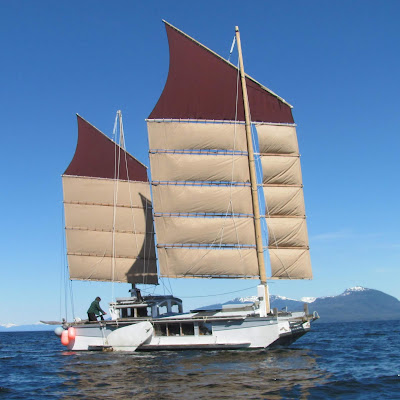
Cat Ketch WAYWARD's Prototype Split Junk Rig


S/V WAYWARD

Photo by John Herschenrider


In theory, theory and practice are the same.

In practice, they are not.

— Benjamin Brewster


It may work in practice;

But does it work in theory??

— Unknown


Cat Ketch WAYWARD's Prototype Split Junk Rig


General Approach


WAYWARD ex T32ft x 8ft x 1.25ft, is our box barge / scow, sailing live-aboard home. My wife, Anke Wagner and I sail engine free, year round in the archipelagos of SE Alaska.


Oh. And we’re lazy sailors.


Our cruising grounds are haunted by williwaws (sudden, fierce, katabatic or downdraft winds that roll off snow and glacier fields), and strong tidal flows that often entail sailing at night. Short, steep seas with plenty of fetch are common, as are swathes of water which can erupt on short notice into ‘dancing water’ riptides. ‘Haystacks’, fortunately, are rare. 


Long, narrow straits and ‘canals’ generally align the wind and seas.  Thus, we are usually sailing directly into it or with it. We find ourselves mostly close-hauled or broad reaching (to comfortably quarter seas).


Ultra-shoal draft, enginelessness and proclivity have us frequently sailing the poorly drawn and often rocky fringes of the chart. In these places, maneuverability and flexibility are much more important than optimal windward ability.


To meet these conditions, we have come to prefer a rather snug, Cat Ketch Junk Rig, ‘dumbed down’ to its bare essentials. 


We like ketch rig for its handiness. Its large sails toward the ends of the hull have several practical advantages:


  • Each sail strongly affects its end of the vessel, both while drawing and backwinded... this lets us turn on a dime in our own length, adjust balance and total CE as we please and sail backwards with ease.

  • Sliding backwards with mizzen backed and rudder reversed, we can reliably come to our chosen tack... this is useful sailing off close quarters anchoring, tacking or drifting (bow on), in about half a boat length, in all winds. Greatly reduces pucker factor!

  • The mizzen can be sheeted close or flat to hold the bow toward or into the wind… this is useful for treading water for a break, maneuvering or allowing traffic to pass.

  • Main sheets are clear of the cockpit and companionway… neither are swept when tacking or jibing.


  • Both masts are clear of the interior… elbowroom, and the bunk to ourselves!

  • The rig is redundant... Should we lose a mast, we can sail under main or mizzen alone (proven by experience), and jury rigging possibilities are much improved.

  • Each mast can be used as a crane for raising / lowering the other… this is very handy for hoisting one’s own petard.

  • Two masts can load cargo or an MOB at either end of the vessel… and we have holds at each end to match.

  • Two masts give a great place to hang a hammock...  8)


For years, we’ve flown flat cut, modified Hassler/McCleod sails. If twist is controlled to allow more in light airs and less in heavier winds, they performed quite reasonably well. We do need to sail somewhat broad on the wind when close hauled in order to sail well.


In our last boat, we reduced the HM upper panels to a single, mostly triangular panel with a deeply hollowed leech, emulating one of the many Polynesian crab-claw styles. 


These flat cut sailforms develop camber from their conic section under press of wind.. 


Pronounced leech hollow brings that panel’s CE (Center of Effort) toward the mast, easing weather helm. As the last sail standing in heavy going, this is an important feature (this will be enhanced by SJR’s greater balance).


Since the two sails enable adjustment of their total CE, there is no need to reposition either. This has a number of simplifying consequences.


  • Standing yard and batten parrels are sufficient to hold and position each sail on its mast. 


  • Our only running lines are one sheet and halyard per sail. 


The benefit is that we eliminate running yard-, luff- and boom hauling parrels, tack and sail downhauls. This significantly reduces handling, and minimizes potential fouling from loops of slack line when reducing sail. 


Sheets are single, aft led running lines of 6 and 5 part. Both are led to the cockpit from forward (we can maintain our forward lookout while handling all lines). Good mechanical advantage means no sheet winches necessary.


We sometimes clip temporary downhauls to batten parrels during heavy winds or special situations. The forward lift is running - to lift the forward end of the sail for visibility or drip control - and tied off on the boom, but is seldom used and may be considered standing for normal use.


In considering SJR and/or cambered rig, we were primarily hoping to improve our performance to windward, while staying within the same profile and priority on handling simplicity.


S/V POPPY

Photo from Slieve McGalliard

JunkRigAssociation.org


Split Junk Rig


Slieve McGalliard developed the Split Junk Rig (SJR).


In his approach, the balance of a junk sail (area forward of the mast) is ‘split’ from the remainder by a vertical gap. Forward are the ‘jibs’, and aft are what I’ll call ‘after panels’.


Upper panels may or may not be split.


All panels are generally cambered for improved aerodynamic lift. Camber is designed with an eye to, “a large entry angle to help produce high lift and a low exit angle to produce low drag” [from C and SJ by Slieve McGalliard]. 


In particular, jib panels are shaped especially full at their leading edges, achievable with the ‘angled shelf method’. 


Additionally, each jib airfoil is shaped with a lofted in sheeting angle relative to battens and after panels. This emulates the set of Bermudan style jibs.


The yard is generally drawn at a low angle, reducing vortex drag near the peak and stresses throughout the rig. The halyard and uppermost batten parrel fixes the upper panels’ position on the mast, letting the lower sail hang vertically.


Handling is limited to halyard, sheet and downhaul adjustment.


An early sketch with ‘vanity panel’ (didn’t make the cut)

 and triangular main heads’l...


Dumbing Down SJR for WAYWARD


We chose to test retaining a) flat cut upper panels (‘crab claws’), and b) a flat cut mizzen. 


Respectively, these likely, and surely detract from SJR and cambered performance enhancements. Yet for our situation, we consider the compromise to be attractive.


Flat Cut Mizzen (vs. Cambered Mizzen)


Flat cut sails are taut across their panels, so transfer stresses vertically along the whole panel, and do not allow diagonal movement. In contrast, cambered sails are slack across their panels, so transfer stress vertically along luff and leech (via roping) and allow diagonal movement.


Flat cut sails on canted battens develop positive batten stagger (upper battens overhang lower battens at their aft ends). Cambered panels have neutral stagger.


Flat cut sails do not flog when slack in the wind. Cambered sails do. When the vessel is tossed from side to side (e.g., when caught in a windless rip tide), cambered sails can ‘pop’ loudly from side to side.


Flat cut sails, when backed, get an immediate ‘bite on the wind’. In cambered sails, we suspected, the forward camber does not engage as soon when backed (later confirmed when backing the main), so require more deflection for a given effect.


In a flat cut mizzen, we value:


  • Extreme ease of construction with very little lofting… large spaces out of the weather are hard to come by and are usually only available for very short windows.

  • Positive batten stagger… this virtually eliminates sheetlet/block fouling. As our mizzen battens end flush with the transom and rather high, this feature is very helpful.

  • No flogging or popping… flogging is hard on the sail, our wa, and interferes with communications between crew. Popping is merely annoying as heck (to be fair, so are all the other aspects of being tossed about; that’s just one more).

  • Quick bite sail backing… small inputs to back mizzen and push the stern to port or starboard simplify and quicken maneuvers, which contributes to safety in tight quarter sailing.


Given where and how we sail, these features are worth quite a bit of enhanced, windward performance. Nevertheless, we prepared to experiment with a shaped mizzen.


All of these considerations apply to the main, as well, but for various reasons don’t weigh in as heavily. Flogging is only briefly tolerated, popping is further from the cockpit, fouling is more safely handled from the deck and backing of the main is seldom necessary.


Flat Cut Upper Panels


WAYWARD’s upper panels (‘crab claws’) raise the yard at a steeper angle than SJR standard. But their flat cut fabric transfers load along their entire run, from the yard to the uppermost batten.  


From There the lower sail (cambered portions) hangs vertically, supported by roping along fore panels’ luff (their leech is not roped) and after panels’ luff and leech.


We hoped, in effect, that yard, panel and batten work together as a very large ‘head board.’ 


As mentioned, the upper panels are the last sail standing. Their amount of camber can be reduced, when strapped down in heavy going, develop low but definite camber while completely avoiding flogging.


NOTE: This can be augmented by a temporary tack downhaul, working against the halyard to flatten the sail. To date, we’ve not felt the need.


Rigging


In most respects, we were able to rig as we have been doing (described above in ‘Background’).


To help top up the aft end of the yard, and encourage the forward swing of the sail, we placed the sling point slightly aft of center. 


Forward movement of the yard is limited by a short, standing yard parrel, which fetches up snug against the aft side of the mast, and runs long on the forward side.


Sail rotation is limited at the uppermost batten by a short, standing batten parrel. It fetches up snug on the aft side of the mast and short but loose ahead. In addition, this limits aft movement of the sail - even when deeply reefed - replacing a running yard hauling parrel.


Once the upper panel is in position, we tie short parrels at each batten. They may be short but loose as there is no apparent batten stagger whatsoever; once the upper panel is positioned correctly, reefing and set are purely vertical affairs. Their sole functions are to keep battens from blowing away from the mast, and as clip points for temporary downhauls.


NOTE: Most analyses of JR sail set focus on limiting sail position via the yard (sling point + yard hauling parrel) and the boom. This still allows the mid sail to rotate forward, which motion is often controlled by luff hauling parrels. It seems to me that limiting rotation at the uppermost batten of the parallelogram (rather than at the boom), controls the ‘high ground’. Everything hangs and mostly behaves below that point.


NOTE: There is a definite but finicky, optimal sling point… too far forward and the yard’s aft end sags; too far aft and the forward end dips below the sail bundle on lowering, presenting a danger to anyone on the foredeck. Look for that Goldilocks point!


NOTE: We had originally thought to hinge the yard and uppermost batten at their forward ends (see drawing, above). Together they would form a strut for better control of upper panel position, and yard dip when lowering. A model looked promising, but we decided to limit the number of new things we were trying at one time, and went with a more standard separation between the two.


Our Theory of Operation of SJR Main and Flat Cut Mizzen


In theory, a flat cut mizzen doesn’t point as high as SJR (or cambered).


This means that, if we point up to the SJR main’s optimum, we’ll pinch the close-hauled mizzen and lose its contribution to overall power. 


Alternatively, we can sail at the mizzen’s optimum and ease the main to match. This swings the main’s force vector forward, improving drive and reducing leeway, without sacrificing mizzen power. In effect, the main will be drawing on a close reach, while the mizzen is drawing close hauled.


Since our pointing was always acceptable to us, improved footing would be pure gravy. 


I’ll note again, however, that we have likely traded away potential performance for what we deem to be flat cut mizzen advantages for our situation.


Prototype Sails


We anticipate a three part main. Upper crab claws, stack o’ jibs and stack o’ after panels, each laced independently in place. But for the prototype...


We built our upper, crab claw panels as final. We laced them to yard and uppermost batten with marline hitches.


Materials are 8ozTopNotch for the upper panels (and eventually, final sails), and 8oz Weathermax. In retrospect, we would like to have made jibs and all lower panels from a lighter nylon, but TopNotch is already purchased and on hand. So it goes.


We increased the proportion of jib to after panels at 1:2 (balance =  33%), adjusted for our deck plan. This further eases sheet loading, and reduces both twist and weather helm when sailing off the wind. I suspect, it increases ‘clean air’ lift and drive from the jibs, as well. 


NOTE: This is in accord with Slieve’s recommendation after having sailed POPPY’s rig at about 1:3 (balance = 25%).


We didn’t anticipate experimenting with the jibs beyond Slieve’s initial specs, so linked them into a vertically contiguous stack of panels (rather than tied and individually adjustable).


The main after panels and mizzen’s panels were built as identical parallelograms (no rounding). 


We lashed the main’s panels Thai-style, but with lashing length varied to induce camber (simulating rounding). We made up a ‘tick board’, marked for distances every foot  from edge-of-cloth to batten for cambers of 4%, 8% and 12% of chord, and began with 8%.


NOTE: 8% camber is a moderate amount which appears to be favored by many offshore cruisers. Many inshore cruisers prefer more. Our inshore cruising seems to have more in common with offshore conditions (SE AK sea and weather conditions, engineless, liveaboard and on the move), so we started there. In particular, we are often tossed in  ‘slop and bobble’ rip-tides, in which cambered sails ‘pop’ annoyingly from one side to the other. 8% has been recommended by several experienced sailors as a tolerable maximum.


NOTE: Lashings were made of three round turns of tarred nylon seine twine, ending with opposing clove hitches around all turns, at cloth’s edge. This let the remainder rotate freely around battens. 


We laced mizzen panels flat and close against the battens. Only if the flat mizzen failed in sea trials did we intend to lash and play with camber options.


NOTE: If they had been available, we would have preferred doubled hook-and-loop strips on a heavy backing, as more quickly and easily adjustable.


Note the wide angular difference between main and mizzen!
Also, that we are still pointing rather high on the wind.


Sea Trials


Questions we hoped to answer in sea trials under prototype included the following: 


  • Is the anticipated gain from shaped sails worthwhile in our situation?

  • Can the flat cut mizzen ‘keep up’ with the SJR main?
    Will it draw at all when close hauled and pointing higher and/or footing faster?

  • Are the amount and distribution of camber too much or too little?

  • Are our dumbed-down rigging arrangements up to the task?


We sailed the prototype for over a year, across a route upwards of 500nm (as the Orca swims… not counting tacks, jibes and side trips). We sailed in estuarial, tight and open waters, flat waters to ‘Chatham chop” to about 15ft swell, against and with the wind from calm to about 55kts (we only tried beating into about 40kts sustained).


Results


Theory panned out!


The ‘head board’ idea seems to have worked out very well. As goes the headsail, so goes the rest.


Sailing ‘close hauled’ (mizzen close hauled; main sheeted high on its close reach; upper panels assuming varying degrees of conic section) we pointed several degrees higher than with both sails cut flat, and footed faster.


We clearly improved our windward performance. 


Off the wind, any gain wasn’t particularly noticable, but no complaints. 


NOTE: We weren't able to replicate the broad reach advantage Slieve reports. Our main luffed well before his when wung out so far. Possibly, this is due to our sheeting arrangement which has not yet been implemented to help eliminate twist? It would mean that, broad reaching, our boom would be oversheeted when the upper sail is drawing well; the lower sail would contribute less drive. At any rate, shaping did no harm, and additional performance with the wind has very low priority for us.


Tacking, including in tight quarters in flukey winds was reliable.


NOTE: Initially, in heavier winds of around 25+kts kicking a short, steep sea, we missed tacks. Turns out that we were strapping the main in a skosh too tight… once we learned to slightly ease the main, tacks became reliable.


Our ghosting was not noticeably affected. Our concern that unfilled, shaped panels would spoil our acceptable ghosting was unfounded. A ghoster, might still be in our future.


The broad set of the main (close reach) preserves a wider margin of effective sailing above our optimal course (i.e., while pinching). In tight quarters, this reduces demands for attention, handling and pucker factor. It’s the difference between sailing toward the upper end of capability, rather than at the upper edge.


NOTE: We could get the same effect with more drive by easing both SJR main and cambered mizzen in tight quarters. But given that we want a flat mizzen for other reasons, this was an unlooked-for gravy point.


The amount of camber (8% of chord) felt about right to us, and we felt no need to reduce camber from bottom to top. It’s ‘popping’ wasn’t too uncomfortable when misbehaving in a toss. It filled out in lighter breeze than the 12% panel, which on the whole felt like diminished returns for our style of sailing.


The only extra handling the SJR main incurred was the occasional clearing of fouled sheets. We didn’t dock the aft end of the lower panel, but plan to in the final sails which should ease fouling.


We sometimes tidy the reefed jibs into the forward lift (if gathered a little off, they can block the forward view under the boom… a better lift lead may fix this).


Conclusions


We’re very pleased with the results.


For our purposes, the SJR main and flat cut mizzen appear to work well enough together for our purposes, significantly improving our windward performance.


Handling remains simple.


Despite what I’ve written about the attractions of a flat cut mizzen, we’re still considering cambering it. Doing so can only further improve performance by empowering our laggard mizzen.


Cambering the mizzen would give us a chance to experiment with a flattening scheme in which brailing lines gather rounding along the battens when drawn up. This would likely be seasonal, set for the blustery months when a flat mizzen is most appreciated


So many possibilities; so little time!


ADDENDUM:


Since writing this, I’ve become aware that there is some concern regarding overbalance in SJR sails with balances nearing the top end of what Slieve McGalliard considers possible (35% of sail chord).


Overbalance, as I understand it, is too much sail area forward of the mast. The overbalanced whole may fail to weathercock (align with the wind) when sheets are let run. A tendency to failure would mean power cannot be reliably dumped in this manner, and rounding up may not be possible.


At 30.5% our SJR balance is nearing that top end, but is not yet extreme?


We can report absolutely no hesitation in weathercocking when sheets were let run beyond normal friction from the blocks. We noticed no difference in sheet responsiveness from our previous (flat cut) main, which had considerably less balance.


Relevant differences between typical SJR and ours include the following:


The higher peaked yard moves the CE of the uppermost panel aft, improving weathercocking.


Our sheets are six part vs. the more usual three, which induces more friction, impeding weathercocking.


Opened by Thai style lashings, our after panels had gaps running along each batten. As their maximum point of camber (and therefore of gap) was 33% of panel chord, I suspect the after sail’s CE was moved aft to some small extent. This would improve weathercocking.



Saturday, March 2, 2019

Building for Blue Water

Doesn't show furnishings, but this is a good, strong start


Once more we sail with a Northerly gale
Through the ice, and wind, and rain
Them coconut fronds, them tropical lands
We soon shall see again


-- From Rolling Down to Old Maui -- Traditional Whaling Song


Building for Blue Water

I want to be clear... I have zero blue water experience, don't particularly want any and am NOT a naval architect. What follows is a bunch of amateur musings. Please take following assurances with a grain of salt and practice due diligence!

I'm often asked about taking TriloBoats offshore. In a nutshell, I don't see why not if they are built for it and competently handled.

That being said, I doubt they'd be the best choice if purpose built for the briny deeps. Wide barge bows and transoms (unless SKROWLed or brought to a point a la NZ SCOWS) could be uncomfortable in big water confused seas. Still, a number of blue water sailors I respect have said they think they'd do fine with only a few days of slow going in certain conditions. And once you're back 'longshore, I think they're hard to beat.

At the less expensive, DIY end of the spectrum, I'd likely choose a MacNaughton SILVER GULL, Benford DORY or Bolger ADVANCED SHARPIE. Of course, I'd fiddle with the designs - mostly regarding keel and rudder arrangements - but these are good, proven starting points.

Building for blue water, I think entails extra robust construction. But really, not a whole LOT more. Or rather, inshore cruisers shouldn't generally be a whole lot less, to my mind.

Where glue can fail and a nail can pull, double-ended fasteners are as secure as it gets (bolts, clench nails, rove and rivet and double wedged trunnels). Plank and frame joined by these should be thick and hard enough to resist pulling the ends through. Tape n Glue joints are strong and waterproof.

Pete Culler's dictum was "Nail where you can, screw where you should and bolt where you must." For taking a boat offshore, consider promoting everything up a notch. Note that bolts are expensive while the other double ended fasteners are not. Time, however, can be money.

NOTE: A non-cargo box barge can be a very light displacement boat for its footprint as it makes the most of its dimensions. This means it rises over, rather than plows through a wave. Skitters rather than absorbs a blow from a sea. Most of the sea stress is in the lower couple of feet of side, and fore and aft. The hull is a girder, as are interior furnishings which can be bonded structurally with an eye to longitudinal and side reinforcement. Rubrails, guards, eaves and the like can also be structural in support of the side panels. Modern glues create a virtual wood sculpture of the hull. All considered, a very strong yet lightweight hull can be built without the heavy frames and scantlings of traditional construction. 

I like strong, doggable, centerline hatches (furthest from water in a knock-down), stout windows (they can be large, but with sea-going shutters to reduce their exposed surface) and 360deg, waterproof ventilation (a round turn in a vent hose is an easy solution).

Myself, I like retractable lateral resistance and rudder on an ultra-shoal draft hull. This leaves little to 'trip' on in a broach. This is controversial, and harder to arrange on the dories as designed.

I'd build a stout junk rig, able to take (running and removable) stays (these generate strong downward forces when sails are full of wind, and cantilevered masts are not generally designed to take that). UltraHighMolecularWeight Polyethelene rope (Dyneema, Spectra, et al) is about as strong as steel by diameter... even going oversized leaves a light, low windage rig.

I'd  incorporate stormsails into the upper working sails, with lighter lowers. Since they'd be stayed, I'd go for maximum junk spread of sail. Maybe have some light-wind drifters for the metaphoric doldrums.

I'd like good anchor gear to include sea anchor and drogue set-and-retrieval (I'm a Jordan Series Drogue fan wearing both hats).

I've waffled about offshore cooking/heating fuels for years, with no real results. I like solid fuel stoves (wood and coal) but those can be scarce. A diesel drip can be added to the firebox as can a gas cooker (propane or LNG). A single burner gimballed stove can be chosen that burns a range of liquid fuels or exchange with a gas burner. A Retained Heat Cooker would be a real plus. Basically, one or two multi-fuel gizmos cover a lot of possibilities.

That's about it. Pretty much the same list for adventurous in- and 'longshore sailing. We can count on wood heat and duck out of the really bad stuff. Inshore, seas seldom reach the 'walking mountain' stage, anyway, and then only with fair notice.

Make good decisions!

*****


Here's a selection of posts touching on this subject:


triloboats.blogspot.com/2012/01/are-shoal-square-boats-seaworthy.html

Thursday, April 12, 2018

A Look at Box Barge/Scow Sailing

SLACKTIDE sailing to windward in about 20 knots of wind.
For some reason, the fairly extensive white caps didn't show up,
and I apologize for the wind-in-mike effect.


If a pitcha's worth a thousand words, how much fer a movin' pitcha?


A Look at Box Barge/Scow Sailing

If one were to go looking for some video of cruising-sized, box-barge/scows under sail... well... it's thin pickin's.

Despite the fact that sailing barges and scows once carried a good deal of freight in Europe and North America, very little information as to how they sail is readily accessible (okay... google, right?).  One can only infer that their numbers prove they must have been able to compete against curvy dog rivals.

We had extensively sailed LUNA, a fine sailing hull modeled on Phil Bolger's AS29. It's a square sharpie... much like a barge, but with ends pinched in. It's full rocker sets it off from the large, mid-ships deadflat that help keep Triloboats relatively quick and easy to build, and was a common feature of the sailing barge/scows of yore.

We reasoned that the barge/scow form couldn't lag too far behind. But as a precaution, we built SLACKTIDE as a proof-of-concept before committing to WAYWARD, a full-sized liveaboard cruiser. After all, sailing engineless in SE Alaska, ya need to be able to get out of yer own way!

To make a long story short, box barge/scows sail reasonably well. We've had no problems going anywhere we wish, and that involves many places and situations most wouldn't care to take their sailing home, no matter its capabilities.

Things I note about box barge/scow hulls:
  • Heeled, they present a V to the water.
  • Upright, their entry is rather fine (directing water downward for lift, rather than parting to either side... this is true even with relatively abrupt bow curve).
  • Easier aft curves release water well and make for an easier driven hull.
  • More abrupt forward curves don't seem to hurt, and do seem to reduce pounding.

The videos embedded here allow a look at how three models sail. Cast of Characters as follows:

SLACKTIDE (26x7x1) is a Triloboat Junk cat-Ketch with rather abrupt end-curves, intended to prioritize carrying capacity over speed.

SPIRIT (36x12x?ft) is a Civil War Cargo Scow gone Blockade Enforcer, with easy lines prioritizing speed.

ALMA (60x22x4 is a San Francisco Hay Scow Schooner. Her lines are quite abrupt with a long deadflat, prioritizing heavy lading.

So here ya go... a movin' pitcha look at box barges under sail:


SLACTKIDE running under reefed sails in confused seas


SLACKTIDE close-reaching in light air.


SV SPIRIT sailing on several points.
Note the view of the bow waterline... not much fuss.


This hull, compared to the others, is a relative pig to handle, 
yet comes about slow but sure.

Tuesday, March 20, 2018

WAYWARD at Last

WAYWARD under sail...Photo by Peter Frost

Spring is sprung,
The grass is riz.
I wonder where
My paintbrush is?


WAYWARD at Last

Finally a picture of WAYWARD sailing!

The Lion of March has turned sheepish away up here in Warmsprings Bay (Alaska). Unseasonable warmth and light winds make for pleasant turns around the bay.

In this pic, we're approaching the dock.

The mains'l (forward) is close-hauled and the mizzen (aft) is eased in anticipation of a 270deg turn in probably fluky breezes. When the wind is forward, the main is trimmed to drive us, and we can haul the mizzen in with a hand on the boom. When the wind is aft, it's the eased mizzen which drives us with the fores'l blanketed. Either way, we have good control and a range of options without the distraction of over-hauling or -easing line.

Since it's a tight corner, we'll send one of us ashore in the dory to catch a line. Sail in, round up, tack and dock (in steady, onshore wind). Or, if it flukes us, we'll settle for sail in, round up, nose the dock and warp alongside (cranking the stern in with the sculling oar against the bow line if practical). If it had been woofy, we might drop an anchor, row a line to the dock and warp in.

The rig (split junk mizzen) is in prototype, right now. The draft is set via 'Thai Style' lacings between individual panels at 8%. This worked out perfectly, so we should have just built the full sail from the git-go without all those inefficient gaps. Oh well. Eventually, we'll change the sheeting geometry to flatten the mains'l leech... all required curvature is cut into the sail, so (unlike a flat cut sail) twist is detrimental.

Adding the curvy shape to the sail is considerably more work than flat cut, and it doesn't look its best in very light to no wind (sags). But it points considerably higher, or alternatively, draws more powerfully at any given windward point. Since the mizzen is flat, it doesn't point as high, and the main is accordingly drawing powerfully at a wider angle. The net effect, however, moves us along noticeably better.

Real sea-trials are quite a ways off, however. We'll have something substantial to report a year from now-ish, from a longer boat with a bigger, split junk mizzen.

Stay tuned!


*****

PS. The photographer, an experienced blue water sailor and delivery skipper came out with us the next day, and we turned command over to him.

His comment... this is the Cat's Ass!

This means a lot, to me... for all my years on the water, I've only once or twice sailed aboard another's vessel. Our boats are limited to a lifeboat conversion and a series of square boats, under-rigged by choice. So I don't have a lot to compare with.

Pete says the boat feels and handles well in the five or so knots of wind we had. I can vouch for the rest.

Not winning races, but hearts?