Please visit our home site at www.TRILOBOATS.com.

Anke and I live aboard WAYWARD, and wrote about it's design and construction at ABargeInTheMaking.blogspot.com.

Access to the net comes and goes, so I'll be writing in fits and spurts.Please feel free to browse the archives, leave comments where you will and write... I'll respond as I can.

Fair winds!

Dave and Anke
triloboats swirly gmail daughter com

Showing posts with label Aging. Show all posts

Saturday, November 1, 2025

Rigged for Success: LOM/Ljungstrom + Quick-Rig Booms


MUSTELID's LOM Main and Ljungstrom Foresail


Live life as if everything is rigged in your favor.

-- Rumi


Rigged for Success: 
    LOM/Ljungstrom + Quick-Rig Booms

I'd like to share a suite of ideas toward a family of lesser known rigs for smaller vessels that I think show a great deal of promise. Part historical, part convergent evolution, part innovation, the result is a simple but versatile, robust rig that can be DIYed at low cost.


Leg o' Mutton (LOM) Sails

This tasty moniker simply means a triangular sail. They're commonly used for headsails (jibs, staysails, etc.), mains (often called Bermudan sails) and drivers (small sails set far aft).


Ljungstrom Rig (2 x LOM)

Ljungstrom Rig uses a pair of LOMs, joined along their luffs and set on a free-standing, rotating mast. No booms were used to avoid troublesome impacts with crew.

This configuration works similar to twin head sails off the wind. From a beam reach on up, the sails are doubled over to one side and sheeted as one.

Pros:

  • Boomstrike is eliminated (the rig's original focus).
  • Light, inexpensive spares and gear.
  • Quick set/reef, roller un/furling via the mast.
  • Sailing off-wind, one side can be jibed for 'instant' 50% reef.
  • Sail area aloft catches higher, upper wind-flows.
  • Low Center of Effort (CE).
  • Twin sails tend to center down the wind.
  • Potential for hands-free operation.
  • Sail steering is straightforward (haul to the side you wish to sail).
  • UV resistant fabric along luff and foot eliminate sail covers.
  • At least in smaller vessels, the furled rig is easy to set and strike, and compact for storage.

Cons:
  • Lack of a boom makes spreading sail difficult (especially on narrow hulls).
  • No clew outhaul or vang options.
  • In contrast to twin stays'ls (unless the mast is canted) it generates no bow lift.

Adding a Boom

The addition of a boom set under a loose-footed LOM allows spreading, a clew out-haul and vang, addressing the main cons.

Interestingly, this approach was taken by both the Sea Pearl 21 (adventurously sailed by Stephen and Ginny Ladd, among others), and is marketed as Holopuni Quick-Rig (by Holopuni Canoes). Convergent evolution?

Both of these designs lead their clew outhauls via track along the top of the boom and sheets to the end of the boom. When the sail is reefed, the upward pull of the clew at mid-boom is resisted by the end positioned on the mast and the downward pull of the sheets at boom's end. 

As a sail's belly is blown full, pulling the clew strongly toward the tack, the boom resists in compression. If it is deflected from straight by the perpendicular pull of the clew between mast and sheet lands, that strength plummets. Usual solution? A heavy boom or one made with expensive, exotic materials.

Hmm.

What if we oppose sheet and clew tensions by having them meet at the same point? They cancel out, unloading the mid-boom! The clew outhaul - led to boom's end, then turned back toward the mast to the clew completes the picture. A rope grommet - travelling along the boom - is the perfect attachment point... simple, cheap and DIY.


Principle parts of the rigging...
This platform and 'collar' are primitive but functional

How We Go About It

Rotating Mast and Gear

In our small-ish boats, we went with a thumb-sized dowel protruding from the rounded bottom of the mast. This is inserted into a hole in its step - a fixed plate of thick HMD (cutting board plastic). This secures the foot but it allows it to rotate with very little friction. The upper partners are simply a loose-fit, fixed square around the mast. The distance between step and partners should be between 10% (minimum) and 15+% (healthy) of the mast's overall length for adequate cantilever.

A gate can swivel open to free one face for raising/lowering or close and lock to contain it. 'Box' sides at the step hold the foot in place for lowering. A pin led through one side and into a corresponding hole in the lower mast prevents rotation against high winds or rock and roll.

Each boom requires an arrangement that fixes their height above the partners, yet allows the mast to rotate independently. 

Our solution is a platform affixed to the mast with a collar from boom's mast end, around the mast, set above the platform... the collar is not so loose as to slip below the platform, but not so tight as to grip the mast.


Booms

Booms can be quite light as compression span decreases as the sail is reefed, and diameter per unit of span increases - functionally speaking, reefing makes them stronger. Further, they are subject to no significant side forces along that span. Sea trials help settle in on a light boom with comfortable margins of safety.

Each boom has a rope grommet loosely fit around it (sized so it doesn't bind when pulled at a flat angle). 

We fix a pinch cleat for the clew outhaul at the boom's mast end, pinch horn down (10deg) toward the distal end. This allows the line to ride over the non-pinch horn (up and toward the mast), under control hands-free as it pays out while furling.

A ring seized to the distal end of the boom turns the outhaul back toward the grommet.

The outhaul leads from its cleat, through the grommet (helps control a slack outhaul) to the turning ring, and back to the grommet. We fix it to the grommet's upper side, allowing a tail which is tied to the clew. We prefer little play between clew and grommet.

The sheet is fixed to the grommet's lower side and led to deck level. A turning device (multiple or travelling for an improved lead?) leads it toward a clear, handy to the crew. We prefer enough friction on the cleat to hold in steady wind but ease in heavy gusts... no lock hitch.


Sails

We used light nylon fabric to build flat-cut sails. These are responsive, and furl neatly around the slightly tapered masts. They are stretchy enough to take on some belly (camber) when full of wind.

Downside is that camber can't be flattened easily in high winds. But reefing is so easy, we can reduce power that way.

For 2xLOMs we screwed the webbed luffs to the mast, but are now considering a pocket for easier installation and removal. Others have found that a simple lanyard from tack to mast is sufficient for furling.


Handling the Ljungstrom

We set the Ljungstrom sail well forward, where it can pull us bow down the wind. 

We don't typically vang our sails to flatten them. Instead, we vary the sheet leads and/or reef a little more than we might. This avoids extra gear, handling and the heavier booms required. Personal call, however. 

Furled Set Up

When furled, the sail is snugly wrapped around the mast. The boom(s), if any, are vertical. Sheets are left slack and hanging. One clew outhaul is marline-hitched once or twice along the mast, securing all the bits, then made fast at its pinch cleat (low).


Setting Sail

Unhitch the outhaul, then refasten to its cleat. Uncoil sheets and lead aft to their cleats. Both outhaul and sheets will go slack as the sail is unrolled. Unpin mast if locked.

Depending on wind, you might wish to round up. For downwind departures, you may have to work in stages, trimming sheets as you go.

Unroll the sail by rotating the mast (we prefer 'righty-tighty; lefty-loosey' as standard... we do this by hand, but various rope windings are possible).

Once unfurled as far as desired, haul the outhaul(s) for the curve you wish, then make fast. Trim sheets and fall off to heading. Backing sail is easy and effective. If you wish to open the sails, do so.


On the Wind

Here the sails are overlapped and are sheeted as one (outer one generally the focus of our attention). They handle pretty much as any boomed LOM.

Off the Wind

Sailing off the wind, the sail is typically balanced like a delta kite. All things being equal, it want s to hold the bow centered downwind. More belly is often a good trade-off against more area.

To steer using sail, haul the sheet on the side toward which you wish to turn (easy, now!). This shortens its force vector and directs it to that side. The opposite sail, now relatively stronger and with a longer lever-arm, works to rotate the hull that-away. Like the reins of a horse!

In a heavy gust, you have a 50% reef at hand. You can jibe one sail (lapping one over the other) or let it fly (this can be harder to retrieve... get a wide angle). But if this comes up, consider roller reefing ASAP. Consider that, in high winds, you don't have to set them wing and wing... they sail well as one.


Odd Situations

If a sudden squall has invited letting both sails fly (they're trailing down the wind from the bow), calmly roller reef until you can bring them in and under control.

If such a situation has reversed their usual sides, don't panic... just hand the sheets around the mast, or refasten them for a fair lead and carry on. The sails won't care.

The whole mast, sails and all, can be furled, hitched up and let over as a sea-anchor.

All in All

We found these LOM/Ljungstrom + Quick-Rig Booms to be simple, cheap, versatile and powerful. Each piece is DIY-able from scavenged materials. Nothing about them couldn't be made in the field, at a pinch.

The lightness of the spars is a BIG advantage, especially as we age. The masts should be manageable for as long as we're likely to be able to row.

In researching the history of the rig, the few who have used it are soberly impressed by its virtues. It is not the fastest rig out there, but its no slouch, and pays its way with easy handling and quick reefing.

I'm hoping to see more of these on the water in the coming years!


Full Ljungstrom / Reefed LOM
Sprit-Boomed LOM Aft


References

Sea Pearl 21 Review by Josh Colvin

About Holopuni Canoes by Nick Beck

Rigging MUSTELID and MUSTELID Voyage by Anke and Dave


Sunday, December 11, 2022

Time's Winged Chariot. Hopefully.

MUSTELID
24ft x 5/4ft x 6in
~1000lbs dry / ~2000lbs loaded

Returning from the Venture

Photo by Bruce Simonson


Time keeps on slippin’, slippin’, slippin’

Into the future…


– From Fly Like an Eagle by Steve Miller


Time's Winged Chariot. Hopefully.


I’ve been musing aloud, as it were, in posts about sailing against the entropic wind (aging).


We want options for less demanding sailing. AND we don’t want to wait too long to get them in hand.


So we worked out a plan, built a vessel (S/V MUSTELID), and took it out for a spin. Four months and upwards of 500nm later we’re pleased with the results. Despite several stretches of conditions we wouldn’t have chosen to venture into, she took all in stride.


The trip included some big water passages with wind ranging from calm to about 35kts (in sustained gusts) and seas from flat to about 10ft (max, over 7ft predominant). Despite bouts of cotton mouth and some pucker factor, it felt safe and capable in every situation. 


Mostly, though, there was a lot of reasonably efficient rowing over flat water. At a relaxed saunter, we moved along at 1.5kts. A sustainable, all-day pace averaged about 2kts (longest day was about 14hrs rowing!). In a sprint we moved along about 2.75kts (we could keep this up for about an hour before falling back to sustainable). Accordingly, our strategy was - as expected - to generally row in light conditions or wait for a fair wind.


All told, the smaller vessel was able to take us faster / farther with less effort than our larger cruiser. Lost in trade were the full comforts of home for the adequate comforts of a camper-cruiser. Most of the trip we foraged hand-to-mouth with a backbone of carbs, which let us sail remote for extended periods, beyond what we could carry in provisions.


*****


Our priorities for the design were as follows:


  • Cheap and easy construction (‘cuz… well… we’re cheap and easy!)

  • Positive buoyancy (best way not to go down with the ship is don’t let the ship go down!)

  • Decent, high stability sailing (our waters are cold… we don’t want to flip)

  • On-board self-rescue (if we do suffer knockdown, we want to right it from on-board)

  • Good carrying capacity (to carry food and tools for extended trips)

  • Decent rowing (the wind is free; our hp ain’t)

  • Retractable rudder / LR (easy beaching)

  • Good offwind sailing (under easy to stow and handle rig)

  • Some onwind sailing (ditto… any windward ability is gravy)

  • Allowance for outboard motor (who knows?)

  • Shelter aboard without set-up (torrential rains after long days)

  • Wood-fire galley (dry heat, fuel gathered as we go)

  • Double berth (important for couples)


After much juggling and balancing, we came up with:


  • Flattie’ hull (flat bottom, moderate flare, moderate full-length rocker)

    • Sampan bow (good foredeck, easy, secure beaching)

    • Parallel runs aft (easy construction above and below sheer)

    • Spread chines (increased stability, displacement, interior volume)

  • BIRDWATCHER aft cabin

    • Fixed shelter (no need to set up dry quarters, improved heat retention)

    • High reserve buoyancy (for knock-down recovery)

    • Telescoping hatches (mount large PV array)

  • Water-tight stowage fore, aft and in cockpit (positive buoyancy)

  • Double station rowing cockpit with rolling seats (efficient, open-air rowing)

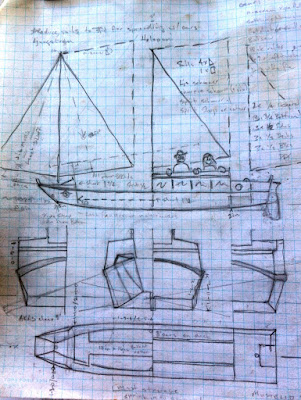
  • Ljungstrom / Holopuni Quick Rig extensible hybrid (easy set, strike, reef, handling)


There’s a lot more - this boat got mutted with years of ideas accumulated over the years - but this’ll do for now.


The upshot is, we met or exceeded all of our expectations, and got some insights toward improving windward sailing (which was unexpectedly worth improving!).


At the design level, we were quite happy with trade-offs (compromise among opposing values).


The hull design is 'tightly coupled'. For example, increasing the carrying capacity (as we might wish), would ramify throughout the hull, impacting several other priorities. Deepening draft would exceed the 2ft side panel limit (materials savings) or reduce freeboard (reducing reserve buoyancy, changing oar angles), reducing forward flair and increasing sleeping platform curvature (hard on the back). And though we might wish to carry more on occasion, the half-ton we have proved ample.


In particular, the flared hull was a departure for us from vertical sides. But in this case, it allowed higher ends and rocker on a narrow panel, added spray deflection for the low sided, open cockpit and preserves reserve buoyancy despite narrowing toward the bow (reducing windage and wetted surface). It adds reserve buoyancy from about mid-ships aft, flaring as it does from the full, 4ft bottom. As a bonus, the flair is much more comfortable to lean against within the minimal interior, and gives extra elbow room at sheer level. All in all, we feel this paid for itself for this particular design.


If we were to change one thing, we would consider making the transom vertical. It's 12deg rake looks better (vanity) and accepts a square motor mount (marginal advantage). A vertical transom would allow aft beaching legs for leveling the boat on a sloped beach, increase the waterline length (marginal speed / displacement / stability increase) and simplify construction.


Rig-wise, we added a small driver aft to help keep the bow into stronger winds while rowing into them. This reduced steering effort from the sweeps, freeing them for the power stroke. Otherwise, the tendency was to blow flat, perpendicular to the wind.


Odd ideas that worked out well:


  • OffCenterBoards stow inboard, vertically against the sides. At anchor, they may be laid flat on cockpit cleats to form a large platform for outdoor workspace, sleeping or picnic.

  • A longitudinal locker / seat, cleated P&S, allows rolling seats for leg-powered rowing. These were DIYed ‘double-rolling’ style without bearings (which are vulnerable to salt water).

  • ‘Spacered outwales’ were built heavy to take ‘accessorized’ mounts for cleats, OCB hangers, whipstaff, and what-have-you.

  • Six identical sails are leg-o’-mutton (triangular) and join along luff and leech for a variety of sailplans, tarps or tipis. Worked well for the most part… might upgrade to a shaped mid-ship sail for improved windward ability.


*****


Looking back, the high count of cockamamy ideas not only worked individually, but worked well together. 


The fixed shelter eased the ends of long days and made a fine hang-out during the generally cool, wet summer, punctuated by several ‘atmospheric rivers’. It’s rocket stove heated the cabin quickly and safely and cooked many’s the delicious meal. While we never had to try its self-righting feature, it was several times reassuring to know it was at hand.


Our hope is that with this vessel as our older-age auxiliary, we’ll be able to use it as a forager for our cruising home which we expect in turn to become more sedentary over the years. This trip proved to us that  the smaller vessel gives us a high bar for adventure while we’re able, with plenty of room to downsize as ability declines.


Time will tell!


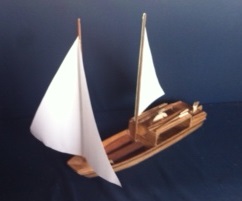
Plain sail Ljungstrom Ketch


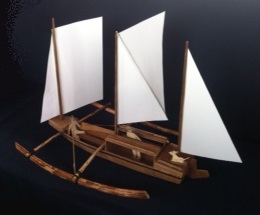
Long-haul tri-mode Schooner (As yet untried)


NOTE: Soon we'll tell you about the experience.

NOTE: Plans are being finalized... watch this space!

Sunday, January 23, 2022

Time in Town


Mainstreet Tenakee
by Ari Snider

You are summer to my winter heart.

-- Gemma Troy


Time in Town

It’s been a while since we’ve sailed into a town from out there. Could be we’re a little ‘bushy’.

We sailed into Tenakee Springs - our home port - in mid-December after three years sailing the wide waters between the communities of SE Alaska. Or not sailing, but hunkered down in the early pandemic. Or not hunkered but building a micro-cruiser. Or none of the above, but just enjoying the shelter and bounty of a beloved estuary.

This is an ever more distinct pattern for us… ever longer stretches out punctuated by a relatively short while in

Town time is time to reconnect with friends we may not have seen for a decade or more. Most folks are pretty local. If we don’t see them in their town, we mostly don’t see them. While we’re out and about, they and their communities interact and continue forward together. 

Our view is something like a series of snap-shots… string ‘em together and it can be a rather jerky, (non)stop-action story of entropy and renewal.

Children leap into adulthood; many moved away. Some have newish children for us to meet; from babes-in-arms to fully formed little individuals with strong opinions of their own. Young adults are now pillars of community. The middle aged are gone gray. Elders become old or have crossed the bar.

It’s a like a chronic case of Rip Van Winkle syndrome, who slept a hundred years and woke to an unfamiliar world, but in smaller naps.

Our town has grown smaller. It’s winter population is down to about 80 souls (a half from when we first arrived, a quarter century back). The handful who share the chores of community are that much more attenuated. The vacation homes of those who live elsewhere are shuttered and dark, affording no entry for the new blood of young arrivals.

We pitch in as we can.

In the coming decades our trend will reverse, and our range will contract. This inlet and town will slowly become our extent, with fewer forays into the wider world. We’ll localize. A process we accept as natural, and hope to keep joyous.

This winter’s time in this town is for the pleasure of friends, old and new. To knit our various lives a stitch closer. A time for music and good cheer among more than ourselves. A chance for re-supply. For maintenance. For communication. For rest.

An investment in both our present and our future.


Wednesday, April 14, 2021

OVERVIEW: Being Mortal by Atul Gawande


Words to live by.
Words to die by.

Really, what's the difference?

Being Mortal by Atul Gawande

See also this review by Maria Popova

All boldface below are quotes from Dr. Gawande's book.

In Being Mortal, Dr. Gawande writes:

This is a book about the modern experience of mortality -- about what it’s like to be creatures who age and die, how medicine has changed the experience and how it hasn’t, where our ideas about how to deal with our finitude have got the reality wrong.

Our main take-aways from the book:

Quality of life is preferable to mere quantity for the vast majority of us.

Care should be determined - in discussion with one’s family, doctors and care-givers - by asking...


  • What is our understanding of the situation?

  • What do we fear?

  • What do we hope for?

  • What are the trade-offs we are willing to make?

  • What are the trade-offs we are not willing to make?

  • What is the best course of action which serves this understanding?

Consider, answer and communicate, if possible, before the onset of care…

  • Do you want to be resuscitated if your heart stops?

  • Do you want aggressive treatments such as intubation and mechanical ventilation?

  • Do you want antibiotics?

  • Do you want tube or intravenous feeding if you can’t eat on your own?


Hospice approaches and attitudes appear to serve the terminal patient much better than standard medical interventions.

In the Epilogue, Dr. Gawande writes:

We’ve been wrong about what our job is in medicine. We think our job is to ensure health and survival. But really it is larger than that. It is to enable well-being. And well-being is about the reasons one wishes to be alive. 


Those reasons matter

not just at the end of life,

or when debility comes,

but all along the way.


Friday, February 12, 2021

Love Among Mortals

Photo by Silke Schmidtchen


You think you have time.

-- From Buddha's Little Instruction Book by Jack Kornfield


Love Among Mortals

Facing Death is transformative.

Somewhere, in the back of our minds, we all know - in a general kind of way - that we are mortal. But then a moment comes when we look Death in the eye and know it for ourselves... for our Beloved... and that knowledge becomes both specific and immediate.

For me, such a moment marks the very beginning of our One Precious Life. 

As sailors in a wild and wooly place, Anke and I live with perhaps a closer view of Death than many. We often sail near the edge, and far from any hope of help should we fail dangerous.

This last autumn, we had a wild passage, where Death was grinning over our shoulders right along, breathing down our necks. It started with a small thing - a jammed block. So many deadly outcomes are the end of a series of small steps inching, then leaping toward disaster. We were able to manage our issues and all was, in the end, well.

But it was another reminder that - even in the mundane day to day - Death can come for us.

And now Plague walks all the lands of the world.

A time of pandemic binds us all in a moment of the awareness of our mortality. The last century has brought humanity a growing understanding of disease in its causes and cures. Yet we remain stubbornly mortal, and a tiny molecular machine - devoid of hope or malice - reminds us collectively of that fact.

For some, inevitable Death sucks all meaning from Life. For others - count me among them - Death is that dark background against which all life is luminous. It's proximity reminds us to live. NOW.

And what is the one thing worthwhile? That one thing to pursue with all the resource of our One Precious Life?

If you ask me, it's Love.

Power? Pffffft. Fame? Sic transit. Stuff? Can be useful but can also own us and weigh us down. Wealth? You know what it can't buy. 

We think we have time... let's assume we don't, and start living. Start loving.


Happy Valentines Day, all ye Young Lovers! 

(And that includes you, my fellow Elder Farts!)

Thursday, December 24, 2020

Storm Tactics: Inshore

Carved handrail from S/V TANTRA
by
Ried Stowe


You can't stop the storm, so stop trying.
What you can do is calm yourself.
The storm will pass.

-- Timber Hawkeye


If you think it might be time to reef, it's time to reef!

- Sailor's Wisdom


Storm Tactics: Inshore

In life and sailing, storms overtake us.

Most often, if we pay attention, we have some warning before their onset. In rare cases, they pounce like a cat upon a mouse. We're the mouse, at least in scale. Unlike mice, we have a range of tools to meet the storm.

NOTE: When I say storm, I'm speaking of high winds in general. Our standing policy is to NOT be on the water in full storm conditions or worse. Despite this, we occasionally find ourselves caught by surprise.


Foundation

These are things I recommend which underlie a successful response to storm conditions:

  • Prior Knowledge... Knowledge and skills acquired ahead of crisis are priceless!

    Learn what you can before exposing yourself to storm...

  • Trained Crew... and train up all who sail with you.

  • Sound Vessel... Robust construction and maintenance, uncluttered decks, capable and easily reefed rig, good anchors with ample rode.

    Without these, any ship is at risk in any weather. When Storm comes with its long boots on, meet it with all head and hands on a stout deck!
 
 
Rules of Thumb

We use a small heap of rules-of-thumb to help us along our way:
  • Fail Safe vs. Fail Dangerous
  • Preserve Options
  • Layer Redundancies
  • Maintain Margins of Safety
  • Act Decisively
  • Develop Standard Operating Procedures
  • Develop Communication Protocols
  • An Ounce of Prevention is Worth a Pound of Cure
  • Get Out of the Wind, Stupid!
  • Avoid Smug
  • Manage Fear and Panic
I go into these at more length here.


Storm Tactics

  • Batten Down - Secure your gear inside and out, dog down hatches, dress for the weather and clip in. MOB (Man Over Board) in storm conditions is a very long shot, no matter how well drills have gone. Stay aboard!

    NOTE: Make sure your harness clips are short enough to keep you out of the water. The USCG warns that a person being towed in the water cannot clear their head to breath from their own bow wake from about 4 knots. We lost an acquaintance that way... his crew didn't know to round up and stop the vessel.
     
  • Reef Early - Reduce power before you are over-powered. Sail handling is easier and you'll be more comfortable and safer on deck.

  • Reach or Run for Shelter - Shelter ranges from protected coves, to the lee side of islands or points, to mere outcroppings that break wind and especially waves. Consider heading into the best shelter available before conditions deteriorate.

    It's important to note that, while wind can be unnerving, it is wind-driven water - weighing a ton per cubic yard/meter - which can toss your boat dangerously. Interruption of seas driven over a long fetch (open stretch to windward) will give your anchors the best chance of holding. Reefs, spits, and even thick kelp beds can provide effective shelter even as the wind whips over them.

  • Consider Quartering the Seas - Quartering (angling across them at about 45deg) gives a much easier ride in large or closely spaced waves, both for boat and crew. This generally means sailing close-hauled or broad reaching.

  • Consider Heaving-To, Sailing Backwards and/or Drag Devices - These are more often used offshore, but they have their place inshore. They help keep the bow up to wind and waves. You can adjust position to a degree by crabbing (backing or balancing sail to edge to port or starboard) without re-establishing full sailing trim.

  • Look Around and Enjoy the Storm - I mean, they are magnificent! As long as we're fool enough to be caught out in one, we may as well enjoy it.
 
It Was a Dark and Stormy Night

We've just completed a winter passage - under press of calendar obligations - that pretty well kicked our butts and tried our mettle. So all this is pretty fresh.

A mere 80ish nautical miles as the fish swims, we started out with winds which, unforecast, edged into gale force. Turns out that our main halyard had jumped a sheave and jammed... we could neither raise nor lower sail. 
 
Fortunately, it jammed in deep reef position... low gear, as it were.
 
Unfortunately, before we had reached a place to pull in, the wind first died to nothing, then turned foul. 

Fortunately, we had shelter behind us and ran for it.

Unfortunately, that shelter had its own katabatic blowing from it over the ebbing tide with river outflow... with our short sail we couldn't sail in.

Fortunately, after heaving-to in a lee all night, the wind returned in our favor, and we again sailed for our destination.

Unfortunately, the forecast called for gale with storm force gusts due before we could possibly arrive.

Fortunately, there was a small hook of shelter right at hand. We know it from years back and call it Whoa Nellie Nook (Nooks protect from North). It has a good lee, a protecting reef and good holding. So we sailed in, set anchor and got our sail (mostly) working again.

Unfortunately, our lee was SO good that a back-eddy of breeze blew us toward the beach as we slept (contrary to the wind that was howling about four boat-lengths from our position)... we whunkered down onto a rocky bottom as the tide ebbed.

Fortunately, the rocks were pretty round. We buffered with some wood cut ashore and lifted off again after several hours and re-anchored.

Unfortunately, the next morning's wind was blowing into our nook (the opposite was forecast).

Fortunately, there was a bit of sand off our protecting reef and we could kedge out and sail on.

...

That was two nights and three days of a five week passage. I won't subject you to the rest, but will merely note that we only got two full nights of good sleep in peace and quiet in all that time.

Looking back in appraisal, we find the following:
  • We need to ditch time-bound commitments, especially in spring, fall and winter.

    Each time we commit to some deadline (for a job, for instance) our decisions become influenced by calendar pressures. We're reluctant to back-track and give back hard-won miles. We trim our margins of safety and head out into smaller, less reliable windows. We push fair winds, tides and daylight hours, which can erode our rest and recovery. All together, we take on higher risks to honor our commitments.

  • We need to increase redundancies in some areas.

    For instance, we have a spare block with halyard on our mizzen, but haven't yet arranged one for the main. This turned out to be an ELE (Exctinction Level Event) on this trip (the jammed halyard could possibly have set off a lethal string of consequences).

  • We need to be more skeptical of weather forecasts in high wind seasons.

    Time and again, we sailed or anchored in conditions which proved contrary to the forecast. In one case, this could have cost us the boat (our sheltered anchorage became dangerously exposed in a 180deg mis-forecast blow).

    Area forecasts cover large areas, and 'predominant winds' is a squishy concept. Worse, we were mostly sailing between one weather system that reaches up into the Yukon (Canadian) interior and another that opens on the Gulf of Alaska. We're learning to look up and take the whole chain into consideration, rather than rely on more local forecasts. This is especially true when updating forecasts flip-flop in wind direction and/or strength.

    NOTE: To be fair, SE Alaska is made up of what we call geographical wonders (local places which alter, amplify or diminish weather patterns). Forecasting the weather - both for pros and amateurs - is notoriously difficult.

    Weather data collection points are few and far between, and are often in sheltered or compromised locations (e.g., at points between two weather systems or in towns whose location was selected for sheltered weather). Models and forecasts based on these data are accordingly unreliable.


    Furthermore, a warming planet increases the discrepancies between models (based on historical data) and the real, emerging world. Winds are tending stronger and less predictable across the board. We need to increase our weather pessimism accordingly.

  • New technique for anchoring in marginal lees:

    Our problem at Whoa Nelly Nook was that, as the tide came in, our protecting reef covered and wrap-around waves sideswiped us badly. So we anchored in very close to the beach and ended up too close.

    The remedy for similar spots - now SOP - is to set two anchors aft against potential wind reversal and one or two high on the 'windward' shore. Tend the vessel with the tide to position close in the protected lee of wind and wave, then out as the tide falls and protecting reef uncovers.

    UPDATE: Given a more recent experience sheltering from Force 11 winds in which a backwind clobbered us briefly, we're now making sure to set our BEST anchors aft and lesser anchors/shoreties set into the lee!
     
  • We're approaching a decline in physical ability.

    This trip was physically demanding. Long hours on deck. Sails and (multiple) anchors up and down. Sculling long distances. Kedging. Swamped dory and recovery, and lots of bailing, often in rough conditions underway. Jury rigging gymnastics. And so on. Meanwhile, we're at the further end of middle age, and looking downslope.

    We're already planning a small, camper-cruiser for high mobility with less physical input. In coming years, we will be sailing WAYWARD less, and in less challenging windows. We are mulling adding an engine down the road (diesel/electric, possibly yawl-boat mount?).
*****
 
Sooo... we loved this trip for all its challenges. It kicked us hard, but there is no living like that at the edge in a gorgeous seascape of stormy wilderness. But all good things...

As Joan Baez sings the poem by Lord Byron:
 

So, we'll go no more a roving

  So late into the night,

Though the heart be still as loving,

  And the moon be still as bright.


For the sword outwears its sheath,

   And the soul wears out the breast,

And the heart must pause to breathe,

   And love itself have rest.


Though the night was made for loving,

  And the day returns too soon,

Yet we'll go no more a roving

  By the light of the moon.


Not there, yet, but we can see the storm ahead. Time to be thinking of shortening sail.

Saturday, August 15, 2020

Running Downwind: A Jibe in Time

Too much, too long, too late?


But at my back I always hear
Times winged chariot hurrying near:
And yonder all before us lye
Desarts of vast Eternity.

-- This and italicized quotes below from To His Coy Mistress by Andrew Marvell


Quality of life is preferable to mere quantity for the vast majority of us.

-- From Being Mortal by Atul Gawande


Running Downwind: A Jibe in Time

Was a time I was pretty much satisfied with putting one foot in front of the other.

You know... plod along the path of life in pursuit of the dream. Uphill all the way, with the peak somewhere well ahead. Vistas opening wide in all directions. And what hurry? There is world enough and time.

Somewhere in there, the 'peak' comes and goes. 

Now, I'm not one who believes in an apex of life. Rather, that the entire journey comprises our One Precious Life, and that be yum. But I do acknowledge that time's winged chariot is careening down a cul de sac. Windows of opportunity are edging toward closed. Somewhere not far ahead lie those Desarts of vast Eternity.

At a mere three score years, I yet see time's imprint more than feel it. But the next will likely see those strengths that have carried me thus far blunted and diminished.

Too many of our friends find themselves late in life aboard a vessel now too big to handle and/or maintan. Going or gone derelict, ship and master alike. The former are content; the latter sad or bitter. Their life ended -as they see it - too much before the End.

Their main problem? They stuck with what they knew until they no longer had the wherewithal to transition to something within their diminishing reach.

So it's coming, and coming soon. What to do?

*****

Okay. What kind of platform for living do we need? Need as opposed to want.

It comes down to two things:  A comfy, dry, warm home, and mobility.

Each of our sailing homes has provided both of these in one salty package. But the day will come when moving the home will likely exceed prudence, if not capability.

Our current best thought is to sail WAYWARD as long as seems wise, then haul her ashore as a fixed base. She's easy to board, heat and maintain (especially if sailing trim is no longer required). What's more, she's our bird-in-the-hand.

For extended mobility, a small camper-cruiser which can be rowed, sailed and hauled with relative ease. The smaller the vessel, the higher the ratio of muscle to boat. 

We can enjoy it as an expedition vessel into relatively dangerous waters while our abilities remain. Later on, the judicious selection of weather windows and a gentle pace. 

And when that won't do, adieu.


*****

I don't often look in mirrors, and even more seldom do I look at my head from above.  So my self-image is of a head of thinning but definitely present hair. An illusion undisturbed by my loving partner.

A odd-angle encounter with our little, post-card size mirror on our boat, however, gave me a startling glimpse of the the rut time's chariot has left across my upper pate!  

So I leave you with this cautionary yarn...


A Cure for Baldness

An uncle of mine never allowed his hair to grow because he said that to keep it shaved prevented it from falling out... the sad moral came towards the end of his life, when he decided to give his locks their one fling, and nothing was left but baldness.

-- From Baghdad Sketches by Freya Stark