Please visit our home site at www.TRILOBOATS.com.

Anke and I live aboard WAYWARD, and wrote about it's design and construction at ABargeInTheMaking.blogspot.com.

Access to the net comes and goes, so I'll be writing in fits and spurts.Please feel free to browse the archives, leave comments where you will and write... I'll respond as I can.

Fair winds!

Dave and Anke
triloboats swirly gmail daughter com

Showing posts with label SE Alaska. Show all posts

Thursday, January 18, 2024

Wall Hangin'


A Wall-Flower's View


I was pretty far gone, but not so far gone that I thought anyone with half a toehold in reality would think what we were doing was a good idea.

-- Meg Rosoff


Wall Hangin'

For years we would scurry for shelter at day's end. Weather can come up from flat calm no matter the forecast, and we were afraid of the dark.

Over the years, though, we slowly got used to night sailing. Getting caught out gave us plenty of opportunities. With experience, anxieties ebbed. We learned that we could almost always see silhouettes and learned to navigate by them, the lead and echolocation. Anxiety slipped away.

We began to notice that exposed anchorings -- we call them wall hangs -- have their own attractions.

First of all, they're at hand. When the wind dies, we can most often get a hook or two down within fifty yards of shoreline. Often while it's still light and we can enjoy sunset and the last of the day.

And the view! One-eighty degrees of vistas open far and wide, unveiled by the close embrace of  cove or creek. 

The full palette of the boreal maritime rain-country waxes and wanes in intensity from distance muted greens, grays and blues to sunshot opalescences of vermilion and golds against bands of brilliant azures. Illuminated gulls like white fire against the sky, or their fuligin counterparts -- the crows and ravens -- like animated rents in the tapestry to the black, underlying void. Then dimming back to the more somber and twilit purples, perforated by stars uncounted as full dark descends.

Most nights the moon, crescent or gibbous, sails above us, illuminating cloud and fog to shades of ghostly pearl. 

And around us, the wider seaways come alive with bioluminescent script, eloquent of all that move within it; fish and kelp and wave and stone. Porpoise surging along in sprays of light, or the great whales fluking dazzlement in their wake.

We're not yet to the point that we sleep as well while wall hangin'. We doze with one ear cocked for the first ripple of wind. Best to be anchors-up and sailing before the wind comes on to blow.

But we're well compensated for these wakeful nights!


*****


A couple of observations...

  • Much of our coastline is steep-to, falling quickly off to unreachable depths. But for reasons unknown to me, there is often a ledge running along before the drop-off at around 2 to 10 fathoms. Kelp fringes tend to holdfast, along here, giving some indication of a spot to prospect at our preferred depths (about 7ftm max). Where the lead finds decent bottom, we have a contender.

  • Beware of rocks and reefs in this stretch, which are poorly charted, if at all... consider tapping around with the lead from the tender after getting a toe-hold, to confirm a clear spot.

  • Because this ledge is most often narrow, we often put out two anchors to limit swing inshore and along the ledge.

  • Consider setting a loose watch to check position occasionally... holding is unreported and likely to be marginal. We prepare to sail at the first breeze, though once awake and ready, may pause for breakfast at anchor if conditions stay light.

Monday, July 3, 2023

MUSTELID Venture (Video Series)

MUSTELID
Photo courtesy of David Reece


MUSTELID Venture (Video Series)

Anke and I are proud (and a little nervous) to announce that Small Boats Nation (online, and affiliated with WoodenBoat) is releasing a 15 part video series, produced by ourselves and featuring our MUSTELID Venture.

Episodes are collected in this Playlist and this Collection at SBN as they are released. This is outside their paywall, so no subscription is required to view the series.  

Episode 1 introduces us, how we live, the need and proposal for our vessel.

Episodes 1 - 6 focus on MUSTELID's goals, concepts, construction, outfit, rig and life aboard.

Episodes 7 - 14  follow our trip in MUSTELID around Chichagof Island (plus a detour).

Episode 15 takes a look back on what we learned (I'll link this once released).


Plans for MUSTELID and other designs are available at triloboats.com.


*****

Small Boats Nation has a wealth of useful information... please consider subscribing. I've written this article for them about this trip which appears in their July 2023 issue.


Sunday, December 18, 2022

Subjectivividy: Row / Sail Around Chichagof


Our route, minus squiggly bits


Is it not better to applaud
and embrace the ever-changing seas,
not a longing dream stranded
on an eroding shore?

For the relentless tides shape
the coastlines: changing the world,
leaving their imperfect marks on time.

-- from The Perfect Myth by kategorical_poet


Subjectivividy: Row / Sail Around Chichagof

Circumnavigation was incidental.

We were aiming for the outer coast. Outer Chich, as it is locally known... the (west) side of Chichagof Island exposed to the Gulf of Alaska. Big water. A half a million square miles big. One and a half million square kilometers. Wind and wave each have plenty of room to develop power. 

So we Inside Passagemakers plan to head outside in a small vessel. And not just small, but new to us, and encumbered with every oddball idea we've collected over an oddball career. 

We got more than the usual cargo of advice. Yagottas and Yacants and Yashouldnts and Yamusts. We're gonna love it. We're gonna die. There's no shelter. There's shelter everywhere. It's all foul bottom. It's good holding anywhere you'll want to be.The usual, in other words, but this time at full volume. 

A general rule of thumb is to prefer those experienced mariners who report positively. 

Nay-sayers - even those with experience - are typically reporting the negative experiences consequent to poor choices. Careless anchoring, poor choice of shelter, machoing out the blows... these all lead to a pessimistic view. Those who have good experiences are typically applying both knowledge and prudence. If these can ride out the storm, it ain't braggin'. If they find holding, it's there. If they find shelter, it's there. If they read advanced notice of trouble, it's there to read.

Still, we approached the trip with caution and not a little trepidation

*****


Passage from Tenakee to Kalinen Bay, jump off point to the outer coast, involved a lot of rowing.

But our third day, in Peril Straits, a forecast of 'light winds' turned suddenly nasty. Five foot chop and gusts to 30kts of wind caught us mid-strait. This was our first stiff wind and way more than we'd bargained on! But MUSTELID took it well. With her whipstaff (vertical tiller) fixed a smidge to port, we could steer to s'brd by sheeting the main and raced across to shelter under a patch of sail.

Away in the distance, a humpback whale - longer than our hull and maybe 20x the mass - was coursing more or less toward us. But so long as we both maintained course and speed, it would pass easily behind us.

A few, absorbing gusts later and I looked again to find it now on a collision course! Not much time, and no room to maneuver on the face of the waves, I stomped the hull and called to Anke, below, to make noise.

That whale surged close, breathing slow and easy all the while, before it suddenly realized we were there, gulped air and emergency dived. I could have touched it with an oar. Anke saw its back, point blank, eclipse the sky. It's quick action saved us from being t-boned!

It would prove to be the closest call of the whole trip!

*****


From Kalinen, we faced a NW passage along 14nm of foul bottom shoreline, girded by breakers over jagged rock teeth. Wind was predicted S15 with 7ft seas, which would allow us to adjust distance off as needed, despite the rock 'n' roll. The concern was SW wind (prevailing direction along there)... we weren't sure we could close reach in the slosh of sea... if not, that coast would be a gradual lee shore.

As it happened, following a wild start the wind dropped to nothing. We rowed. And rowed. And rowed. All the time rising and falling to W seas from the Gulf and watching them burst against the shoreward rocks, close at hand.

Finally, we found the S wind, blowing hard, and made for Peele's Passage.

Peele was a paragon of the many Prohibition era smugglers supplying hootch to hundreds of outer coast miners. He knew this rock strewn passage well, and ditched pursuing law enforcement in its narrow, weed-wracked confines.

Our first look at it, we come screaming in under dark of a squall. We close-hugged a windward rock, ensuring we could make the sharp turn in. As we rounded, we were alarmed by the roar of several sharp, black fangs of rock that seemed to surge toward us!

Quickly became clear... those were no rocks. Sea lions, startled as we were!

*****
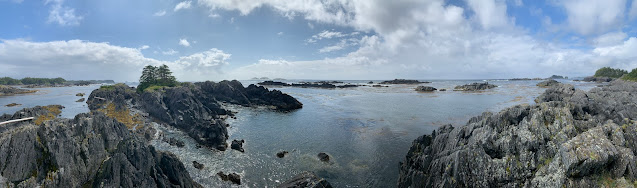
Crazed and Crazy

Once through Peele's we entered an island wonderland. 

I don't love the word 'awesome' (overused), but it's hard to think of a better. 'Terrific', maybe, in it's archaic sense of ability to inspire fear and respect? In any case, words fail.

Stretching from Slocum Arm in the south (Peehle's snakes along it) to Lisianski Strait in the north, outer Chich packs thousands of miles of coastline into a raven's flight of 30nm.

Approaching from the sea, solitaries and spray lines of rock must first be negotiated. Then fans of myriad tiny islands surrounding larger anchor islands. Then the perforated main body of Chichigof itself. All separated and connected by a labyrinth of weedy, bereefed passages. Shoals and deeps. Mountain, cliff and moor. Sheer rock and climax forest. And populated by fish, fowl, land and sea mammals running the local gamut.

Pretty much all of Southeast Alaska in a nutshell!

We drifted. We rowed. We sailed. We poked and prodded and scrabbled and scrooged. Feasted on its bounties, nourishing body and soul. And tucked away like the gem it is, White Sulfur Hotsprings let us look out on the open Gulf from the luxury of hot water! OMFG!! (Can I say that??)

We moved about in a daze - sometimes a literal daze of fog - overwhelmed by the beauties of the place.

But autumn was approaching, and with it equinoctial gales and storms rolling off the Gulf. On the first day of September, we rounded Three Knob Rock and turned toward inland waters.

*****


Sunset over Icy Strait

Icy Strait looks simple. Should be simple. Ain't simple.

Forecast winds blow mostly E or W. Water rushes in and out the E end... that's a fact. After that, it's complicated. Deep troughs are separated by relatively shallow ridges... water rises, turns and rushes. Waters collide in rips and ridges. Eddies back and fill. Point Adolphus puts a kink in the whole works, throwing water from one side of the strait to t'other.

Over the years, we've figured out jigsaw pieces of the puzzle. Maybe put a corner together.

Going E from Adolphus, for instance, if you follow the S shore (where all the good shelter is), you soon run into a W setting current. A strong one. Always. Goes like this:

  • Outgoing tide, headed W to the sea, is on the nose.
  • Incoming tide, headed E from the sea, is on the nose.
Wait, WHAT?? Well, incoming water is thrown NW by Adolphus, setting up a huge back-eddy that curls and back-fills alongshore, headed W.

Best bet is to push E at low slack, hoping to forge across the eastbound river of water, into the eye before the back-eddy sets up full throttle.

And that's just one challenge!

But the vistas! Wide waters aligned with sunrise and sunset. Towering, glaciated mountains and Glacier Bay to the NW, with lesser but no less beautiful mountains lining the shores. Deep sounds, inlets and estuaries to either hand.

With all this open water view we realize that we're surrounded by whales in flight, breaching for reasons they have never shared with us.

They say when pigs can fly, meaning never. But whales do fly. Go figure.

*****
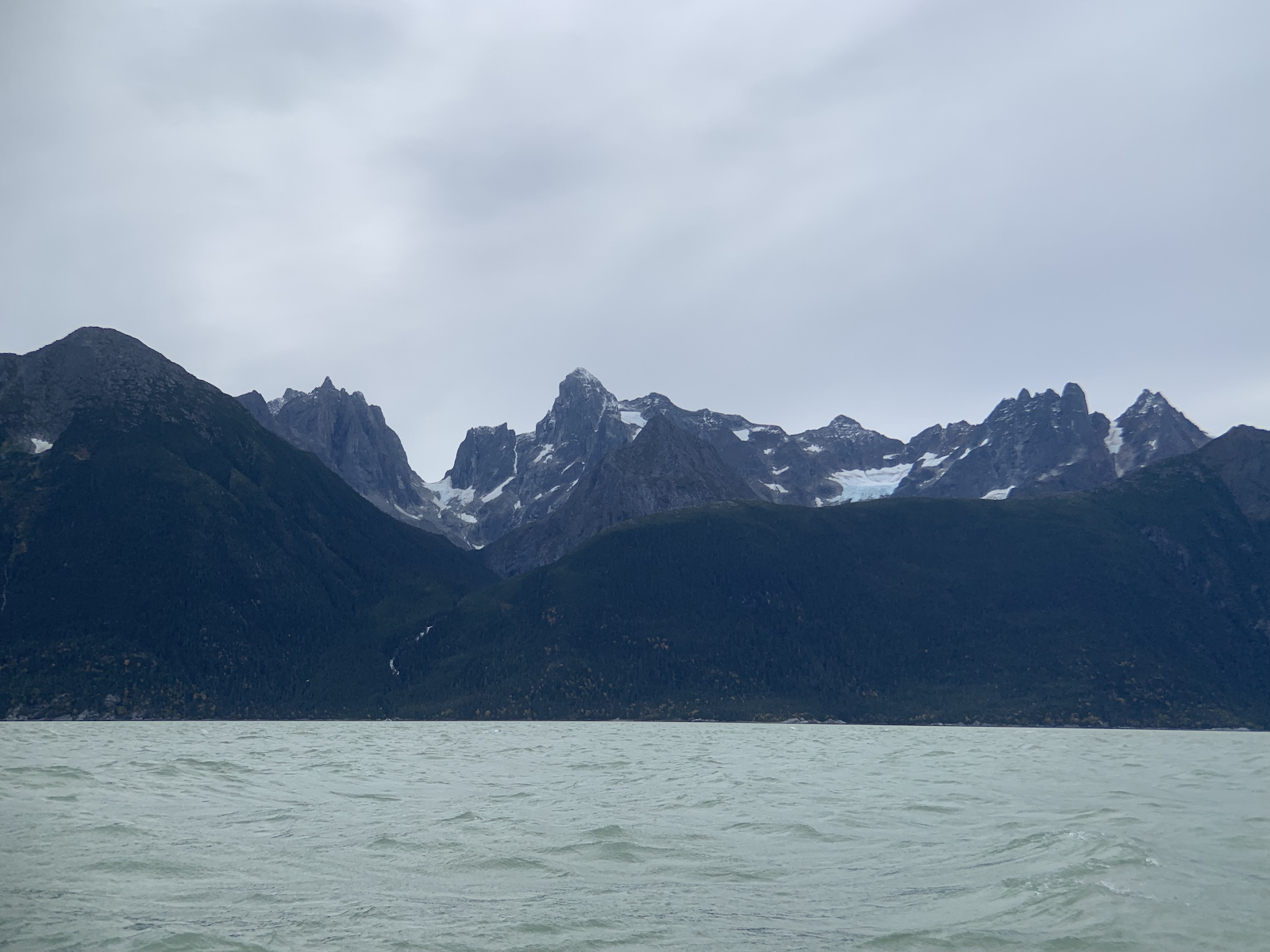
Chilkoot Mountains

So we pull into Swanson Harbor at the cross-roads of Icy, Lynn and Chatham Straits. It's now late September and well past time to return to Tenakee before winter comes down hard.

But. But. But. But. 

But we're having such a great time! The temps are milder than usual for the season, and we're feeling in command of our vessel. Having family up there in Haines gives us a pretext. If we're there for a birthday on the 1st of October, we can take the next window S.

Now Lynn Canal is a full on fjiord let into mainland, North America. The wind comes down, as a friend says, with his Long Boots on! We've sailed it often, but even in bigger vessels, we prefer to keep our time there to the summer months. It would be... y'know... ill advised to head into the Lion's jaws this late in the year.

So rather than turn our bow south for home, we head north.

It's a humbling run at any time of year. The Chilkat and Chilkoot mountain ranges ramp up and up as we sail north, their peaks shredding the clouds. But as October approached, snow fell high and beautiful, clothing the naked rock with a mantle of white.

Birch turned autumn golds and reds are at first now and then. Soon they crowd the alluvial fans spreading at the outflows of valleys yet buried in ice. Flats along the way are limned with grasses turned sere and electric. Birds are flocking and on the wing, heading for winter grounds. 

We had more wind in six days of actual transit, coming and going, than we had all the rest of the trip combined! Water heaping up with 'well marked streaks' between bouts of scud blowing off the cresting waves. 

Sailing in such felt much more under control, however, knowing our boat and having advanced our small craft sailing skills considerably over the summer. A little cotton mouth here, shaky legs there, and speedy runs up and back.

At one point, we were running south with a fair wind and last end of tide. Wind and sea had both been picking up, but a large lee lay close ahead. But then three short, steep, tall waves overtook us, one after the other. If they arose with a fair tide, we'd better get out of that before it turned foul! We had at hand a cove with a tricky tidal entrance, but low slack is the perfect time. So we rounded into a sudden, flat calm and rowed, easy as you please, with the new incoming tide into one of the best harbors in the world.

Slept like babes.

*****

Back in Swanson in mid-October, it was only a matter of waiting for a window to head for home. It's still the cross-roads of three cranky stretches of water, and Swanson itself is a geographical wonder... wind might be 15 gusting to 25kts higher than the surrounding areas at any given time.

But in due time, a window came. After all this, the homeward leg was uneventful, to our great relief. We rowed and sailed in lighter winds for the very most part.

Turning that last corner into Tenakee inlet aroused mixed feelings. 

We felt the pull of that next horizon strong within us. Despite generous helpings of friends and family along the way, we'd mostly been just the two of us, delighting in our duetude. We had faced much together. Leaned on one another with an intensity not called from us since our early days on the water. To immerse ourselves in a community, even for a season, is to trade something we value for something invaluable.

To me, this closeness to one another throughout the trip was the most vivid aspect of our whole, luminous venture.

Subjectively speaking.
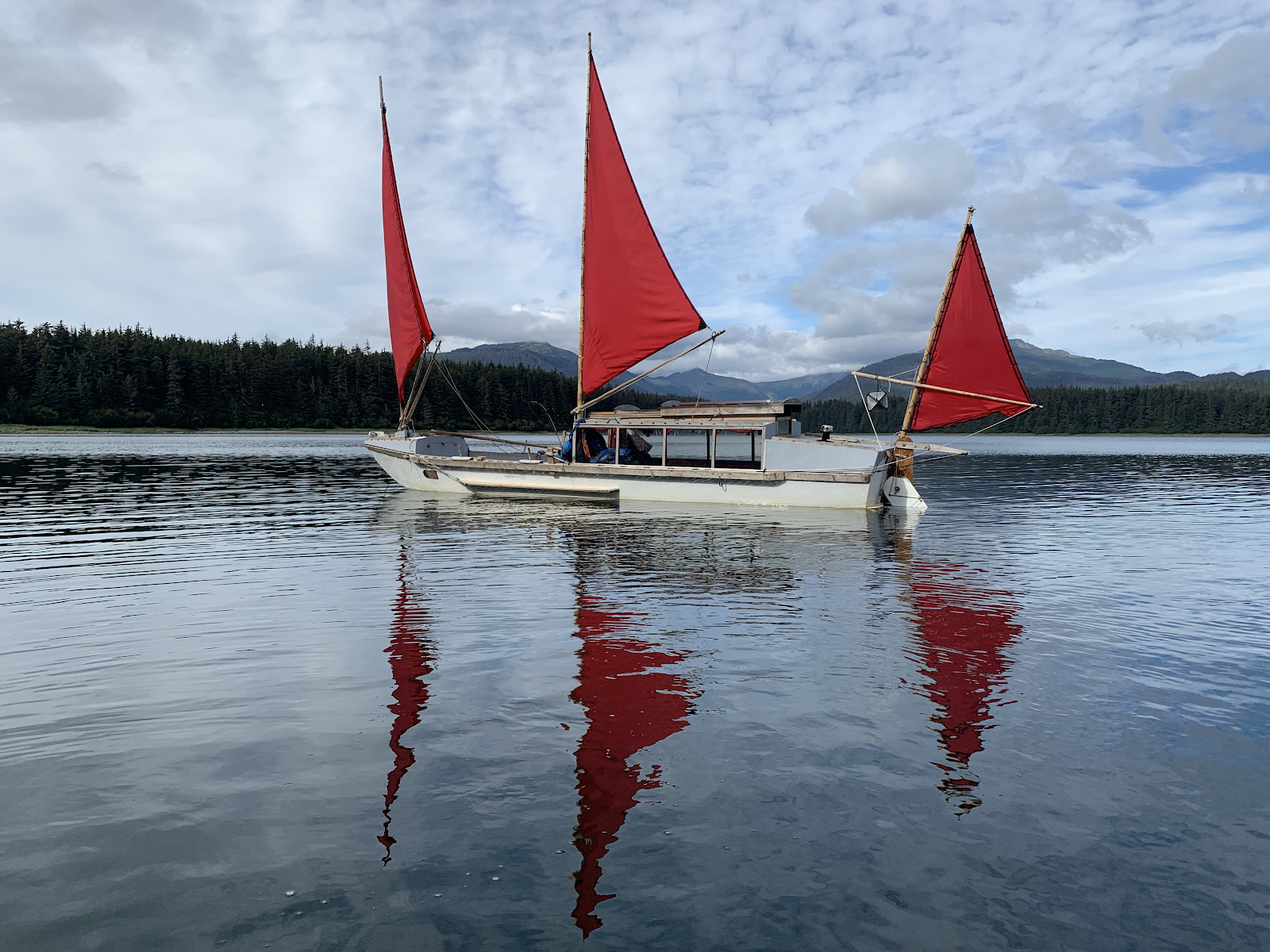

MUSTELID


Sunday, December 11, 2022

Time's Winged Chariot. Hopefully.

MUSTELID
24ft x 5/4ft x 6in
~1000lbs dry / ~2000lbs loaded

Returning from the Venture

Photo by Bruce Simonson


Time keeps on slippin’, slippin’, slippin’

Into the future…


– From Fly Like an Eagle by Steve Miller


Time's Winged Chariot. Hopefully.


I’ve been musing aloud, as it were, in posts about sailing against the entropic wind (aging).


We want options for less demanding sailing. AND we don’t want to wait too long to get them in hand.


So we worked out a plan, built a vessel (S/V MUSTELID), and took it out for a spin. Four months and upwards of 500nm later we’re pleased with the results. Despite several stretches of conditions we wouldn’t have chosen to venture into, she took all in stride.


The trip included some big water passages with wind ranging from calm to about 35kts (in sustained gusts) and seas from flat to about 10ft (max, over 7ft predominant). Despite bouts of cotton mouth and some pucker factor, it felt safe and capable in every situation. 


Mostly, though, there was a lot of reasonably efficient rowing over flat water. At a relaxed saunter, we moved along at 1.5kts. A sustainable, all-day pace averaged about 2kts (longest day was about 14hrs rowing!). In a sprint we moved along about 2.75kts (we could keep this up for about an hour before falling back to sustainable). Accordingly, our strategy was - as expected - to generally row in light conditions or wait for a fair wind.


All told, the smaller vessel was able to take us faster / farther with less effort than our larger cruiser. Lost in trade were the full comforts of home for the adequate comforts of a camper-cruiser. Most of the trip we foraged hand-to-mouth with a backbone of carbs, which let us sail remote for extended periods, beyond what we could carry in provisions.


*****


Our priorities for the design were as follows:


  • Cheap and easy construction (‘cuz… well… we’re cheap and easy!)

  • Positive buoyancy (best way not to go down with the ship is don’t let the ship go down!)

  • Decent, high stability sailing (our waters are cold… we don’t want to flip)

  • On-board self-rescue (if we do suffer knockdown, we want to right it from on-board)

  • Good carrying capacity (to carry food and tools for extended trips)

  • Decent rowing (the wind is free; our hp ain’t)

  • Retractable rudder / LR (easy beaching)

  • Good offwind sailing (under easy to stow and handle rig)

  • Some onwind sailing (ditto… any windward ability is gravy)

  • Allowance for outboard motor (who knows?)

  • Shelter aboard without set-up (torrential rains after long days)

  • Wood-fire galley (dry heat, fuel gathered as we go)

  • Double berth (important for couples)


After much juggling and balancing, we came up with:


  • Flattie’ hull (flat bottom, moderate flare, moderate full-length rocker)

    • Sampan bow (good foredeck, easy, secure beaching)

    • Parallel runs aft (easy construction above and below sheer)

    • Spread chines (increased stability, displacement, interior volume)

  • BIRDWATCHER aft cabin

    • Fixed shelter (no need to set up dry quarters, improved heat retention)

    • High reserve buoyancy (for knock-down recovery)

    • Telescoping hatches (mount large PV array)

  • Water-tight stowage fore, aft and in cockpit (positive buoyancy)

  • Double station rowing cockpit with rolling seats (efficient, open-air rowing)

  • Ljungstrom / Holopuni Quick Rig extensible hybrid (easy set, strike, reef, handling)


There’s a lot more - this boat got mutted with years of ideas accumulated over the years - but this’ll do for now.


The upshot is, we met or exceeded all of our expectations, and got some insights toward improving windward sailing (which was unexpectedly worth improving!).


At the design level, we were quite happy with trade-offs (compromise among opposing values).


The hull design is 'tightly coupled'. For example, increasing the carrying capacity (as we might wish), would ramify throughout the hull, impacting several other priorities. Deepening draft would exceed the 2ft side panel limit (materials savings) or reduce freeboard (reducing reserve buoyancy, changing oar angles), reducing forward flair and increasing sleeping platform curvature (hard on the back). And though we might wish to carry more on occasion, the half-ton we have proved ample.


In particular, the flared hull was a departure for us from vertical sides. But in this case, it allowed higher ends and rocker on a narrow panel, added spray deflection for the low sided, open cockpit and preserves reserve buoyancy despite narrowing toward the bow (reducing windage and wetted surface). It adds reserve buoyancy from about mid-ships aft, flaring as it does from the full, 4ft bottom. As a bonus, the flair is much more comfortable to lean against within the minimal interior, and gives extra elbow room at sheer level. All in all, we feel this paid for itself for this particular design.


If we were to change one thing, we would consider making the transom vertical. It's 12deg rake looks better (vanity) and accepts a square motor mount (marginal advantage). A vertical transom would allow aft beaching legs for leveling the boat on a sloped beach, increase the waterline length (marginal speed / displacement / stability increase) and simplify construction.


Rig-wise, we added a small driver aft to help keep the bow into stronger winds while rowing into them. This reduced steering effort from the sweeps, freeing them for the power stroke. Otherwise, the tendency was to blow flat, perpendicular to the wind.


Odd ideas that worked out well:


  • OffCenterBoards stow inboard, vertically against the sides. At anchor, they may be laid flat on cockpit cleats to form a large platform for outdoor workspace, sleeping or picnic.

  • A longitudinal locker / seat, cleated P&S, allows rolling seats for leg-powered rowing. These were DIYed ‘double-rolling’ style without bearings (which are vulnerable to salt water).

  • ‘Spacered outwales’ were built heavy to take ‘accessorized’ mounts for cleats, OCB hangers, whipstaff, and what-have-you.

  • Six identical sails are leg-o’-mutton (triangular) and join along luff and leech for a variety of sailplans, tarps or tipis. Worked well for the most part… might upgrade to a shaped mid-ship sail for improved windward ability.


*****


Looking back, the high count of cockamamy ideas not only worked individually, but worked well together. 


The fixed shelter eased the ends of long days and made a fine hang-out during the generally cool, wet summer, punctuated by several ‘atmospheric rivers’. It’s rocket stove heated the cabin quickly and safely and cooked many’s the delicious meal. While we never had to try its self-righting feature, it was several times reassuring to know it was at hand.


Our hope is that with this vessel as our older-age auxiliary, we’ll be able to use it as a forager for our cruising home which we expect in turn to become more sedentary over the years. This trip proved to us that  the smaller vessel gives us a high bar for adventure while we’re able, with plenty of room to downsize as ability declines.


Time will tell!


Plain sail Ljungstrom Ketch


Long-haul tri-mode Schooner (As yet untried)


NOTE: Soon we'll tell you about the experience.

NOTE: Plans are being finalized... watch this space!

Friday, November 25, 2022

Foraging Ahead: Independence Along the Way

Our Go-to Guide

Good info; great pictures
We also use it to organize notes from other sources


Hunter-gathers by nature
Store information for use,
Understanding that there may be a time
When information is scarce.

― Brian C. O'Connor, Jud H. Copeland, Jodi L. Kearns


This sudden sweet loot appearing...

― Aspen Matis


Foraging Ahead: Independence Along the Way

Anke and I have been pursuing the know-how and means to stay out and away for longer and longer periods. At least to have the option. We've come a long way; still have a long way to go.

We recently spent half of a four month rowing / sailing trip experimenting with near hand-to-mouth forage. During this time we lived mostly from fish and wild plants. We took along our complementary rice / lentil mix (2:1 for complete protein), dried fruit and olive oil, using each very sparingly.

Result? We lost weight and felt great! 

We were hungry more often than we normally tolerate, but not to the point of discomfort, and were eating amply at mealtimes. We quickly learned to make up a 'salad' for the day (fish and berries mixed in)... this allowed us to snack as needed between two cooked meals a day. 

Of note, the 'super-carb' diet of vegetables, fish meat and oils, and fresh berries - the bulk of what we were eating - supported the heavy exertion of rowing up to 12 hours a day (well... mostly more like 6 to 8).

Meanwhile, we were cooking and heating with a rocket stove modified for indoor use. This let us gather wood every few days with ratcheting anvil loppers (quicker and easier than sawing), while drying it onboard as needed.

So we're pleased to find that our sloppy assemblage of skills has brought us near to the point that we could subsist indefinitely, if need be. 

*****

If we wish to venture away for any extended stretch of time - let's say months to years - from towns / resupply it helps to find werewithal along the way... shelter, water, food, fuel and materials.

Shelter is pretty easy, assuming we're sailors aboard our live-aboard vessels... they come with us as a matter of course. When necessary, shelter may be improvised from foraged materials (a big subject... maybe later?).

Water is nowadays only a little tougher. Offshore seawater desalinators are available in manual models and can be DIYed

'Longshore, especially in our rainforest, spring and groundwater flows provide plenty of fresh water, which can be easily filtered by compact, cheap and durable systems. These too can be DIYed with simple filtration systems, using home-made charcoal as the active principle. 

A plastic bottle filled with water and left in bright sun for a sufficient time will UV-sterilize its contents (SODIS: SOlar water DIStillation). Sadly, plastic bottles may be foraged along all the coasts of the world.

Food is foragable in hunter (fish, game, fowl) / gatherer mode. 

For sailors, fishing is the easiest, especially if you are willing to eat cod and other 'scrap' fish. I'll include other seafoods in this category, despite not being fish per se... crustaceans and molluscs  (grazing, single shell types are less prone to PSP (Paralytic Shellfish Poisoning) than bivalves).

Hunting and fowling are another deep subject I'll leave for another time. Consider salting, smoking, jerking and canning as longer term options for preservation without a freezer.

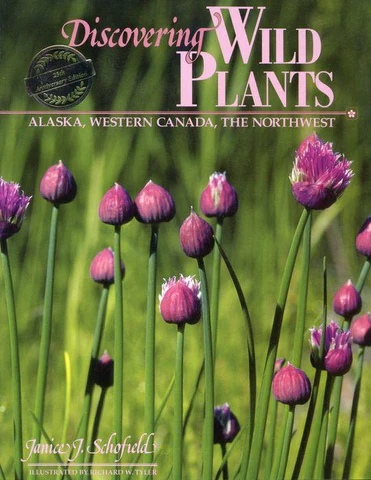
Most environments that are even marginally intact support a wealth of edible plants, and guides are generally available featuring local edibles and those to avoid.

Guerrilla gardens can help concentrate and enhance native plants, and add select, supplemental varieties. In our region, for instance, high-carb plants are few and far between... guerrilla potato patches are one way to add them. Alternatively, consider adopting a paleo-, neo-paleo- or neo-lithic diet... all three come much easier once you're out there.

NOTE: These diets are a little fuzzy. Generally speaking, paleo diet allows only wild grains (if at all), neopaleo diet adds early, cultivated grains, while neolithic adds 'modern' whole grains.

Plants can be dried (big weight and volume savings... just add water!), canned and fermented to preserve.

Fuel is used for heating, cooking and power (electrical and possibly propulsion).

Wood and other bio-fuels can be collected from land and shorelines along the way. 

We've had the most experience with wood, and supporting technologies are highly developed. A mild-steel stove or range, for instance, will work with driftwood, where cast iron will degrade. Rocket, gassifying and forced draft stoves are widely available, DIYable, and have the advantage of burning more efficiently and with less smoke. Less wood is necessary, and smaller pieces work well meaning reduced impact ashore, footprint aboard and gathering effort.

Materials are mostly wood in some form, and, nowadays, beach-combed trash. These can be used for repair, replacement and fabrication of new features.

Wood grows on trees, and spars of all sorts - masts, booms, battens, sprits - can be constructed with minimal shaping (especially when your vessel has been designed for tree shapes). Planks, knees and half-rounds (rails) take more effort, but can cover most any ship-board need. Wooden vessels take these materials in stride; resin based and composite vessels can be patched with them but may require further work once back in 'town'.

Beach combed garbage can often be repurposed to fill all sorts of needs. We're living in the neo-plasticene, after all. Planks, fasteners, containers, hoops, chafe gear, (PVC) springs, hose, valves, and so on can all be improvised from plastic garbage. There's an amazing assortment of metal this and that floating about, too, attached to wood or half sunk in sand. Repurposing rulz!

*****


Two additional aspects are key to all this; skills and tools.

Skills include the ability to identify, hunt / gather / process / preserve wild foods, tool use and maintenance. Is ingenuity a skill? Certainly of help! Ditto a sense of humor.

Tools run the gamut and are suited to your approach. Tools for mechanical, wood-working, wood-gathering and transport, fishing rods and reels, firearms, canning, drying, cooking and processing and maintenance are all possibilities to be tailored to your particular approach.

I lump into this category fasteners, wire, zip-ties and the what-have-you that lets you keep stuff from moving. Lubes to keep stuff moving. Consider generalist items that can be used flexibly in unexpected situations.

*****


The learning curves involved vary from low pitch to steep, and all are more or less life-long pursuits. That being said, the journey has rewards from the very first step, and the entire path is rich in satisfactions.

Foraged necessaries extend our time at large on the water, freed from return to the world of shopping and the cash economy with all its demands.

The reward is freedom!


PS. On our return, our first serious guerilla garden plot of potatoes had done well despite record heat early on, followed by exceptional wet! WooHOO!!

Sailing quietly, doing nothing, potatoes grow by themselves!


Spuds in Space!
Well... it's a Rocket Stove.


Tuesday, February 1, 2022

Winter Sailing

Think it's gonna snow?


Hope ain’t a tactic.

– From Deepwater Horizon (the movie)


Winter Sailing


Winter covers a lot of ground. Pretty much a whole hemisphere at a time. Arctic sailing techniques and equatorial call for radically different sets of tools!


Our home waters are the islands of the Southeast Alaskan archipelago. Very roughly from 55 to 58 degrees North. At this latitude, daylight hours grow short and the nights long.


We’re warmed by the Japanese current, which keeps our temperatures moderate relative to continental cold air masses. But this thermal energy, exacerbated by pressure gradients between offshore lows and continental highs, makes for some mighty winds. Worse, they can huff up from nothing at a moment’s notice. They can hurl down-slope from icefields and on high. They might blow out quickly, or they might settle in till spring.


We can get a lot of early snow, then warm abruptly with copious rain, causing flooding and freshwater outflows over the surface of denser, salt-water tidal movements. Things get lumpy.


Cold snaps can freeze any surface water holding still. Or can blow freezing spray which can cripple and sink the unwary. Lines can freeze stiff, refusing to run and resisting any handling, while strength drops to the snapping point. A warming turn can cause ‘break up’, which can strip anchors and carry a vessel from shelter. Skim ice can slice a boat along its waterline, clean through the hull.


And, y’know, it’s cold!


Winter Tactics


Winter sailing can be a different kind of a beast anywhere outside the tropics. All the hard stuff is harder. More fail-dangerous. More apt to sap our energy and mental acuity. Ice and snow are strident factors.


Warmer, moist maritime air carries a load of heavy water vapor, which packs a whallop; as much as X times the force in the sails. Cold, dry interior air has less of a punch, but dries and freezes exposed skin, even at low speeds. Both can lead quickly to hypothermia and bad decisions. Protect yourself!


Here’s a handful of the things we do in the face of winter. These are all considerations (despite all the DOs and DON’Ts)... they’re stated as imperatively as we observe them:


Clothing and personal gear:


  • Layer Up – Moisture wicking near the skin, then thinnish, lofty (air trapping) layers until warm, topped off by a waterproof layer (PVC isn’t breathable, but it’s impermeable). Have lots of standby clothes to trade out if they become wet or damp, and don’t put off getting dry!

  • Headgear – Lotsa heat leaves via the head. Hats, balaclavas, neck gaiters, scarves… these help keep it in.

  • Gloves and Mittens – Rubber gloves with inserts keep hands warm and dry while getting under way, but then sweat and chill. We switch to mittens, ASAP, so our fingers can huddle together.

  • Insulated Boots – Felt lined rubber boots are great for cold weather. They’re fully waterproof and, like PVC, non-breathing. Slipping plastic bags over (the first layer of) socks still gives damp feet, but preserves outer insulation for warmth.

  • Goggles – These warm your eyes and keep snow, ice and slush out of them. A swipe with mittens clears them pretty well, unlike glasses.

  • Sailing Harness with Lanyard, Clips and Jackline – A little insurance for slippery decks and surging hulls. We like our lanyards short with a quick release shackle inboard and caribiner to the jackline. Short enough to keep us bruised but on deck, should we stumble, rather than drowning in our own bow wake alongside.

    We like inflatable vest/harness combos with whistle, survival kit and strobe light attached.


A Hole in the Weather


  • Warm Interior – We like to keep our fire going for winter sailing. We trade off frequently and get warm below. A hot water bottle in the foot of a sleeping bag helps with toes.

    NOTE: Make sure ahead of season that the smokehead draws well in all winds and at all angles of sail!

  • Warm Food and Drink – Making up a stew ahead of sailing and keeping our vacuum bottle topped off lets us keep hot energy flowing.

  • Hot Stones – Warming in the oven, these make great hand and pocket warmers. Watch out for any that are too hot, and wrap as necessary. A larger, flat stone works great for feet. Water bottles work, too, but they're a little harder to keep renewing underway.


Weather and Sea States


  • Check the weather before heading out! – Forecasts are fairly accurate for big winds, but diminish proportionally. In winter, anything up to Force 5 could be from about anywhere. But check.

    And use our own eyes and knowledge! We are privvy to local knowledge the forecasters and their models can only infer. Doesn’t matter what the forecast tells us if actual conditions are shouting otherwise.

  • Avoid (Strong) Wind or Surface Outflows against Tides – These conditions cause the seas to stack short and sharp. Hard on us and our gear. Whatever else is going on is that much harder to handle.

  • Don’t head out into rising conditions – In winter, things that are getting worse don’t know when to stop. Even when the forecast calls for a moderate pick-up, things can get carried away. ‘Course, a calm going light gives some margin of error… I’m thinking more of 15 going to 25kts… we might well get 40kts!

  • Don’t head out into freezing spray – Of all the dicey conditions, freezing spray gives us the willies. A little can be tolerated; a lot can roll us under. But which it’ll be is a crapshoot.

  • Don’t anchor in the mouth of vertical valleys, avalanche chutes or off of windbroken trees – Williwaws and avalanches are no joke! Consider a topographical map (e.g., the state Gazetteers) to help spot wind holes.

  • Don’t Sail through Skim Ice – Our copper plating gives a big margin of safety, but ice is patient. Be aware that, if sculling, even a little ice will stop you in your tracks.

  • IceUp Calls for High Alert – We try to keep an ice free moat around the hull with breakout to the point our anchor lines intersect the water/ice. If possible, we neap out above the worst of it.

    Once the weather warms (or melt begins from below), we set a watch, and start breaking things up as soon as possible.

    Worst comes to worst and we are dragged out of shelter (never happened, but it could) prepare to sail. Run for shelter as soon as free of ice. Maybe even before?


Frozen Lines


  • Make Sure Sheets and Halyards are Running Free – This is tricky. If it’s very cold and dry, often iced lines will more or less sublimate free (solid ice evaporates with no intermediate liquid), aided by beating and working. Tails can often be brought below to thaw and dry. We don’t set out until we can raise and lower all sail. If in doubt, stay put when possible. If not, keep working on them once underway.

We start working the lines free as soon as it gets cold enough, even if we’re not planning to sail. It’s a slow process, and ya never know.

  • Install (Temporary) Downhauls – Sometimes our best efforts fall short, and a sail that can’t be lowered is positively dangerous. Downhauls are good insurance. We can usually haul a reluctant sail down by hand, but our winches are handy in case we need more pursuasion.

  • Anchor Lines – these are a skosh more forgiving… In our self-bailing anchor locker, they can be swashed down with seawater before deploying (salt water has a lower freezing point than fresh). Usually, this is a little less time critical, as they have no blocks to run and are gravity assisted. Still, take a look to check they’re not a block of ice before we set out.

  • Dock Lines – Double them up and use wider angles than usual. Where possible, get them working together, rather than one by one, to share loads. Try to minimize shock loading from a surging hull by reducing slack.

  • Fenders – Double them up, too (they can get brittle) such that, should one fail, the hull is still fended off. Consider some non-inflatables such as tires or rope fenders. Consider an off-haul system (anchor set abeam or strut ties).


NOTE: Recently, I’ve seen a type of loosely braided, synthetic line being used for docklines in winter conditons… It shrugs off water so doesn’t freeze so remains pliable and presumably retains strength. Haven’t yet been able to research. Might it be fit for sheets and halyards?


Rules of Thumb


  • Throw Away the Calendar – Scheduled sailing is dangerous any time of year. In winter, it can be deadly. Having to be somewhere pushes us to sail when we shouldn’t. Sailing when we shouldn’t can lead to pushing daisies.

  • Await the Opportune Moment – Wait for a fair wind, in fair amount, over a fair sea, with a fair prospect. This is our best shot at getting on down the road safely. Don’t fight conditions… long money’s on them!

  • Increase All Margins of Safety – Maintain more than ordinary room to deal with trouble. We’ll likely need it. Consider a winter set of heavier anchors.

  • Move in Short Hops – Winter windows are short and snap closed fast… go from one secure situation to the next with dispatch. Don’t long haul for distant shelter or dawdle daylight away.

  • Prepare for Night Sailing – Chances are, we’ll end up in the dark. Be ready with navigation, information, skills and lights.

  • Have Fall-backs and Be Ready to Engage Them – Should conditions change, be prepared to change with them. Even if it means giving up a whole difficult day to run back to where we started or worse. Better safe in a downwind anchorage, than caught out in a rising, night-time gale!

  • Be Prepared to Hunker Down – If we get weathered in, we want to have all the wherewithal to stay for an extended period. Like maybe the rest of the winter? Food, water, books. Some winters, may be best to catch up with friends in a town.


All this is on top of having our selves, vessel, gear and outfit in fine fettle. Winter is no time to let things slide. Of course, knowledge is imperfect so we can and will encounter the unexpected. But we do what we can…


... and don’t sail on hope.


Related Posts:


Tired is Stupid

Night Sailing