Please visit our home site at www.TRILOBOATS.com.

Anke and I live aboard WAYWARD, and wrote about it's design and construction at ABargeInTheMaking.blogspot.com.

Access to the net comes and goes, so I'll be writing in fits and spurts.Please feel free to browse the archives, leave comments where you will and write... I'll respond as I can.

Fair winds!

Dave and Anke
triloboats swirly gmail daughter com

Showing posts with label Forage. Show all posts

Monday, July 8, 2024

Wood Heat for the Lazy

Spike in the Log 


Pulled from the Log


EROEI – Energy Return On Energy Invested


Wood Heat for the Lazy

It’s often said that wood is the fuel that warms us twice. But that’s understated!

Lessee…


  1. Locate, fall and limb tree (standing dead and dry).

  2. Buck into stove-length rounds.

  3. Split to various sizes..

  4. Transport to home.

  5. Stack (store) handy to stove.

  6. COOK and/or HEAT.

  7. Clean stove (periodically).

By my count, it warms us seven times! On our waterborne home, this omits fetching wood in from the woodshed. And I didn’t even mention greenwood seasoning (drying 2 to 3 years)!.

All this represents a considerable amount of energy invested in the energy returned for desired cooking and heating.

Similar to cost/benefit analysis, EROEI is the ratio of the amount of energy we get from a given energy expenditure; the bang for our energetic buck. Without doing any math, it urges us to think about our energy inputs, outputs and benefits in relation to costs. It’s an orienting concept. High EROEI is good; Low EROEI is less good. EROEI = 1 is pointless; EROEI < 1 is a downward spiral.

For fuels such as diesel, gas or electric, our personal EROEI may appear lesser, but money must be made and spent with all the energy investments that requires of us. The equation is more complex, perhaps, but pertains, nonetheless.

From our point of view, a few hours passed weekly in beautiful woods and useful exertion  in return for energy independance has been a good bargain. It has gotten us off our lazy butts and into the wider world. Our blood flowing and our backs strong. But as we age and our store of individual energy diminishes we’re looking ahead. 

What follows are a handful of approaches, resources and tactics aimed at increasing our return and reducing our investment for higher EROEI.


Smaller Volume plus Insulation

Insulation is a lesson we learned better late than never. Higher R-value hull and overheads with double-paned windows have become our standard practice. 

Now we’re looking to reduce volume. The smaller a space to heat, the less energy return is required, which in turn lowers our necessary energy investment (for heating, but also for row/sailing and maintenance).

In WAYWARD (our present boat), the living space is 20ft x 8ft x 5ft in the main, plus a trunk cabin and hatch that end up totalling about 1000ft3. The boat we’re now building for our dotage will be 12ft x 4ft x 4ft plus a small galley extension to total about 250ft3. 

We’ll have only a quarter the volume to heat!


Rocket Stoves

It’s said that the energy lost in woodsmoke is nearly half the total of unburnt wood. Rocket Stoves burn that smoke, reducing wood demand accordingly. With a quarter the volume to heat and (about) half the wood per unit of heat, we’re already talking around 1/8th the required energy investment for the desired outcome.


Furthermore, they reduce or eliminate energy invested in points 1-4 from our list above.


  1. Target small dead limbs – Thumb to wrist size covers cooking to heating. This eliminates whole tree felling and brings the dead limbs of many otherwise living trees online. In our forests, there is a super-abundance of limbs in this range, both among lower branches and windfallen. As a bonus, our coniferous limbs are sap rich near the bole for extra energy density.

  2. Process to length – All methods (see below) are much easier with small diameters than bucking sound wood. Since there is no stove box, we can use longer pieces, reducing the number of cuts.

  3. No splitting! – This is especially helpful as long-fibered spruce, generally our most practical firewood, resists splitting (which make it great for spars).

  4. Transport – Because gathering is such light duty, we can typically keep up by gathering a small amount on our daily ventures on shore, spreading effort over longer time. In our case, the heavy packs we’ve been using over treacherous footing constantly threaten strain or sprain… smaller loads are fail-safer.

These points are hard to quantify, but further increase our EROEI to a substantial degree.


Alternatives to Sawing

Sawing wood is hard work, even with a blade that is well sharpened and set (a process of considerable energy investment!). Nevertheless, it’s the least effort for bucking up rounds which are sound and of larger diameter, and/or of a tough species. For small diameters, however, other methods are faster and take less effort. As a bonus, since small stuff is less stable for sawing, the saw can skitter dangerously… other methods, while not carefree, are generally a degree fail-safer.


  • Lop – A good set of ratcheting anvil loppers (for dry wood) makes quick and easy work of any limb within its range.

  • Chop - With an ax, hatchet or hatchet/maul and a hardspot (stump or log) chop down perpendicular with a single strike on opposing sides (two, four or more according to difficulty) of a limb to create a weak spot (we’re not generally chopping through). Pull the end back to bridge between hardspot and ground and smack it with the back of the tool to break or use any of the following methods. It’s generally more efficient to first chop along the whole log, then break along in one go.

  • Break - Depending on diameter, species, soundness and dryness wood can be directly broken by hand or across a knee, tree, limb, rock, etc.. Holding to either side and striking at the breakpoint impact loads that point for usually good results (use caution to preserve your wrists against that same impact!).

  • Leverage - Leverage multiplies our power, greatly reducing energy invested. Look for a hard point and a fulcrum a little less than the desired length apart. Closely spaced trees or limbs work well, as do rock neighbors, crevasses and overhangs. Insert the stick with its end on the (further) hardspot and break point on the (nearer) fulcrum. Pry until broken. Sometimes it helps to break halfway, turn the stick 180deg and finish the other way.

  • Whack Job - This one only works with punky wood, but is fastest and very easy. Find a hardspot, preferably with a sharpish edge (rock, say). Swing the wood like a bat to impact at your desired break point. Momentum snaps the stick on contact. As with an axe, use effort to accelerate the swing but relax before impact (ride the end of the swing) to reduce shock to your joints.

  • Cudgeling - Again, pretty much for punkwood. Find a soundwood cudgel (usually about the size of a baseball bat), bridge the victim, and whop it in the middle to break. Watch out for flying ends!

All these methods can be mixed and matched as convenient. The ‘tool-less’ methods are especially helpful in the field for impromptu picnics, and help reduce long wood for a smaller, safer fire.

As you can see, the more brittle the wood, the easier it all gets. Which brings us to…


Punky Wood

Punky (rotting) wood has lost a portion of its energy content to oxidation… in effect, it is pre-burnt to a degree. But a goodly amount of energy remains. 

The benefit is that fermentation has weakened the longitudinal fibers, leaving it easy to break by any of the manual means or with ‘found’ tools. In minutes of light effort, armloads of firewood can be gathered with neither lop, chop nor saw. No tools to sharpen, transport or lose!!

While gathering, we look for the rather broad ‘Goldilocks’ point: not too firm, not too far gone. Light and dry. Well-aired in place or partially elevated above the ground, they dry quickly. The woods are rife with low-hanging dead- and fallen limbs in this state. Close to our fire, boat or dory is a plus.

Punkwood is consumed quicker than sound wood. Thicker diameters can be used to slow and cool combustion (which is proportional to engaged surface area). Where sound wood thin enough to break by hand burns away quick and hot, we can go for larger diameters in punky woods that burn cooler and last far longer. This is especially useful for even heat of a cool evening. Thick ‘uns also take up less storage volume than the equivalent mass in small stuff.

In our parts alders line much of the coast. This quick-growing ‘hardwood’ produces many dead limbs which go punky in short order. Other species such as poplars, aspens and birch are similar.

A couple of cons with this approach…

Compared to sound wood, punkwood requires more volume to transport, tend and store for any given amount of heat. Greater throughput means more ash and its clean-out. These energy investments weigh against its other gains.

While punkwood dries quickly, it absorbs water just as readily. In wet weather (which includes most of winter), it’s often too wet to use.

Still and all, for much of the year, it requires substantially less energy invested for energy returned. So low, in fact, that ‘bouquets’ of punkwood from our daily walks generally supply us with all the summertime wood we need.


‘Spikes’

Spikes are the pitchy roots of limbs from a rotten conifer trunk of pitch rich species (e.g., some pines, spruce, fir?). The pitch is energy dense AND preserves the spike AND waterproofs it… spikes are only ever surface-wet and dry quickly. The rest of the limb has usually rotted away leaving stove-length pieces.

Once the trunk of a fallen tree is fully soft, one can walk along it and harvest the limbs, pulling the spikes like carrots. Or walk along many creeks and beaches and simply pick up spikes (which don’t float) from trees long gone. A few days in the sun or behind the stove and good to go.


Bark

Beachcombed fir bark is a windfall, as fir only grows far to the south of us. Ranging from 1 1/2in to 6in thick and up to 6ft long, it is easily broken to length. Quite resinous, it resists absorbing water and dries quickly in any case. It charcoals quickly but lasts long, perfect for warming on a rainy day.

Alan and Sharie Farrell used mostly fir bark, especially in their later years. It became scarce as British Columbia logging receded, and this became quite a problem for them as time went on.

Fir bark works great in a fire-box. We haven’t yet tried it in our Rocket Stove, and I have my doubts. Too smoky? And the Rocket principle is a hot burn. 

But there are other applications…


Coppicing

Coppicing is the practice of cutting a swift-growing species (such as alders, willows, poplars and many fruit trees!) back to a stump trunk. New limbs spring up in their hundreds for sustainable harvest. It was commonly used for prolific woodlot fuel production on farms and commercial stands.

This approach looks to be a promising option for favorite spots…an arboreal guerrilla garden!


*****

There are many things we’ll miss about our current wood-range with oven. But I gotta say, its low EROEI won’t be one of them.


We’ll just have to find other ways to get our exercise!

Tuesday, December 5, 2023

A DIY Rocket Stove Smoke Hood


Eco-Zoom Rocket Stove with DIY Smoke Hood


Somebody who claims to speak for the ‘hood don’t need no private jet.

– Chuck D


A DIY Rocket Stove Smoke Hood


About half of the energy in wood literally goes up in smoke, and with it, a good deal of our own! If the smoke can be burned, efficiency nearly doubles. The corollary is that only half as much fuel produces a given amount of heat.


Rocket Stoves were developed as a low-tech solution. At their heart is an L shaped, insulated tunnel, wide open at both ends. Fuel is fed horizontally, oxygenation and combustion burn hot at the crux, and what little smoke is left is pushed vertically, up and out the top. Typically, a pot directly atop the stove absorbs heat from the hot, gaseous outflow for cooking.


We’ve been using an EcoZoom Rocket Stove for years as a nearly smoke-free, otherwise open deck fire for outdoor cooking in hot weather, an evening blaze in nice weather and to heat metals for various projects (it easily takes ferrous metals to red-hot). It runs on limbwood from about thumb to wrist size, the former for cooking and the latter for longer, more subdued heat. In short, perfect for easy wood-gathering, especially as we age..


In planning MUSTELID, we hoped to bring this marvel indoors for cooking and heating. It requires far less wood to gather, dry and store within her small volume. Being insulated, wood can be dried directly alongside the stove, warm but nowhere near wood’s flashpoint (we can touch the stove sides without burning!).


To bring it indoors, we must gather and direct combustion gasses outboard, like any other onboard stove. The solution is a smoke hood fit snugly over the stovetop with a stack, which has the extra perk of increasing the cooking surface area. We wanted one more feature… we wanted to easily install and remove the stove for outdoor use on deck or ashore. So we went for a swing-up, cantileverd variation.


This called for some head scratching…


Grate spacer for airflow under,

Ash tray…

Whole thing slides aft behind bulkhead lip

And between heat / splatter shields.


Removed...
Note black fire-retardant pad
protecting carpet from sparks


Swing hood upward to remove


A look under the hood...
a vertical ring fits closely over upper plate
for extra fume collection


*****


Smoke Hood Plan
Not to Scale


Smoke Hood Elements


At it’s simplest, the hood is a flattish box made from sheet metal (in our case, stainless steel from and old stove’s grease trap… a heavier top plate has better thermal mass for cooking, if available. A large hole in the bottom fits closely over the Rocket Stove top, while a smaller hole in the top has stovepipe fit into it, which leads to a standard deck-jack and smokehead. If you leave the stove in pace, this is all you need.


For a swing-up top – allowing removal of the stove – we broke the hood into two boxes, each with an open end:


  1. The far box is fixed (in our case to bulkhead and flanking heatshields), with the flue let into its upper surface. Its near end is open, with rounded shoulders and an under-lip. This part is female, slightly larger than the second part.

  2. The near box is cantilevered (stops may be additionally fitted to help support heavy pots). Its far end is open, with a partial rounded shoulder fairing to 45deg… extending an over-lip, while the angled section limits upward swing. This part is male, slightly smaller than the first part. Insert its open end into the female’s until their respective hinge-pin holes align.


Other parts:


  • The long hinge pin (alternatively, short, opposing pins) are let through paired holes centered on the shoulders. If it binds while swinging upward, grind away from the lower male shoulders till clear.

  • A vertical smoke collar can be used around the stove-top cut–out (not sure it’s necessary). We used a strap of sheet metal, its edges doubled over just short of its outer mid-line (result about one inch wide) and tabbed around its outer mid-line (tabs bent alternately, slightly away from cut-out). When pressed into place, it ‘snaps’ in to lock. It works best to cut the tabs before bending.

  • Rims, rails, bars and what-have-you may be added to secure pots while cooking underway. In our case, we added a low front rim and let that and tall heat / splatter shields along each side contain pots. Watch for swing-up clearance.


Notes:


  • Any gaps allow air to be drawn into the hood. The closer the fits, the more energy is available for cooking and heating. Once the stove is drawing (seconds) there appears to be no leakage, even from wider gaps. We didn’t use gaskets, but they can’t hurt.

  • We sized our male part to be 1/16in smaller than the female’s inside dimensions. Given our crude techniques, we managed between 3/32in and 1/8in. So long as it slides in without undue forcing and the gaps are small, it should work fine. Thermal expansion binding isn’t a problem as we only ever move it out once cool.

  • In both cases, the lips should overlap the opposite part to help close the gap and contain ash. Small tabs may optionally be bent along single edges to help minimize warping with heat.

  • Sizing can be more or less according to your available space. We sized around our frypan plus our small teapot, to cook and heat water at the same time.

  • The smokehead can be lower to the deck than is usual. Although it does induce some draft, Rocket Stove’s generate expansion in their combustion chamber, and actually push gas about 40ft. Still, an efficient draft smokehead hedges our bets in some gnarly conditions.

  • We didn’t have a brake (sheet metal bender), so clamped sheets over a piece of sharp-edged hardwood, then hammered it over. Cutting was with a thin-wheel grinder and touched up with a mill file. We used bent tabs with (copper/stainless) pop-rivets to join. Wear gloves, eye, ear protection and work safe!


Looking Ahead


One of the intriguing possibilities with Rocket Stoves is to make our own from a substance that insulates, absorbs and radiates thermal energy. In other words, which acts as a thermal mass or ‘sink’. Such are easily made from brick, firebrick, concrete, clay, cob and other materials. 


Perlite (pumice) is a light, inexpensive insulator, and can be mixed with concrete for a lightweight aggregate with decent thermal mass. The combustion chamber can be lined with refractory clay. A thick, steel cook surface is easy to install over a lipped smoke chamber for a full sized stovetop / smokehood. Sand makes a good gasket between plate and stove. Alas, this doesn’t sound very portable!


But we keep on thinkin’.


Friday, November 25, 2022

Foraging Ahead: Independence Along the Way

Our Go-to Guide

Good info; great pictures
We also use it to organize notes from other sources


Hunter-gathers by nature
Store information for use,
Understanding that there may be a time
When information is scarce.

― Brian C. O'Connor, Jud H. Copeland, Jodi L. Kearns


This sudden sweet loot appearing...

― Aspen Matis


Foraging Ahead: Independence Along the Way

Anke and I have been pursuing the know-how and means to stay out and away for longer and longer periods. At least to have the option. We've come a long way; still have a long way to go.

We recently spent half of a four month rowing / sailing trip experimenting with near hand-to-mouth forage. During this time we lived mostly from fish and wild plants. We took along our complementary rice / lentil mix (2:1 for complete protein), dried fruit and olive oil, using each very sparingly.

Result? We lost weight and felt great! 

We were hungry more often than we normally tolerate, but not to the point of discomfort, and were eating amply at mealtimes. We quickly learned to make up a 'salad' for the day (fish and berries mixed in)... this allowed us to snack as needed between two cooked meals a day. 

Of note, the 'super-carb' diet of vegetables, fish meat and oils, and fresh berries - the bulk of what we were eating - supported the heavy exertion of rowing up to 12 hours a day (well... mostly more like 6 to 8).

Meanwhile, we were cooking and heating with a rocket stove modified for indoor use. This let us gather wood every few days with ratcheting anvil loppers (quicker and easier than sawing), while drying it onboard as needed.

So we're pleased to find that our sloppy assemblage of skills has brought us near to the point that we could subsist indefinitely, if need be. 

*****

If we wish to venture away for any extended stretch of time - let's say months to years - from towns / resupply it helps to find werewithal along the way... shelter, water, food, fuel and materials.

Shelter is pretty easy, assuming we're sailors aboard our live-aboard vessels... they come with us as a matter of course. When necessary, shelter may be improvised from foraged materials (a big subject... maybe later?).

Water is nowadays only a little tougher. Offshore seawater desalinators are available in manual models and can be DIYed

'Longshore, especially in our rainforest, spring and groundwater flows provide plenty of fresh water, which can be easily filtered by compact, cheap and durable systems. These too can be DIYed with simple filtration systems, using home-made charcoal as the active principle. 

A plastic bottle filled with water and left in bright sun for a sufficient time will UV-sterilize its contents (SODIS: SOlar water DIStillation). Sadly, plastic bottles may be foraged along all the coasts of the world.

Food is foragable in hunter (fish, game, fowl) / gatherer mode. 

For sailors, fishing is the easiest, especially if you are willing to eat cod and other 'scrap' fish. I'll include other seafoods in this category, despite not being fish per se... crustaceans and molluscs  (grazing, single shell types are less prone to PSP (Paralytic Shellfish Poisoning) than bivalves).

Hunting and fowling are another deep subject I'll leave for another time. Consider salting, smoking, jerking and canning as longer term options for preservation without a freezer.

Most environments that are even marginally intact support a wealth of edible plants, and guides are generally available featuring local edibles and those to avoid.

Guerrilla gardens can help concentrate and enhance native plants, and add select, supplemental varieties. In our region, for instance, high-carb plants are few and far between... guerrilla potato patches are one way to add them. Alternatively, consider adopting a paleo-, neo-paleo- or neo-lithic diet... all three come much easier once you're out there.

NOTE: These diets are a little fuzzy. Generally speaking, paleo diet allows only wild grains (if at all), neopaleo diet adds early, cultivated grains, while neolithic adds 'modern' whole grains.

Plants can be dried (big weight and volume savings... just add water!), canned and fermented to preserve.

Fuel is used for heating, cooking and power (electrical and possibly propulsion).

Wood and other bio-fuels can be collected from land and shorelines along the way. 

We've had the most experience with wood, and supporting technologies are highly developed. A mild-steel stove or range, for instance, will work with driftwood, where cast iron will degrade. Rocket, gassifying and forced draft stoves are widely available, DIYable, and have the advantage of burning more efficiently and with less smoke. Less wood is necessary, and smaller pieces work well meaning reduced impact ashore, footprint aboard and gathering effort.

Materials are mostly wood in some form, and, nowadays, beach-combed trash. These can be used for repair, replacement and fabrication of new features.

Wood grows on trees, and spars of all sorts - masts, booms, battens, sprits - can be constructed with minimal shaping (especially when your vessel has been designed for tree shapes). Planks, knees and half-rounds (rails) take more effort, but can cover most any ship-board need. Wooden vessels take these materials in stride; resin based and composite vessels can be patched with them but may require further work once back in 'town'.

Beach combed garbage can often be repurposed to fill all sorts of needs. We're living in the neo-plasticene, after all. Planks, fasteners, containers, hoops, chafe gear, (PVC) springs, hose, valves, and so on can all be improvised from plastic garbage. There's an amazing assortment of metal this and that floating about, too, attached to wood or half sunk in sand. Repurposing rulz!

*****


Two additional aspects are key to all this; skills and tools.

Skills include the ability to identify, hunt / gather / process / preserve wild foods, tool use and maintenance. Is ingenuity a skill? Certainly of help! Ditto a sense of humor.

Tools run the gamut and are suited to your approach. Tools for mechanical, wood-working, wood-gathering and transport, fishing rods and reels, firearms, canning, drying, cooking and processing and maintenance are all possibilities to be tailored to your particular approach.

I lump into this category fasteners, wire, zip-ties and the what-have-you that lets you keep stuff from moving. Lubes to keep stuff moving. Consider generalist items that can be used flexibly in unexpected situations.

*****


The learning curves involved vary from low pitch to steep, and all are more or less life-long pursuits. That being said, the journey has rewards from the very first step, and the entire path is rich in satisfactions.

Foraged necessaries extend our time at large on the water, freed from return to the world of shopping and the cash economy with all its demands.

The reward is freedom!


PS. On our return, our first serious guerilla garden plot of potatoes had done well despite record heat early on, followed by exceptional wet! WooHOO!!

Sailing quietly, doing nothing, potatoes grow by themselves!


Spuds in Space!
Well... it's a Rocket Stove.


Monday, April 25, 2022

S/V SCAVENGER


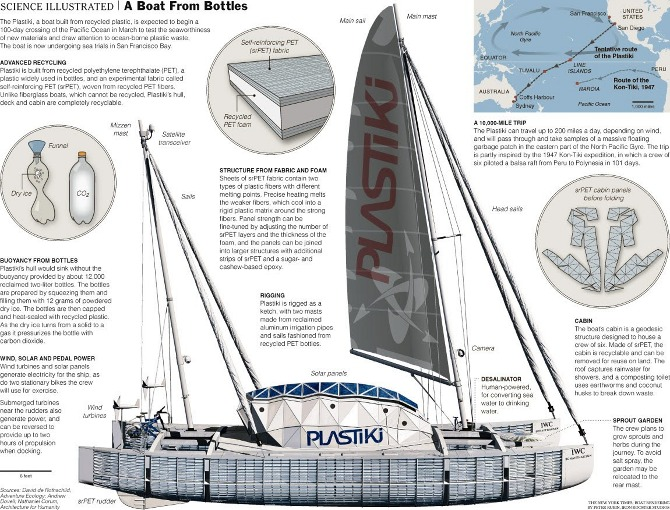
PLASTIKI

– A particularly ambitious vessel from found materials

From theplastiki.com


For a scavenger, patience is the key to the pantry.

– Delia Owens


S/V SCAVENGER


Trouble can come upon whole peoples, catching everyone by surprise. It happens. It’s happening now around the world. It can happen here.


Let’s try a little thought experiment…


Say that things have fallen apart, a little or a lot. Either the local, regional or global center did not hold and things got chaotic. Looters came and went, along with most residents. 


Say we want or need to build a sailing vessel from scratch with materials at hand in a depleted sub-urban area. Let’s say things have been permanently abandoned, and the moral coast is clear. Let’s further stipulate that all stores have been emptied.


What do we need? What of that is at hand??


Triloboats are designed to comprise a workable minimum. Simple box barge / scows, they are relatively quickly and easily built from rectangular materials (sheets and planks). They’re largely ‘form stable’, requiring little or no ballast. 


But there are plenty of other contenders!


Free-standing rigs simplify construction immensely. They are set on what are essentially flagpole principles: get a solid grip at the bottom and let the rest fend for itself.


A whole range of waterproofing puckies can be magicked up from combinations of asphalt, oils, waxes, gas/diesel/mineral spirits/turpentines, cement (lime) and toxins (antifouling).


So let’s look around for what’s at hand…


  • Residential – Fasteners galore, plywood (sheathing and sub-floor, mostly), 2x framing, beams (solid and composite), hardwoods(?), insulation (foam and fiber), windows, roofing (asphalt, sheet metals and flashing), plumbing, electrical, hinges, carpets, fabrics, housewares, soaps and bleaches. Jonni Rings™ (micro-crystaline wax rings sealing toilets)!!! Electronic and electrical.

  • Commercial buildings and schools – Bolts, hardware, hardwoods (bars and VIP enclaves), plumbing/piping, stainless sheets and furnishings (from kitchens), propane hardware (can be used with home brew methane), industrial cleaning agents, big glass, plexiglass, electrical, asphalt (flat roofs). Awnings?

  • Cars, RVs and trucks – Oils, 12VDC electrical and batteries (keep an eye out for lithium based batteries or better!), alternators + regulators, inverters, engines (can run on wood -smoke or -gas), pumps, hose, radiators (vehicular air conditioning radiators use lead-free solder), bolts, tires, tarps?, jacks, tools and tire irons, maps.

  • Roads – asphalt, bolts (guardrails), sheet metal (signs), manhole covers (ballast), culverts. Bus-stops (plexiglass).

  • Power Lines and sub-stations – Poles, guys anchors, bolts and Ubolts, turnbuckles, wire (electrical and supporting cable). Copper for melting and plate production.


Appliances and accessories yield small AC and DC motors (windshield wipers, vacuum cleaners, hairdryers, washers and dryers, etc), alternators and vacuum pumps (refrigerator/freezers). 


Line can be found in various ropings, scaffolding and window-washing set-ups, on flag poles. Keep an eye out for line in the back of trucks.


Look around for tools. Saw blades and files are some of the harder things to improvise, so keep an eye out. The business end of power tools can be given handles and used manually. Home garages, garden sheds and firehalls may have been overlooked. 


If you’re in a higher-brow kind of area, look for copper furnishings, roofing, gutters and flashing for anti-fouling.


Marinas and boatyards could be full of goodies, up to and including vessels that weren’t cherry-picked and need some work, much of it left behind in the rush to turn-key

 (see Bob Wise’s Volkscruiser Blog). 


Junk yards, of course. And landfills.


I’ll bet libraries - full of analog know-how - will largely be unlooted. Meantime, any skills acquired in advance of trouble are a plus.


And I didn’t even mention dumpsters!


Point is, we’re awash in material abundance which our ancestors would have coveted, and immediately pressed into service. No matter which way we turn, the merest garbage of our age is the stuff of early sci-fi dreams.


Consider looking around for vessel ideas that might work well with found materials. Let’s use our imaginations! Think out-of-the-box!!


The scenario of our thought experiment is extreme-ish. But no need to await some fallen sky… much of all this is available now for nearly free. Permissions to mine liabilities (condemned or obsolete installations) are easy to come by.


Look around!


Related Posts:


A Rogue’s Gallery of Boat Recipes

Musings on the Economics of DIY

Simply Does It