Please visit our home site at www.TRILOBOATS.com.

Anke and I live aboard WAYWARD, and wrote about it's design and construction at ABargeInTheMaking.blogspot.com.

Access to the net comes and goes, so I'll be writing in fits and spurts.Please feel free to browse the archives, leave comments where you will and write... I'll respond as I can.

Fair winds!

Dave and Anke
triloboats swirly gmail daughter com

Showing posts with label TEOTWAWKI. Show all posts

Monday, April 25, 2022

S/V SCAVENGER


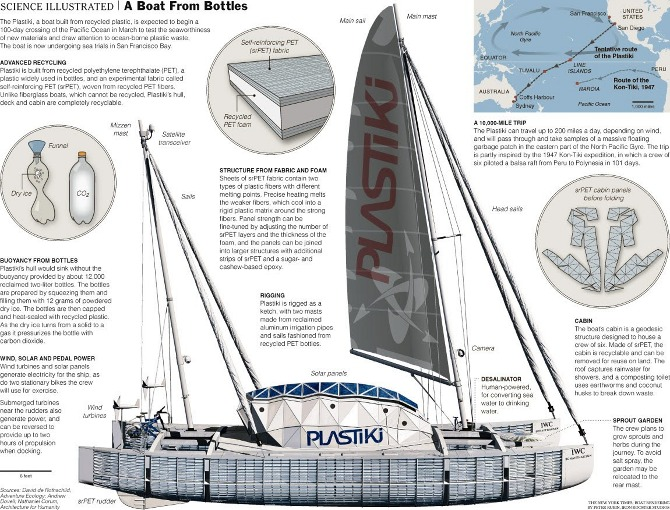
PLASTIKI

– A particularly ambitious vessel from found materials

From theplastiki.com


For a scavenger, patience is the key to the pantry.

– Delia Owens


S/V SCAVENGER


Trouble can come upon whole peoples, catching everyone by surprise. It happens. It’s happening now around the world. It can happen here.


Let’s try a little thought experiment…


Say that things have fallen apart, a little or a lot. Either the local, regional or global center did not hold and things got chaotic. Looters came and went, along with most residents. 


Say we want or need to build a sailing vessel from scratch with materials at hand in a depleted sub-urban area. Let’s say things have been permanently abandoned, and the moral coast is clear. Let’s further stipulate that all stores have been emptied.


What do we need? What of that is at hand??


Triloboats are designed to comprise a workable minimum. Simple box barge / scows, they are relatively quickly and easily built from rectangular materials (sheets and planks). They’re largely ‘form stable’, requiring little or no ballast. 


But there are plenty of other contenders!


Free-standing rigs simplify construction immensely. They are set on what are essentially flagpole principles: get a solid grip at the bottom and let the rest fend for itself.


A whole range of waterproofing puckies can be magicked up from combinations of asphalt, oils, waxes, gas/diesel/mineral spirits/turpentines, cement (lime) and toxins (antifouling).


So let’s look around for what’s at hand…


  • Residential – Fasteners galore, plywood (sheathing and sub-floor, mostly), 2x framing, beams (solid and composite), hardwoods(?), insulation (foam and fiber), windows, roofing (asphalt, sheet metals and flashing), plumbing, electrical, hinges, carpets, fabrics, housewares, soaps and bleaches. Jonni Rings™ (micro-crystaline wax rings sealing toilets)!!! Electronic and electrical.

  • Commercial buildings and schools – Bolts, hardware, hardwoods (bars and VIP enclaves), plumbing/piping, stainless sheets and furnishings (from kitchens), propane hardware (can be used with home brew methane), industrial cleaning agents, big glass, plexiglass, electrical, asphalt (flat roofs). Awnings?

  • Cars, RVs and trucks – Oils, 12VDC electrical and batteries (keep an eye out for lithium based batteries or better!), alternators + regulators, inverters, engines (can run on wood -smoke or -gas), pumps, hose, radiators (vehicular air conditioning radiators use lead-free solder), bolts, tires, tarps?, jacks, tools and tire irons, maps.

  • Roads – asphalt, bolts (guardrails), sheet metal (signs), manhole covers (ballast), culverts. Bus-stops (plexiglass).

  • Power Lines and sub-stations – Poles, guys anchors, bolts and Ubolts, turnbuckles, wire (electrical and supporting cable). Copper for melting and plate production.


Appliances and accessories yield small AC and DC motors (windshield wipers, vacuum cleaners, hairdryers, washers and dryers, etc), alternators and vacuum pumps (refrigerator/freezers). 


Line can be found in various ropings, scaffolding and window-washing set-ups, on flag poles. Keep an eye out for line in the back of trucks.


Look around for tools. Saw blades and files are some of the harder things to improvise, so keep an eye out. The business end of power tools can be given handles and used manually. Home garages, garden sheds and firehalls may have been overlooked. 


If you’re in a higher-brow kind of area, look for copper furnishings, roofing, gutters and flashing for anti-fouling.


Marinas and boatyards could be full of goodies, up to and including vessels that weren’t cherry-picked and need some work, much of it left behind in the rush to turn-key

 (see Bob Wise’s Volkscruiser Blog). 


Junk yards, of course. And landfills.


I’ll bet libraries - full of analog know-how - will largely be unlooted. Meantime, any skills acquired in advance of trouble are a plus.


And I didn’t even mention dumpsters!


Point is, we’re awash in material abundance which our ancestors would have coveted, and immediately pressed into service. No matter which way we turn, the merest garbage of our age is the stuff of early sci-fi dreams.


Consider looking around for vessel ideas that might work well with found materials. Let’s use our imaginations! Think out-of-the-box!!


The scenario of our thought experiment is extreme-ish. But no need to await some fallen sky… much of all this is available now for nearly free. Permissions to mine liabilities (condemned or obsolete installations) are easy to come by.


Look around!


Related Posts:


A Rogue’s Gallery of Boat Recipes

Musings on the Economics of DIY

Simply Does It


Tuesday, March 8, 2022

A Rogues' Galley of Boat Recipes

Boat Soup


Boil, boil, toil and trouble,

Fire burn and cauldron bubble!

– From Shakespeare’s MacBeth


A Rogues' Galley of Boat Recipes


Once upon a time, we mixed our own. We mixed our puckies to fit the need at hand. It's a very personal process... secret recipies, undisclosed additives and esoteric procedures. Sound crazy? It was, and - be warned - some of the ingredients carelessly handled made more than a few adepts more than a little crazy-for-real.


Better-living-through-chemistry stuff was still in development and, if available, cost an arm and a leg. Slowly, the industrial materials got better and cheaper. Now, when I ask around, I find that it’s only a few old-timers and Luddites that still mix our own.


Not to disparage the new goods… quite the contrary. Adhesives can’t be matched by home-brew. Modern resins are ultra-versatile; a one-size-fits-most solution. Paints are hard to beat.


But where goes wood, there lies a spectrum of needs. Wood works and swells and shrinks and cracks and closes up again, as one expects of a once living material. To meet the needs of wood, a just-so solution is often the best fit, filling in the wishlist between the broad strokes of modern, industrial magic.


Using them sets you down a road less traveled. Insofar as they replace plastics, they might be considered ‘greener’ on the whole. Their half-life is certainly shorter. For ‘natural’ wooden boats to be maintained in the field, this approach has a lot going for it... while they must be renewed more often, thy can be applied piecemeal in very short weather windows.


All in all, I can’t generally recommend going back to them while modern methods are available, but they can be a good fit for many situations. They DO represent a set of alternatives, and set one to thinking along pathways now mostly overgrown.


The following amounts to a menu ingredients with various consistencies and properties. Being mostly oil-based, they can’t easily be painted over or adhered to, neither in the short nor long term. Their economy is outstanding.


Here’s what I’ve stumbled across from boatwrights and fishermen and women…


INGREDIENTS


The following include materials I’ve heard of as having been used. New stuff shows up all the time (can you say Buckyballs?). Mix, match, improvise and adapt!


Thick Stuff


  • Bees'- and Microcrystaline Wax - Great bases for filling cracks or waterproofing. Microcrystalline wax is superior… most toilet rings are high in it and cheap, or it can be purchased pure.

  • Asphalt - Fibered or not, is used for roofing. Messy but cheap and versatile.

  • Tar (aka Pitch) - This used to be common around boatyards. Have to heat it to melt.

  • Furniture/Car Wax -- This stuff is easy on and can be combined. Buff to a beautiful finish. Check for exterior rating if exposed to UV.


Oils


  • Pine Tar - A fave of mine. Anti-fungal. On the thick side.

  • Tung Oil - Reputed not to mold or mildew. Turns laquery black after long sun exposure.

  • (Boiled) Linseed Oil - Pleasant oil… ‘boiled’ has drying chemicals added.

  • Oil Sludges - Generally used crank-case oils.

  • Corn Oil - New to me via a young old-timer. Inexpensive base. Outdoor apps look great, several years down the road.


NOTE: All of these are prone to spontaneous combustion. Rags and brushes should be immediately burned after use or immersed in water in a closed, metal container. Do NOT leave rags in direct sunlight for even a minute! (Experience talkin’, here).


Solvents


  • Turpentine - Distillate of wood. I trust this one irrationally.

  • Mineral Spirits and Paint Thinners - Cheap and work.

  • Diesel - Ditto, but smells like you’d expect, and never quite goes away.

  • Gasoline - Careful with this one. Deep penetration, then evaporates.

  • Acetone - Ditto.


NOTE: All of these are rich in VOCs (don’t breathe them) and highly flammable to the point of explosive (no sparks or flame). Note and employ all pertinent safety precautions!


Thickeners (Thixotropics)


  • Wood Flours - Cedars are fungus resistant, as are select exotics.

  • Talc - Thickens without setting firm (sometimes used above the waterline).

  • Chalk - Thickens without setting firm.

  • Cement - Thickens, but also sets firmer (sometimes used below the waterline). Highly alkiline, it protects wood to some extent. Consider latex additives, fabric matrix and/or chopped fibers if using alone.

  • Plaster of Paris - Ditto.

  • Brown Paper Fiber - Special case additive to tar ‘ties the room together’.

  • Various Chopped Fibers - Glass, poly, dryer lint, hemp, oakum, etc..


Additives


  • Bottom Paint - Cheap copper bottom paint is antifouling for below waterline.

  • Cuprous Solutions - Used for toxifying wood in contact with ground (e.g., Naphtha and Cuprinol).

  • Cayenne and Paprika Powder - High BTU capsicum is anti-fouling. Added to exterior below the waterline. Might work in the interior, and seem to be much less dangerous overall than leads?

  • Varnish - This is a generic term… lots of proprietary varnishes with various properties.

  • Powdered Mica or other UV inhibitors - These help slow deterioration and oxidization.


  • Red and White Lead Powder - Formerly used in beddings and exterior primer coats. Work great, but are highly toxic, especially when in powder form (both applying and repairing/renewing). Available as pottery glaze. Many consider these off-limits… we prefer Pine Tar as our go-to anti-biotic, with copper or capsicum thrown in as needed.


Commercial Additives

These are a few commercial items that many have included in their brew:

  • Penetrol and Thompson's Water Seal -- Two particular commercial brands that can be useful in the mix for exterior uses. Both are thin liquids.

  • Naptha (Copper Napthanate) -- Very toxic liquid, now banned. For careful, external use only.

  • Creosote - Very toxic biocidal, tarry substance. Can be DIY. It was sometimes used under a copper bottom paint to double protection.

  • Polyethelene Glycol (Anti-freeze) -- The green, poisonous stuff (vs pink, safer polypropylene glycol) is highly anti-fungal. Hydrophilic (loves water), it can penetrate wet woods, but also washes out over time. Rumor has it, it penetrates paint without staining for easy application.

  • Borax -- Powder additive with antifungal properties. Water soluble, however, so needs renewal.


NOTE: Again, many powders and solutions are NOT to be touched, much less breathed in. Consider carving conspicuous warnings to boatwrights down the road who may wade in unawares.


RECIPES


Rogues’ recipes are fuzzy things, and tend to vary wildly from person to person. These proportions will vary in the real world, according to your choices and by ingredients’ specific manufacture. Consider the proportions given a rough starting point.


Get to know the materials and how they react in your environment. Consider your purpose, and select for the properties you desire (flexibility, reset in warm conditions, penetration, hardness, antifouling, etc.). Nuance one way and the other as you deem fit, adjusting for the properties of each ingredient.


Small batches and test samples are strongly advised until you get a feel for it. A graduated Liter makes for easy, proportional math. All recipe parts given by volume. While all can be combined at ambient temperature, most mix better when heated in a double boiler, then allowed to cool.


Feel free - very free - to  experiment, innovate and otherwise roll-yer-own. It’s kind of addictive, really!


Here are a small sample I’ve encountered… adjust, extend or modify as desired:


Bedding Compound -


  6 parts Thickener : 1 part Oil : Dash of Additive (anti-biotic)


  Talc is a common choice for Thickener, while Pine Tar is antibiotic. Adjust mix for consistency.


Radial Crack Filler


 1 part Pine Tar : 1 part Wax


 Thicken with more wax, thin sparingly with turpentine.


Seam Compound (below WL) - 


  2 parts Fibered Asphalt : 1 part Portland Cement : 1 part Cuprous Bottom Paint


  Stiffen with more Asphalt, harden with more cement, thin with more paint.


Canvas Waterproofing -


  1 part Wax : 1 part Oil : 1 part Solvent


  Consider reducing Solvent to effective minimum.

  Saturate warm cloth and roll to penetrate fibers. Maybe check YouTube for a range of ideas.


Wood Slurry (Sealer for horizontal exterior surfaces) -


  1 part Wax : 2 parts Oil (Corn Oil was suggested to me for this application)


  Apply on cooling wood. Scrape lightly smooth once cooled.


Wood Slurry (Sealer for vertical, exterior surfaces) -


1 part Pine Tar : 1 part Oil (:1 part Solvent)


Consider adding Solvent for the first coat and a little Wax for subsequent coats.


Wood Exterior Water-Resistant ‘Stain’ -


10 parts Heavy Solvent: 1 part Oil : 1 part Non-Fibered Asphalt Tar


More Tar darkens; less is lighter. Consider an inexpensive solvent (such as Diesel) that will evaporate.


NOTE: For exterior coatings aka ‘Log Oil’s, I remember seeing a US Forest Service recipe that added powdered Mica to reflect and protect against UV rays. Powdered Mica is widely available, but I’m not sure about effective proportions. One full recipe is cited in the Using Paint, Stain and Oil section, from Dovetails and Broadaxes: Hands-on Log Cabin Preservation by USFS, which I am unfortunately able to access presently.


Thursday, April 2, 2020

COVID-19: Ozone Generators for Sterilization

Diagram from PrimaZone

COVID-19... Some dis-assembly is required.


 COVID-19: Ozone Generators and Sterilization


We've been using an ozone (O3) generator for several years, now, to sterilize our boat cabin and holds against various fungi including dry rot, mold and mildews. We also blow into a garbage bag to sterilize small items, now including masks, gloves and other PPE.

 << Our EnerZen unit costs about $85 as I write.

An advantage over UV sterilization is that it fills a space, where UV is line-of-sight and won't work in the 'shadow'.


While several studies suggest that ozone (O3) 'kills' COVID-19, this hasn't been fully established.

A word of caution... this type of generator sterilizes the space by elevating O3 concentrations to lethal levels for a short time. No People, Plants or Pets while working and until fully aired out. Don't even want to breathe a little of it. We amateurs should probably leave the building, even if you're only doing a single room within it.

Here's a quick article that hits the main points. And another in more depth.

There is another kind of ozone generator on the market which uses low levels of O3 to ionize particles to help purify air with people in the room. Some are being marketed as helping against CV19. These are not recommended by most medical authorities ever, and especially not now.

If breathed in, ozone irritates, inflames and even kills cells all along the respiratory tract. This makes the cells even more susceptible to virus and bacteria, and if infected, inflammation is a serious co factor for worse outcomes. 'Safe' levels for O3 can be understood as merely 'negligible damage' even when threat of infection is low.

Incidentally, ozone also clears away smells from such maritime nuisances as locker funk, diesel or gas, wet dog, bilge, etc..

Thinking of you all, especially in these somber times.


NOTE: Most hospitals have ozone generators for sterilizing operating and patient rooms. PPEs can be treated for re-use in room-sized batches. Even if it only reduces viral load, it is better than some of the desperate measures (such as paper bags between re-uses!). Please help spread the word your health care professionals.

NOTE: For sailors using ozone in the Spore Wars, be aware that ozone is extremely oxidizing, the heat-producing reaction behind spontaneous combustion. Be sure there are no oily rags lying about!

Sunday, March 22, 2020

COVID-19: Why Nobody Likes Math


Double, double, toil and trouble!
-- Shakespeare


COVID-19: Why Nobody Likes Math
(Or at least, Mathematicians)

Um. The majority of people I speak with are busy making business-as-usual plans through summer.

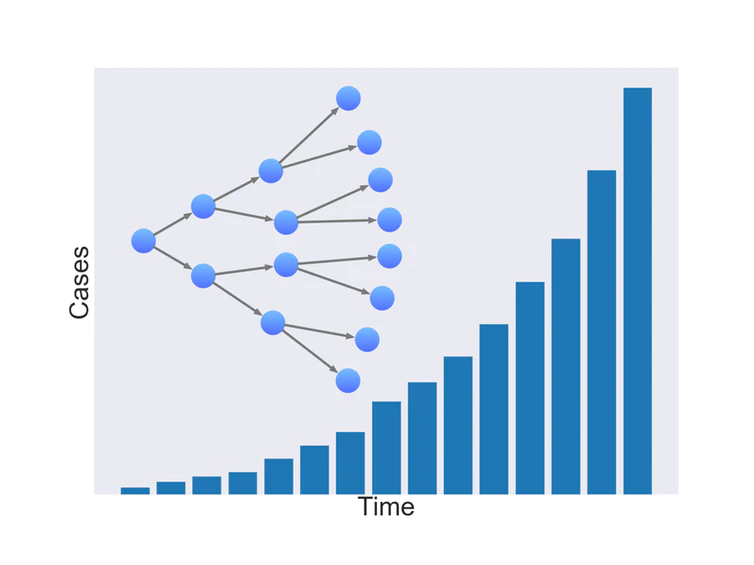
COVID-19's global reach is doubling every 4 to 6 days resulting in explosive exponential growth. There's a lot of finicky issues in calculating these numbers... let's be optimistic and say it's only doubling every 10 days.

That is to say, the total number of people who have been infected with the virus doubles in every 10 day period. Let's roundly say that each month has three 10 day periods, so it will double three times every month. The total at the beginning of any month will grow by a multiple of 2... 4... 8 times by the end of that month.

As I write, today's global total is 300,000 who have been infected.

How many months ahead do you want to plan? Each month, the total grows by a factor of 8. Here's a convenient little planner:

  1. Mid-April ...              8 x 300,000   = 2,400,000
  2. Mid-May ...             64 x 300,000   = 19,000,000
  3. Mid-June ...           512 x 3000,000 = 153,600,000
  4. Mid-July ...         4,096 x 3000,000 = 1,228,800,000
  5. Mid-August ...   32,768 x 300,000   =  OOPS...
                                                              ...  exceeds human population.
  6.  
  7.  
  8.                          >>>  Here there be Monsters  <<<
  9.  
  10.  
  11.  
  12.  As I write, this is the earliest we might hope for a vaccine.

Things not cool today? So many months from now, the first number is how many times worse it will be at the present doubling rate. The math spotlights the urgency

If you can think in terms of doubling time (rather than days, weeks and months) it will help you with vital decisions.

*****

At the rates we used, the spread will peak sometime between four and five months out if it hasn't been flattened. That's the July? August? the President mentioned. 

While the CDC knows all this (their data, after all), they are coy about being specific. They urge, for example, that we have supplies on hand for "a period of time", or occasionally "two weeks". Yet stay-at-home orders implemented today are likely to be in place and tightening for months ahead.

China managed to flatten their curve and are seeing declining numbers of new cases. Whatever we might think of their politics, they moved relatively early and according to accepted epidemiological practice. In two months, they were able to locally flatten and reverse spread. Nevertheless, they may miss a case or two, or be re-infected from the rest of the world which has not taken strident measures to date. Then it's start over with the same 'draconian' measures.

Of course, this presently high doubling rate we're discussing won't sustain.

Social distance and travel restrictions will slow the rate of growth (won't eliminate it without unAmerican resolve). But these flattening measures also prolong the period of pandemic by spreading cases over time. Even if no measures are taken, the spread slows as a higher percentage of the population acquires immunity or dies.

Things won't turn on a dime. We are seeing measures ramp up late in the game, but early in the eventual spread. We hope to avoid the spike. At best, there will be tightening restrictions for months to come. Our best laid plans are all agley.

Meanwhile, the global economy is coming apart at the seams.


So provision up, batten down hatches and take a reef, me Hearties! 
Were in the storm, sure enough!!


The higher the dot, the slower the spread.
From Scientific American article


PS. Among the mitigation and travel restriction measures being implemented, travel by private vessel is being restricted in places around the globe. Even those of us who live aboard need to get where we want to be NOW, before rules and enforcement get around to our stretch of water!

Monday, March 16, 2020

COVID-19: Circle the Wagons

Important, but is it happening in time?
Treatment capacity lines seem optimistic, to me...
assumes healthcare is exceeded vs overwhelmed.

James gave the huffle of a snail in danger,
And nobody heard him at all.

-- A. A. Milne


COVID-19: Circling the Wagons

For those of you who don't know it, I've been huffling since the run up to Y2K about TEOTWAWKI - The End Of The World As We Know It.

Now I believe we're watching it unfold.

The basic factors are these
  • A fragile, Global Industrial Economy (GIE)... our tightly coupled, deeply indebted Complex Adaptive System (CAS).
  • A vast, overshot, human population which depends on a functional GIE for its livelihood.
  • Exponential spread of COVID-19 pandemic which will almost certainly overwhelm the healthcare system.
  • Failed containment and failing mitigation measures.
  • Exponential growth of associated problems.

Exponential growth of anything catches humans by surprise in almost every case. Windows of opportunity for meaningful action / preparation are snapping closed at a rate that's difficult for human beings to grasp intuitively.

NOTE: See here (~4 min vid... visceral impact of exponential growth) and here (~9min vid... exponential spread of COVID-19 vs flattening) to get a taste of the challenge.

David Korowicz lays out the general issues in his paper Trade-off (77 pages for the very interested) and specifically, pandemic based analysis in Catastrophic Shocks in Complex Socio-Economic Systems: A Pandemic Perspective (10 pages for the interested). Both are challenging reading, but, I believe, provide a foundation for viewing current events.

CAS's - such as the human body - have a range of stability. Within that range, they can be astoundingly resilient. But if events drive them beyond that range, a tipping point is reached and the whole system settles into a new equilibrium.

In the human body, an infection can lead to the loss of a critical function (breathing, say), and in a rapid cascade it collapses (and without rapid, correct intervention, dies). In a just-in-time economy, supply-chain interruptions block down-chain production and can rapidly paralyze the economy. In finance, disturbing the mountain of debt can bring currencies and institutions crashing down.

All of these are underway. [Or, for a less detailed and challenging glimpse of the problem, try this article.]

This is my long-winded way of saying that this is both serious and moving faster than we imagine.


 My Urgent Advice...

>>>  Get together with those you most love RIGHT NOW. Stay together for the duration.

>>>  Get together provisions RIGHT NOW (food, water, essential medicines, cooking/heating fuel) for a minimum of two weeks (CDC advice). Longer is better.

>>>  Make an isolation / infected plan and put it into action RIGHT NOW.

>>>  Don't panic, but GET MOVING.


Whether I'm right or wrong about larger consequences... even if the GIE manages to function beyond the crisis... even if your area has no known cases...  whether you are riding this out or hunkering down for trouble...

Containment and mitigation measures are shutting down travel and contact for unspecified periods. If flattening the curve is successful (our best chance), lockdowns will be in place for months, not weeks.

I say again, windows of opportunity are snapping closed.

Fair winds, health and happiness to all of us,

Dave and Anke


P.S. Here's some good advice from a guy who's been there.

Saturday, March 7, 2020

Ama AHA! Quick and Dirty Approach to a Small Multihull

Insurance for a narrow hull

My escape is to just get in a boat and disappear on the water.

-- Carl Hiaasen


Ama AHA! Quick and Dirty Approach to a Small Multihull

Let's say we can get our hands on a canoe, dory, kayak or other small craft. We enjoy paddling around, but are thinking a sail would really be kinda fun. But we're cheap.

What might we do?

To sail, we'll need some basic things:
  • Stability
  • Sail and rig
  • Lateral Resistance
  • Steering

Stability

I'll presume our little boat is narrow and tippy. We may get some stability from ballast, but that's awkward and complicates everything. So we look for ways to increase form stability.

The arrangement shown above looks quick and dirty to me.
Three features excite me...

A) The simple, bent ama shape... even with blunt ends, most of the time the immersed shape will be hydrodynamic. These look to be PVC which can be momentarily softened and permanently shaped with moderate heat (hot air gun, hair dryer or holding over a heat source). 

Small trees for cross beams and curved drift logs from the base of select trees would work as well, and can be quickly shaped with an axe.

B) The over and under arrangement with the cross beams... the aft strut could easily be eliminated with more curvature or an arced cross beam.

C) The whole affair can be lashed up... all we need is some line and a few holes bored below the sheer rail at mounting points.

This simplifies a scheme Anke and I have been wanting to try with our dory as well sas a planned, half-open beach cruiser, in which we can go into proa or tri mode using beachcombed crossbeams and akas. Using this approach, so long as the hull has xbeam mounting points, the whole thing can be lashed up with minimal carpentry. 
When done with a (windward) sailing stretch, we can disassemble and row/downwind sail off leaving the components in our wake. 

Of course, this works especially well in an area like the Cascadian Passage. Won't be so easy, in a lot of places where the beachcombing is limited.

Sail and Rig

A sail is a simple thing. Any flat fabric of the right size will do. Problem is, flat sails work (if you allow them to twist) but they are not powerful. A little shaping goes a long way. The trick is to get the right amount and proportion of extra fabric toward the middle of the sail.

Q&D fabrics include tarps of most any kind, house-wrap, awning material, sheets and so on.
Q&D solutions for shaping a sail:
  • Cut one or more perimeters with some curvature (curved away from the sail's center). When straightened along a spar or under tension, the extra fabric goes toward the middle.

  • Seize around one or more corners. This pinches the tied corner, tightens the perimeter and radiating cloth from the corner toward the middle.

  • Selectively dart the edges. This is a little fancier, and takes some knowledge or experience. But good in the tool kit.

Masts can be made from small diameter trees (chances are your guess at about right will be about right). If straight ones aren't available, consider a balanced lug rig, which sets well on a crooked mast.

They need at least two points of support - step (or heel stop) and partners with as wide a spread as you can manage (can always add stays). Since we're talking small boats, these needn't be too beefy. U-shaped pipe hangers have worked well for us as partners and stop. If the hull is thin, we'll add a small plate of plywood under the mast heel (bottom end of mast).

If you decide to go bigger, scale up as need be.
You'll need sheets to haul the sail in and let it out. A halyard is optional (sail may be fixed to mast). Some rigs will have their own extras. Consider rigs that keep the extras down (sorry Junk Rig!).

PDRacers are a racing platform with no specified rig. In short, you can see all manner of practical (and impractical) rigs for small boats here.


Lateral Resistance

The harder the chine (angle or radius between sides and bottom), the more lateral resistance from the hull. If we want to sail to windward, we'll need to add more.

Simplest means I know of is an Off-CenterBoard. Most just call them leeboards, but they work on both tacks. Of these, among the simplest is Jim Michalak's pivoting leeboard.


Steering

The simplest solution is no rudder. Balancing sail adjusted with sheets against lateral resistance adjusted by weight shifts (LR moves for and aft with crew weight). This is why sailboards need none.

An oar over the side or stern is next. A well placed pin or stern notch, respectively, help keep it in place and reduce fatigue.

A light kick-up rudder (bearing plate style is simplest of these) can be easily hung on strap hinges, and doesn't require mounting or dis-mounting when leaving or approaching shore.


*****

So there you have it. A bag of Q&D approaches that can have you sailing day after tomorrow! 
Don't forget flotation and life-jackets!


...

Full disclosure: COVID-19 has me on alert. If you may need to travel by water, it's a good time to be getting a boat in hand. Go small, go simple, get ready!

Sunday, June 7, 2015

Introducing Ray Jason's SEAGYPSY TRIBE Proposal

Pair of Wharram Catamarans


I believe that a catastrophic global collapse is coming and that the best escape is through small bands of enlightened sea gypsies surviving and then sculpting a style of living that is authentic, just, sustainable and joyous.
- Ray Jason


Introducing Ray Jason's SEAGYPSY TRIBE Proposal

Ray Jason (aka the Seagypsy Philosopher) is one who balances a love of the moment with the belief that our modern civilization, built on 'conquest agriculture' - he calls it Humanity 2.0 - is going down. Hard. Hard enough that NTHE (Near Term Human Extinction) is, at least, a plausible outcome.

But he has a proposal for us... the Seagypsy Tribe.

Loosely networked, anarchic tribes of sea gypsies sailing vessels able to keep the sea for considerable periods, he argues, would have the best chance of surviving local and/or global disaster. In his Start-Up Manual, he outlines his thinking on how the tribe might coalesce.

In case of local trouble, head 50 miles offshore - beyond the range of fuel-strapped marauders - and await developments. Should the region become untenable, set sail for a new one.

For Ray, as or more important than survival is a better way of looking at things. Wisdom.

His proposed Seagypsy Tribal Principles include such as Life is a web - not a pyramid. Simplicity is better than complexity. Embrace co-operation and not competition. Each a step-stone toward Humanity 3.0.

If you don't agree with all of them, no problem... they and your own can be discussed over a friendly cup o' kindness.

Preserving some of what has been wonderful about civilization while warning of its pitfalls is part of the Seagypsy Tribe's true essence. Ray calls it Mozart without the mushroom cloud.

But what about piracy? And a sailing vessel can't stay at sea forever! Ray addresses these concerns and others in further thoughts.


*****

Of course, this is right down my alley!

I pine for such a tribe in an earlier post, TAZ, Sea-Steading and Water-Borne Communities. A coming together - and going a'venture - of similar souls in a watery environ. In no small measure, this blog has been a way of attracting such a community. Scratching that itch, as it were, and I thank you all for your friendships.

Like Ray, I see the hand-writing on walls closing in. Limits to Growth tightening everywhere I look. The sea is no exception. But the sea is old, and vast.

Gaia Theory notes that the liquid state of water can only pertain in a very small range of temperature. Below freezing (273.15deg Kelvin) and above boiling (373.15 Kelvin) - a tiny fraction of possible planetary surface temperatures- our oceans freeze solid or vanish, taking all life with it. Yet, for 3.5+ billion years, the liquid sea has harbored life, which has in turn moderated planetary geophysics within that narrow, crucial range.

If our life is to go forward, what better refuge than the sea? What better vessel than one which sails?

What better tribe than one composed of friends?


Here are Ray Jason's SEAGYPSY TRIBE essays to date, recapped from the preceding text:


The SEAGYPSY TRIBE - The 'why'.
The True Essence of SEAGYPSY TRIBE - The spirit.
The SEAGYPSY TRIBE Start-Up Manual - The 'how'.
The SEAGYPSY Tribal Principals - The wisdom.
SEAGYPSY TRIBE Further Thoughts - Responding to the response.