Please visit our home site at www.TRILOBOATS.com.

Anke and I live aboard WAYWARD, and wrote about it's design and construction at ABargeInTheMaking.blogspot.com.

Access to the net comes and goes, so I'll be writing in fits and spurts.Please feel free to browse the archives, leave comments where you will and write... I'll respond as I can.

Fair winds!

Dave and Anke
triloboats swirly gmail daughter com

Showing posts with label New Age of Sail. Show all posts

Monday, April 25, 2022

S/V SCAVENGER


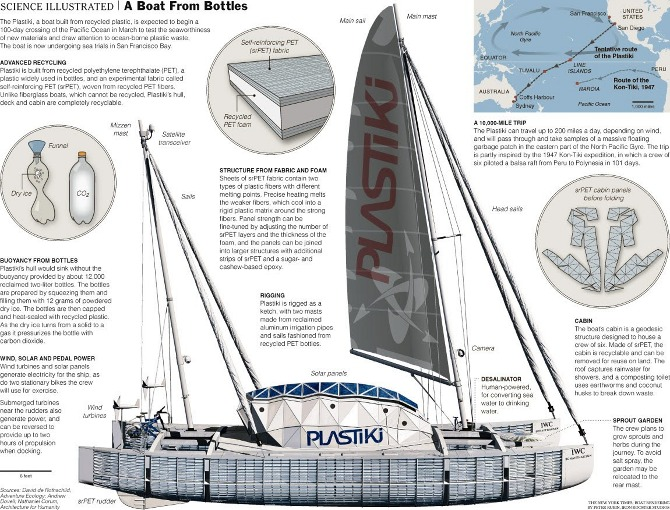
PLASTIKI

– A particularly ambitious vessel from found materials

From theplastiki.com


For a scavenger, patience is the key to the pantry.

– Delia Owens


S/V SCAVENGER


Trouble can come upon whole peoples, catching everyone by surprise. It happens. It’s happening now around the world. It can happen here.


Let’s try a little thought experiment…


Say that things have fallen apart, a little or a lot. Either the local, regional or global center did not hold and things got chaotic. Looters came and went, along with most residents. 


Say we want or need to build a sailing vessel from scratch with materials at hand in a depleted sub-urban area. Let’s say things have been permanently abandoned, and the moral coast is clear. Let’s further stipulate that all stores have been emptied.


What do we need? What of that is at hand??


Triloboats are designed to comprise a workable minimum. Simple box barge / scows, they are relatively quickly and easily built from rectangular materials (sheets and planks). They’re largely ‘form stable’, requiring little or no ballast. 


But there are plenty of other contenders!


Free-standing rigs simplify construction immensely. They are set on what are essentially flagpole principles: get a solid grip at the bottom and let the rest fend for itself.


A whole range of waterproofing puckies can be magicked up from combinations of asphalt, oils, waxes, gas/diesel/mineral spirits/turpentines, cement (lime) and toxins (antifouling).


So let’s look around for what’s at hand…


  • Residential – Fasteners galore, plywood (sheathing and sub-floor, mostly), 2x framing, beams (solid and composite), hardwoods(?), insulation (foam and fiber), windows, roofing (asphalt, sheet metals and flashing), plumbing, electrical, hinges, carpets, fabrics, housewares, soaps and bleaches. Jonni Rings™ (micro-crystaline wax rings sealing toilets)!!! Electronic and electrical.

  • Commercial buildings and schools – Bolts, hardware, hardwoods (bars and VIP enclaves), plumbing/piping, stainless sheets and furnishings (from kitchens), propane hardware (can be used with home brew methane), industrial cleaning agents, big glass, plexiglass, electrical, asphalt (flat roofs). Awnings?

  • Cars, RVs and trucks – Oils, 12VDC electrical and batteries (keep an eye out for lithium based batteries or better!), alternators + regulators, inverters, engines (can run on wood -smoke or -gas), pumps, hose, radiators (vehicular air conditioning radiators use lead-free solder), bolts, tires, tarps?, jacks, tools and tire irons, maps.

  • Roads – asphalt, bolts (guardrails), sheet metal (signs), manhole covers (ballast), culverts. Bus-stops (plexiglass).

  • Power Lines and sub-stations – Poles, guys anchors, bolts and Ubolts, turnbuckles, wire (electrical and supporting cable). Copper for melting and plate production.


Appliances and accessories yield small AC and DC motors (windshield wipers, vacuum cleaners, hairdryers, washers and dryers, etc), alternators and vacuum pumps (refrigerator/freezers). 


Line can be found in various ropings, scaffolding and window-washing set-ups, on flag poles. Keep an eye out for line in the back of trucks.


Look around for tools. Saw blades and files are some of the harder things to improvise, so keep an eye out. The business end of power tools can be given handles and used manually. Home garages, garden sheds and firehalls may have been overlooked. 


If you’re in a higher-brow kind of area, look for copper furnishings, roofing, gutters and flashing for anti-fouling.


Marinas and boatyards could be full of goodies, up to and including vessels that weren’t cherry-picked and need some work, much of it left behind in the rush to turn-key

 (see Bob Wise’s Volkscruiser Blog). 


Junk yards, of course. And landfills.


I’ll bet libraries - full of analog know-how - will largely be unlooted. Meantime, any skills acquired in advance of trouble are a plus.


And I didn’t even mention dumpsters!


Point is, we’re awash in material abundance which our ancestors would have coveted, and immediately pressed into service. No matter which way we turn, the merest garbage of our age is the stuff of early sci-fi dreams.


Consider looking around for vessel ideas that might work well with found materials. Let’s use our imaginations! Think out-of-the-box!!


The scenario of our thought experiment is extreme-ish. But no need to await some fallen sky… much of all this is available now for nearly free. Permissions to mine liabilities (condemned or obsolete installations) are easy to come by.


Look around!


Related Posts:


A Rogue’s Gallery of Boat Recipes

Musings on the Economics of DIY

Simply Does It


Tuesday, June 16, 2015

Bootstrap Economics: Reaching for Escape Velocity

Maybe UP isn't the preferred direction?


Bootstrap's bootstraps. Hehe.
- From Pirates of the Caribbean


Bootstrap Economics: Reaching for Escape Velocity

I've been mulling over a reader's recent comment regarding the building of our new boat, WAYWARD:

To tell the truth, it is a little hard to see how 30 grand in materials for a boat is exactly shoestring living. Maybe it's different on the water, but where folks around here live close to the land, owning our own little places, people are very hard pressed to gather into one place a little pile of money one-sixth of that. HARD pressed.

We don't think of WAYWARD as a shoestring build, despite many shoestring aspects of our operation.

The actual number is closer to $20K for materials (now in retrospect... reduced by discounts and adjusted to eliminate costs of building remote). Our labor is 'free' to us. Almost half of that is copper plating costs, which we feel pays for itself over time AND - as a commodity metal - has intrinsic value. By making other choices we could possibly have cut the remainder in half (we made some expensive choices based on our build situation... it could have been much simpler and cheaper to build elsewhere).

So before copper but including infrastructure, our materials came to about $11K.

But the point is well-taken. THIS boat swallowed up a chunk-o-change. The question is a good one...

How do low-income folks sweep together this kind of cash money?


Income - Overheads = Disposable Income or Debt

Disposable income is money free to be directed where one will. Toward ease, entertainment, travel... or the fulfillment of dreams.

It is the left-overs from income after overheads - those costs necessary to one's lifestyle.

Low income folks seldom have reasonable opportunity to substantially increase our income. In fact, the general trend is downward. But lifestyle can be changed to reduce overheads.

Life on the water is potentially very low overhead. This fact underlies bootstrap economics that make it possible to attain the dream, even on low income.

Let's start with the simple life on land...


Overhead

"...Folks around here live close to the land, owning our own little places..."

A whole economy is implied in this phrase.

Nowadays, property for habitable land must be inherited, gifted, rented or purchased. Before and after land is paid for, it is subject to property taxes based on assessed value (which may be far above actual market value). Access and rights-of-way must be reserved and maintained.

Structures either came with the property or must be constructed. If not let run to ruin, they must be maintained, often in accordance with zoning laws and regulations. Generally, their scale produces proportionally large expenses. Their value is taxed, and improvements of one's own or one's neighbor generally increase assessments.

Whether you rent or own, these costs find their way to the Occupant.

Generally, one or more vehicles are involved. Purchase, maintenance, repair, fuel, insurance. Secondary costs creep up, too... that trip to see Auntie, a wedding just a few hours away, that rendez-vous just a state over... each side-trip is festooned with small, extra-vehicular expenses.

From the full comment from which I quoted above, the folk in question seem to be keeping up. Foreclosure is not mentioned, and some savings are possible. But it is implied they are not getting ahead.

NOTE: Children are sometimes thought of as generating overheads, but I'm not so sure. In our case, we're a couple of LINKs (Low Income, No Kids). This frees a certain amount of cash, though not as much as our culture generally assumes. Kids don't require cash... they mostly thrive on love, food, water and fresh air. I won't go into it further, here, but there are plenty of quality families persuasive on this point.


Crunching Some Numbers over a 5-year Span

Let's look at rent. Since 1985, $500/month has been near what's considered to be low end for a functional space in places I've lived (Pacific NW). That's $6K/year. Over 5 years, that's $30K!

NOTE: That rental price used to be for a modest apartment - nothing fancy - in okay condition... now it's getting to be dive price. In some parts of the country, rents may be somewhat lower, but will nevertheless generate large figures over time. My contacts assure me that ALL these numbers are wildly conservative.

How 'bout a car? Let's say $1K purchase price. You put 5K miles on it per year - half the national average - at 25mpg and $2/g for gas. Legally required liability insurance costs, say, $100/month. Over five years, you replace the tires with retreads for say, $500, and  do your own oil change/tune-ups every 2K miles averaging $25 a pop (oil, filters, plugs, etc). In five years, these conservative numbers generate costs close to $10K!

Okay... that's a $40K lump swept together from $8K/year given over to quite modest rent + vehicle.

If we could eliminate just these two overheads, the same, low income that had been narrowly paying the bills would generate relative heaps of disposable income.

Fortunately, there is a way...


Bootstrap onto the Water and Deep-Six Overheads

Once on the water overheads can be low to niggling - especially for engine-free sailboats, with solar or wind electrical generation and biomass heat/cooking.

If you anchor out, no rent. No utilities (though on-board electrical is in effect a utility cost). No fuel. No taxes. Reasonable costs to meet Coast Guard regulations. Low maintenance. Replacement costs are low and spread out.

How to get there?

Bob Wise, at Volkscruiser, has a lot of good advice on the how-tos of getting a boat under you for reasonable outlay. When I say 'reasonable' I mean obtaining a home for the cost a used car. It's a buyer's market, out there, with a lot of lonely, serviceable boats at fire-sale rates.

With both feet still on land, one can save toward a small cash-down purchase or build. The bar can be lowered by arranging 'owner-financed' terms.

Consider avoiding credit with attendant interest payments (which can easily double the cost of purchase).


Income

We Water Rats have in our favor the ability to take on remote work while providing our own infrastructure, plus the generally handy skills we WILL develop aboard. Having to make-do naturally suits us to a range of jobs that drive Professionals nuts on the urban frontier.

We can get a job done without an employer having to worry about our transportation, care and feeding. Out-of-the-way work affords a substantial and uncrowded market niche for our services.

Odd jobs suit our kind; commuting to regular work does not... leave that to the Lubbers! We strike a bargain, fulfill our commitments, collect our pay and sail off.

Micro-streams of income, thanks to low overheads, can play a large role in our micro-budgets.

Special situations may call for something like a 5-year plan. In effect, we financed WAYWARD by working two extra seasons (seasonal caretaking), between recent every-other-year gigs. That extra push provided the 'extravagant' wherewithal without raising our prospects to anywhere near the official poverty level.

We're now looking forward to recovering from chronic employment.  8)


Location

Much of this presupposes that we live aboard in areas which are not yet rigged to milk us, nor yet move us along. There are generally two types of suitable waters:

Waters remote from population centers - Concerned Citizens - and conformity regulations they tend promote - are few and far between. They're more likely than not to be friend, client and employer material. Much of Cascadia is an example of this type, especially its mid- to northern reaches.

Cracks - In these, regs might well be in place, but enforcement is low to lackadaisical. If Concerned Citizens inhabit the neighborhood, it has enough blind spots to keep out of their view. A bit more shuffling around might be in order to diffuse the profile. The Sacramento Delta is such an area.

Sometimes, a funky marina can be found for a reasonable trade-off between increased income (earned nearby) and low rent. But careful... a lot of us who enter, never return. Escape was hard enough the first time round!

If you wish to attain escape velocity but don't currently live in an area where on-board life is inexpensive, consider relocation as part of your plan.


Savings

Disposable income is very often disposed of. Money burns holes in pockets. A splurge here; a luxury there. Just doesn't seem to accumulate.

Your Money or Your Life recommends we spend consciously. Put that money toward realizing dreams, not impulses.

You might be surprised how quickly it accumulates.  How powerful money, well spent, can be!


Our Escape Trajectory

In 1990, Anke and I bought our first boat, used, for $5K - $1500 down and $500/month for 7 months (could see it as short horizon rent-to-own). To pay it off, I flipped pizza at a notch above minimum wage, while Anke worked at a winery and childcare for a notch below. We both quit steady work the day we put paid. From then on, we were able to live on odd jobs (easier to manage from the water), yet sock half our piddly earnings away.

We lived on BRAMBLE for five years, learning to sail and boat carpentry. When we sold her, we recovered our purchase price.

The financial story is a bit more complex than this, but the gist is, the low overheads enabled by that first boat freed up 'capital' for use toward building our own. A sizable portion of our investment in each vessel has passed from one to the next (equity). Our moderate income over the years has been divided between low overheads, family related travel and a short run of DIY, liveaboard vessels.

An important point... BRAMBLE was not our dream boat, but rather our 'kindergarten boat'.

All inadvertently (and thanks to Anke's pragmatism), we lucked into a viable, bootstrap approach which broke the financial burdens of life on land. If we'd followed my lead, we'd have dithered away years - if not our lives - vainly scraping for that 'perfect' boat, anchored by overheads.

From our first days on the water, it has been different.


NOTE: There are many reasons to council that one NOT build one's first boat, but rather buy used. There is so much that first boat will teach you; lacking that experience to inform your choices, it's difficult to justify the time, effort and expense invested in building, unless you simply enjoy the process. Triloboats attempt to lower that cost, while this blog attempts to fill some experiential blanks. But the main goal of both is to help those of you who wish it toward the water!



Sunday, June 7, 2015

Introducing Ray Jason's SEAGYPSY TRIBE Proposal

Pair of Wharram Catamarans


I believe that a catastrophic global collapse is coming and that the best escape is through small bands of enlightened sea gypsies surviving and then sculpting a style of living that is authentic, just, sustainable and joyous.
- Ray Jason


Introducing Ray Jason's SEAGYPSY TRIBE Proposal

Ray Jason (aka the Seagypsy Philosopher) is one who balances a love of the moment with the belief that our modern civilization, built on 'conquest agriculture' - he calls it Humanity 2.0 - is going down. Hard. Hard enough that NTHE (Near Term Human Extinction) is, at least, a plausible outcome.

But he has a proposal for us... the Seagypsy Tribe.

Loosely networked, anarchic tribes of sea gypsies sailing vessels able to keep the sea for considerable periods, he argues, would have the best chance of surviving local and/or global disaster. In his Start-Up Manual, he outlines his thinking on how the tribe might coalesce.

In case of local trouble, head 50 miles offshore - beyond the range of fuel-strapped marauders - and await developments. Should the region become untenable, set sail for a new one.

For Ray, as or more important than survival is a better way of looking at things. Wisdom.

His proposed Seagypsy Tribal Principles include such as Life is a web - not a pyramid. Simplicity is better than complexity. Embrace co-operation and not competition. Each a step-stone toward Humanity 3.0.

If you don't agree with all of them, no problem... they and your own can be discussed over a friendly cup o' kindness.

Preserving some of what has been wonderful about civilization while warning of its pitfalls is part of the Seagypsy Tribe's true essence. Ray calls it Mozart without the mushroom cloud.

But what about piracy? And a sailing vessel can't stay at sea forever! Ray addresses these concerns and others in further thoughts.


*****

Of course, this is right down my alley!

I pine for such a tribe in an earlier post, TAZ, Sea-Steading and Water-Borne Communities. A coming together - and going a'venture - of similar souls in a watery environ. In no small measure, this blog has been a way of attracting such a community. Scratching that itch, as it were, and I thank you all for your friendships.

Like Ray, I see the hand-writing on walls closing in. Limits to Growth tightening everywhere I look. The sea is no exception. But the sea is old, and vast.

Gaia Theory notes that the liquid state of water can only pertain in a very small range of temperature. Below freezing (273.15deg Kelvin) and above boiling (373.15 Kelvin) - a tiny fraction of possible planetary surface temperatures- our oceans freeze solid or vanish, taking all life with it. Yet, for 3.5+ billion years, the liquid sea has harbored life, which has in turn moderated planetary geophysics within that narrow, crucial range.

If our life is to go forward, what better refuge than the sea? What better vessel than one which sails?

What better tribe than one composed of friends?


Here are Ray Jason's SEAGYPSY TRIBE essays to date, recapped from the preceding text:


The SEAGYPSY TRIBE - The 'why'.
The True Essence of SEAGYPSY TRIBE - The spirit.
The SEAGYPSY TRIBE Start-Up Manual - The 'how'.
The SEAGYPSY Tribal Principals - The wisdom.
SEAGYPSY TRIBE Further Thoughts - Responding to the response.

Sunday, January 19, 2014

Diet for a Small Boat

Complimentarity for Complete Proteins
See Diet for a Small Planet by FM Lappe


We're not just what we eat, we're how we eat.


Diet for a Small Boat

Okay, not so much a diet as a handful of strategies for feeding oneself on a shoestring.

A lot of the info available for self-sufficiency focuses on land-based homesteads. Horti- and agriculture, often coupled with animal husbandry techniques don't translate as well to seasteading. 

Our distinguishing characteristic, as cruisers, is our mobility. We're not tied to any particular piece of land, but have access to a range of resources. We want, therefore, strategies that allow us to feed along the way. We want to avoid, or at least minimize those which tie us to a particular time, place or economy.

The following are a number of strategies that we're doing, dabbled in, or hope to try. Like most things in our life, it's a work in progress. You'll note that some are diametrically opposed to others. What they have in common is the promise of easing us out of the consumer economy, and toward a more subsistant lifestyle.


Guiding Philosophies

  • Nomadics -- Gotta eat and run!
  • Wildivoracious -- Eat wild, when possible.
  • Locovoracious -- Eat local, when possible.
  • Opportunivoracious -- Eat what presents itself.
  • Omnivoracious -- Broaden the palette.
  • Neo-Primitivism -- Do what can be done by hand.


Approaches

  • Neo-Primitive aka Paleolithic Diet -- Fewer, high-quality carbohydrates and more proteins.
  • Vegetarian -- Potentially more energy efficient by orders of magnitude.
  • Vegan -- See New Age of Sail by Dmitry Orlov.
  • Raw Foods -- As adherents ask, "What's so different about humans, among all other animals on earth, that we require cooked food?"


Food Sources

  • Gathering (Wild)
  • Gleaning (Fringe)
  • Fish, Game and Others
  • Guerrilla Gardening
  • On-Board Gardening
  • Barter -- Includes barter for 'money'.

Enhancement

  • Fermentation -- See Wild Fermentation by SE Katz.
  • Protein Complimentarity -- 2 part grains : 1 part legumes (and other combos).
  • Sprouting


Preservation

  • Drying -- For the weight-conscious cruiser!
  • Pickling
  • Brining
  • Smoking
  • Canning


Fuel

  • Biomass -- Wood, peat, etc..
  • Biofuels -- Let's say, liquid fuels processed from biomass.
  • Solar -- The gift that keeps giving.


*****

We've tried all of these, and most of them have become staple approaches. 

They're easy, fun and tasty. Each of them takes us one step further afield, lets us stay out longer, and reduces our dependency on the monetary economy. They help tie us into local networks of gardeners, fisherfolk, home cooks and friends at large.

Food is something we all need and love...

Why not make the most of it?


Saturday, October 26, 2013

DON'T BLINK! CERES in NYC


The Dream...


The Vermont Sail Freight Project Reality!


 In the end all was fine, our fine barge rose to each challenge gloriously.  Captain Steve, who had been dubious about the seaworthiness of the barge right from the start was ready to hug me and declare me a master shipbuilder by the time we had rounded the battery. 

From Ceres has Arrived in NYC by Erik Andrus


In the brief time since my last post - SPLASH! CERES Launches the Vermont Sail Freight Project - much has happened.

First, she goes and attempts a late-season maiden voyage / test cargo run from here homeport of Vergennes, Vermont, across Lake Champlaign to Burlington. Full success.

Okay... that was ambitious. New boat with all the small details to work out. Challenge enough. But a cargo of foodstuffs to organize, load, transport, unload and market? Well... if you can do it, it ain't braggin'.

Time to put her to bed for the winter, right? Right?? Ruminate and plan for another, modest step forward come spring?
 
Wrong!

Next I check in, she'd acquired Captain Steve (Schwartz) "who has a pedigree of experience with traditional sail on the Hudson River going back to the inspired zaniness of the early days of Pete Seeger’s sloops, the Clearwater and the Woody Guthrie. Steve has been involved with skippering the latter for many years."

Note: All quotations from Erik Andrus (Designer and Builder of CERES) who is enscribing her adventures at vermontsailfreightproject.wordpress.com.

Then straight-away, she headed off down the Hudson River, in October, loaded to her lines with several tons of cargo, worth thousands (the very livelihood of local Vermont farmers who comprise the Project)!

I mean, do these guys have cojones, or what???

'Course, I missed all that. By the time I next get connectivity... they have ARRIVED in the Big Apple!!!

No way! Nobody moves this fast! 

Started in May, launched in September, initial sea/commercial trial in September. And in October? MAJOR FULL ON VOYAGE WITH HOLDS STUFFED TO THE GILLS!! 

 I feel old.

And it's working! They are met with open arms in every port, wined and dined, and their cargo is selling like hotcakes all up and down the Hudson!

It is truly wondrous to see this project bloom. Aside from my obvious, bargey bias; to see the buzz and excitement enfolding this small step toward the New Age of Sail.

Well, I won't say more, other than to marvel at being able to witness the transformation of Erik's dreams and drawings into the very stuff of life. 

If we only dare...

Speaks for itself, dunnit?


Monday, May 13, 2013

The PROMISE of Speed


Showin' 'em what FAST is!!
The PROMISE of Speed

Scows and barges have a reputation for being slow, which I and TriloBoats have done little to assuage. But Great Lakes racing scows have always been among the fastest monohulls, adjusted for length. Lately, high-sided, bluff-bowed racing scows such as MAGNUM, here, have been running with the big boys... and whuppin' 'em!

Note the 'saucer' bottom, which could be described as three dimensional rocker. 
Francois Chevalier’s 100ft Maxi Scow yacht and WallyCento superyacht concepts

The heeled, immersed area of the scow hull form remains nearly in-line (less power loss to cross-hull flow) and much larger (more righting arm to stand up to sail). The broad-yet-low-resistance forward area of the scow rises over waves, where the fine entry of the sharpie-style digs in and absorbs more of a wave's stopping power.

TriloBoats are optimized for DIY construction, not speed. Their large deadflat, amid-ships, plays an important role in minimizing lofting, layout, cutting, spiling and bevelling. Sheet materials (e.g., plywood, foamboard and copper plate/bronze angle) are easily incorporated. Curves are few and simple (no recurve and lying in a single plane).

But the hard angles at the bow slow the boat in steep chop. The ends are thus carried high to keep them clear of the water, but the resulting curves are more abrupt (lacking a 'good run').  The long deadflat is not as fast as a rockered bottom. A merely rockered bottom is not as fast as a 'saucer' bottom.

NOTE: I've only
heard it asserted that rockered bottoms are inherently faster than deadflat ones, but never come across actual evidence. Fact is, many commercial tow barges have large deadflats, despite their apparently efficient use over long hauls. If anyone can point to substantial evidence, one way or the other, I'd love to hear of it!


SKROWL, by Quenet Yann, is a brilliant, DIY interpretation of a MAGNUM scow hullform.  Using multiple chines, he approximates a saucer bottom. Using foam-carved corners, glassed over (forward and outboard), he softens inefficient entry angles and planes at the bow. In combination, this should be a very fast hull form at any size. In addition, he outfits the boat with gofast bells and whistles... high aspect foil daggerboards, twin rudders, powerful rig (he has others than shown in this lines plan).

My guess is that this style scow will tend wider for their length than pointy boats, though windsurfers (same hull form) successfully tend long and narrow.  For a cruiser/live-aboard, however, the ability to achieve speed in a boat that's wide for its length is a welcome feature.

So naturally, I find myself musing on the spectrum, represented by TriloBoats on one end, and SKROWL on the other. As usual, it is a 'morphing' process of small steps. I've left many possibilities out, here, hitting only the highlights. Keep in mind that these sketches are but crude characatures, exagerated for clarity, and don't represent likely proportions or curves.


Each step along the way eases some of the inherent drawbacks of a TriloBoat, at a cost in money, building time and effort. Involvement of resins and synthetics tend to increase. The easy incorporation of other secondary sheet materials (principally copper, angle and foamboard) becomes more and more complicated.
Payoff needs to be considered, as always.

Anke and I build on a shoestring, usually in marginal and/or time limited conditions. Since we like to copper plate, it takes some tricky work to handle the new curves. It's difficult to fasten copper to glassed foam. A fast hull with a our slow rig (etc.) won't make the most of the investment. And, truth be told, we're already fast, off the wind, and prefer not to sail in sloppy headwinds, where the SKROWL approach really helps.

There are drawbacks, as well, even once built. Rectangular storage is very hard to give up, even though the slopes involved are small. Bronze angle is tough, tough, and can make the difference between shrugging off a rock and major repairs (SKROWL bows can't use angle at the vulnerable, forward quarters).

One more concept to throw into the blender. Phil Bolger's ADVANCED SHARPIES (AS) are 'box' sharpies whose bottom curve in profile matches their side curves in plan. The idea is to create a symmetrical chine... this tends to equalize pressure on either side, reducing or eliminating drag from turbulent, cross-chine flow. LUNA (our AS) did, in fact, slip right along and tracked beautifully.

An ADVANCED BARGE (AB) could utilize the same principles, and be SKROWLed, as well.

So here's a gander at such a beast, adapted from a T32x8:


One solution to the copper plate dilemma would be to carry the forward bottom higher, SKROWLING forward and above the end of the copper plate (Bottom and Sides) with its bronze angle. This would make the curve more abrupt, and therefore less slippery, but that's what compromise is all about.

Another would be to leave it low, and copper in the more traditional manner -- narrow strips of thinner copper which can follow the curves. Fastening is still a problem... still, epoxy sockets for barbed or threaded fasteners are one among many possible solutions. Where there's the will, there's a way.

A few thoughts about the after arrangement shown... it is a modification to the simple, box barge shape, intended to compliment the faster, TABed and SKROWLED bow. Essentially, the flat bottom is divided into three 'panels', and the outboard ones are twisted from flat at their forward ends, increasingly angled, aft.

This 'faux' multi-chine could be achieved by darting the flat expanse of bottom material (similar to a tailor's dart in fabric). The mid panel is raised to the desired curve. The outer panels' outboard, aft corners are jacked up and a bit in, twisting them from flat, forward to canted at the transom. Tape N Glue along the matching seams.This draws the sides slightly inboard for a bit of aft, side curvature. More can be added, if desired, by trimming the outboard edges.

By lowering (easing) the aft curve, better release is achieved for a slipperier hull. The canted, outboard panels clear the water, when heeled, avoiding (box barge) transom dip and drag.

*****

In conclusion, TAB and/or SKROWL adaptations of TriloBoat hulls should result in  slipperier, more easily driven hulls. Coupled with a powerful rig and efficient lateral resistance, I believe these hulls could be quite fast while retaining most barge/scow advantages, including relatively easy construction.


Sunday, February 5, 2012

TAZ, SeaSteading and Water-Borne Community

SeaStead on the BC Coast

The TAZ is like an uprising which does not engage directly with the State, a guerrilla operation which liberates an area (of land, of time, of imagination) and then dissolves itself to re-form elsewhere/elsewhen, before the State can crush it.
...
The TAZ is thus a perfect tactic for an era in which the State is omnipresent and all-powerful and yet simultaneously riddled with cracks and vacancies.

From The Temporary Autonomous Zone by Hakim Bey... Wikipedia article, here.


TAZ, SeaSteading and Water-Borne Community

I find ol' Hakim a little hard to read, but the name says it all, don't you think? Temporary. Autonomous. Zone.

It fits right into the blender in my head with the concept of seasteading - an attitude which may occur at the vessel or fleet level. Add in many years of musing, missing and longing for water-borne community. A dash of easily built barge hulls in kaleidoscopic plethora of form and function. ZZZZZZZZZ! Mmm-mmm!! A heady mix.

Water-borne communities are nothing new. In fact, what's new seems to be wide-scale efforts to eradicate them. In the eyes of many Concerned Citizens, any conglomeration of home-built shantyboats or even down-at-the-heels yachts tends to be viewed as blights on the viewshed. Bureaucrats see us as health hazards, impediments to navigation or hotbeds of public menace.  Between them, they grind away every working day to contain the problem of Us.

"Got a problem with that," they say, "Come to the meeting and represent yourselves."

Sure. There'll be at least one a week, forever. But I shall breath deeply to regain my wa, and spare you the rant.

What I wanted to talk about are possible synergies inherent to these concepts.

TAZ means that, within the existing set of laws and prejudices - and potentially into a future where such peaceful assemblies are outlawed - a water-borne community can coalesce in a locale. Density need not be as high as pictured above, though it has its attractions. Alternatively, a complex of bays and coves might be chosen, each within rowing distance of the next. Evaporation of the community is as easy as casting off, to re-condense in another place, another time, another configuration.

The beauty is that each can come as they are. Rolling stones may roll through, pausing to gather a bit of moss. Some may prefer to explore the area in small excursions interleaved with festivity and art.  There is world enough, and time for elders, gardeners, weavers, homebodies... those with large equipment hobbies, or to whom the rigors of mobility exceed their abilities or interests. Resources impractical to those constantly underway - owned in common, perhaps - may be concentrated. When large endeavors are undertaken, many hands are available to lighten the work.

I modestly propose the TriloBoat as work-horse hull. Greenhouses, shops, living quarters, storage, decks... communal vessels of every stripe. Perhaps the tractors, cargo runners and cruisers, as well. Keep it small, of course, and KISS... get each to wear as many hats as possible. Don't want sprawl, after all

Once a certain, critical mass is achieved, such a community and its constituents would be able to bootstrap itself into whatever its citizens dream of being.

It can start with one, but the more the merrier.


In the end the TAZ is almost self-explanatory. If the phrase became current it would be understood without difficulty...understood in action.


This post also appears at SHANTYBOATLIVING.com