|
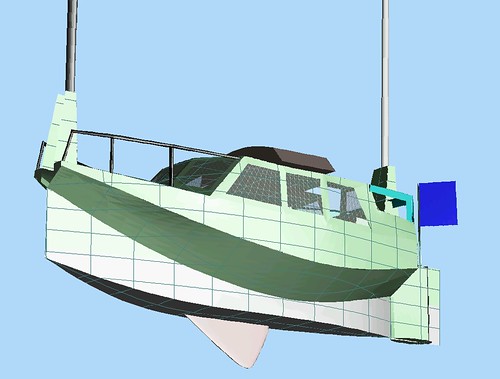
| Don't get more off-center than this Bolger BRICK, TETARD Note that crew weight has more than compensated for heeling moment. |
One does not walk into the forest and accuse the trees of being off-center,
Nor visit the shore and call the waves imperfect.
-- from the Tao te Ching
Think off-center.
-- George Carlin
Off-Center Masts for Off-Center Sailors
When we were building ZOON (ex Bolger LONG MICRO), we stood the aft mast in place, off-center, to see how it stood. A visitor to the project took three wordless passes around, humming and clucking at such unusual features as the square sections and bow transom. Finally, he draws himself up with hands on hips and exclaims, "NO. That off-center mizzen is just too much."
But that off- center sail was perfect. Squared off across the stern, we could run down the off-wind quadrant in a gale of wind with balanced power and a clear view ahead.
Since then, every boat has had at least one mast off-center for one reason or another. Masts at the aft transom are offset to clear the rudder and sculling oar. Those at the companionway are offset to allow center-line openings which, in a knock-down, remain furthest from the water and least likely to flood.
We've never been able to observe a sailing difference between tacks in our larger, relatively heavy cruiser size vessels. We will wing out the offset sail to its near side when running... from there, they overlap the foresail less and behave much better. Otherwise, it appears a draw.
But this one time...
I wrote this account in a previous post:
A friend of ours had built a Bolger BRICK (shaped about as it sounds). He brought it out to Tenakee for a Mess-About. All day, he and his daughter sailed circles around the rest of us (including respected designs of similar size by Devlin, Hess and a TORO!).Circles, in fact, barely describes the figure 8s and jaunts across the inlet and back while our fleet trudged along in comparison.
I was wowed by this and have mused lo these many years upon it. Now I venture a theory...
The BRICK has its mast stepped along one hull wall, and very near the bow. The crew is live ballast, but in practice needn't move much around (according to its skipper). When I first saw the arrangement, I felt sure it would capsize mast-side at the first gust. But no.
Here's my thinking, taking the BRICK pictured above as example:
On the port tack (wind blowing from port across the hull to the lee-side sail) it acts as a proa. Windward hull lift is opposed by crew weight.
On the starboard tack (wind blowing into the wind-side sail, then across the hull) it acts like a normal hull (center mast). Leeward hull depression is opposed by outboard displacement.
Setting the mast at a point of maximum beam, in effect, doubles the beam! That dinky li'l x4ft punt has the equivalent lever arm at the mast as our x8ft WAYWARD. Whether sailing as a 'double wide' monohull or proa, the righting arm is twice what one can expect with a centered mast.
With such a doubling, one can fly twice the sail area or sail a normal amount twice as aggressively (which appears to be the case).
Somethin' to ponder on!
 |
| Picture this mast position as center-line! |