All of life is the management of risk,
Not its elimination.
- Walter Wriston
I have two rules about winning in [...] life:
- You can't win if you don't bet.
- You can't bet if you lose all your chips.
- Larry Hite
Fail Safer Design for Barge/Scow Hulls
Life is risky.
Every act. Every step. Every beat of our hearts. Every breath we draw entails risk. To go forth upon the waters is in a sense 'unnatural' and carries risk.
Yet we act, walk and run. Our hearts pound and we suck in air. We sail forth in vessels of our own design and build. We live.
We manage risk.
To me, the mantra of risk management is
fail-safer.
Not fail
safe, which I believe encourages hubris, neglect and risks catastrophic failure.
Rather fail safe
R, which I believe encourages humility, continued awareness and involvement with our journey.
Fail safer is a lens through which we can view the design of the hull (in this case, I'll include the decks and superstructures).
Many of the risks to a hull can be reduced at the design stage, and it's these I'll talk about, here.
Structural Integrity
A boat that cannot maintain its shape or watertight integrity in a seaway is on its way to Davey Jones'.
Robust construction - Always a plus, of course. Strongly joined components, especially along exterior angles (chines and corners) hedge your bets. Girder construction backs up and stiffens the entire structure. Consider well bonded girder furnishings and web-frame bulkheads throughout.
Thicker Bottoms and Lower Sides - Impacts with rocks - especially sharp ones - can pierce the hull. Adding material resists puncture. The extra weight is low in the hull where it doubles as ballast. If added to outboard of the bottom proper, its added volume floats its own weight, increasing displacement (if it soaks up water, however, wood approaches slightly negative buoyancy).
Protected Weak Points - In some conditions, a weak point (such as windows) can give before the storm. Shuttering systems with strong closures protect these. Closures, tie downs, dogs, and good storage of loose items are all design options.
Water Management
One of the main jobs of the hull is to keep water
outboard. Water's uncontrolled weight - whether on deck or below - is one of the main factors pushing a situation from bad to worse.
Good Deck Drainage - Should green water come up and over the sides, its weight is high on the hull and precarious... like Santa standing on a rocking chair. It can be encouraged by design to drain quickly overboard. Large scuppers (drain holes), open edges, sloped decks, small footwells, inverted or covered dinghies (when carried) and watertight hatches help 'show water the door'.
Midline Openings - In a knock-down, mid-line openings stay as far as possible from the water. Those offset further outboard are that much more likely to take a swig. Companionways, hatches, vents, smokestacks, exhaust pipes and the like are all fail safer the closer they are located to the mid-line.
Secureable Offset Openings - Opening ports, vents, intakes, etc. which are offset from the mid-line can let water in. Consider gasketed, doggable arrangements.
Multiple, Water-tight Bulkheads - Should water get below - via hull breach, a lost hatch, getting pooped, leaks (from above or below), spray... - dividing the hull into separate water-tight areas maintains the flotation of intact sections, which can continue to float the vessel.
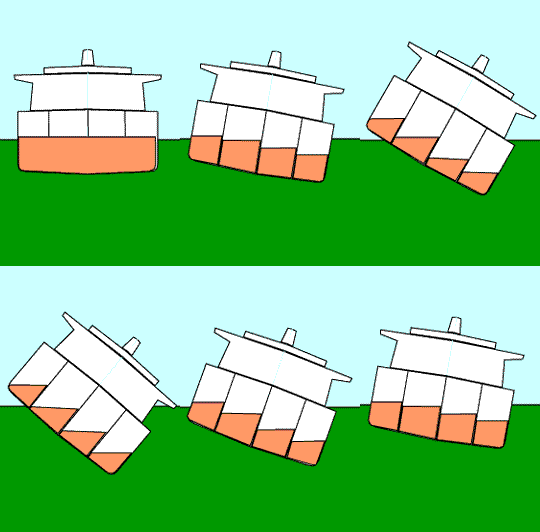
Multiple, Water-tight Longitudinal Dividers - Because...
Free Surface Effect (slosh) is a boat sinker. Loose water or other shifting masses in the
hull can slosh from one side to the other, transferring weight plus
momentum. This makes a vessel roll dangerously and can capsize it. The
cure is to keep it out of the hull when it doesn't belong, and minimize
slosh once aboard.

For shallow hulls, this is a particular problem. Where a deep dead-rise hull (V shape) encourages water to remain low in the hull, a shallow hull can allow the free flow across the interior.
Longitudinal dividers, even if open at the top, can help manage this cross flow.
The girder structure furnishings, which contribute to structural integrity, can be arranged to reduce free surface effect.
NOTE: These GIFs from Free Marine.
Stability and Self Righting
The ability to automatically self right from a knock-down is a fine thing. From beyond a knock-down to a roll-over is also fine, but not an essential for most vessels plying inside or 'longshore waters. In looking toward this fail safer feature, consider the use and actual needs of your vessel
I cover this at some length in the post
Where Ultra-Shoal, Square Boats Get Their Stability, so will keep it brief, here.
Low Center of Gravity - A heavy bottom,
secure storage for heavy items low in any hull and possibly ballast all
contribute to the cause. While many barge / scows do not use any ballast
(relying entirely on form stability), it's an option to enhance.
Longer and Beamier - Barge / Scow hulls are naturally form stable (their shape makes them harder to tip over, regardless of ballast). Lengthening a hull adds to its initial and reserve stability. Making it beamier does, too, but if it does flip, wider beam makes it harder to return to upright.
Higher Sides - These add reserve buoyancy, which kicks in later to resist roll-over. They also add to windage and raise the center of gravity.
Inversion-Proof Ventilation - This one, oddly, seems often overlooked. The principle is to create an air-lock when rolled, usually below-decks, between vent(box) and the interior which blocks water from passing from outside in.
A loop of large diameter (dryer?) hose works, or boxes can be arranged with overlapping baffles (the latter shown here). Hose is less compact, but works throughout a tumble.
Sea-going Features
Trailing Lateral Resistance - Most sailing at sea is downwind. As such, an aft area of lateral resistance (skeg, large rudder, board, etc...) aids downwind tracking. Think of the fletching on an arrow.
Strong Bitts - In a storm, lying to a sea-anchor or running with a drogue are vital tactics. But you need very strong bitts with good fairleads. To reliably deploy them. Don't want to be improvising in Force 10!
Secure Deck Storage - When it whumps up, you don't want loose oars, pike poles, dock-lines or other paraphernalia blowing about. Make sure there is a secure place for every item, and that they generally stay there.
Secure Mountings - Things like solar panels have incredible windage. At sea, they must be stowed in very high winds or have
extra strong mountings. Plan for hurricane force winds.
*****
In all respects, better safe than sorry.
*****
In designing our own vessels, we have a free hand to nudge the whole toward fail safer. In acquiring a vessel, we can use the principle to guide our choices, and can further modify it as we may.
One last thought... so called
safety-in-depth (many layers of redundant fail safers) is a concept used in such endeavors as a nuclear reactor.
I believe in and practice the approach.
Yet to think that we have magically conjured safety is that pride which goeth before a fall. Think Three Mile Island, Chernobyl and Fukushima. All were 'protected' by safety-in-depth design.
The World denies us safety. We are mortal. Human error is our lot. Entropy and what a friend calls 'depreciation' rule with universal jurisdiction. To imagine that we have engineered away the hard chance leads to betting more than we can cover.
Eternal vigilance is the price of freedom!