Please visit our home site at www.TRILOBOATS.com.

Anke and I live aboard WAYWARD, and wrote about it's design and construction at ABargeInTheMaking.blogspot.com.

Access to the net comes and goes, so I'll be writing in fits and spurts.Please feel free to browse the archives, leave comments where you will and write... I'll respond as I can.

Fair winds!

Dave and Anke
triloboats swirly gmail daughter com

Friday, October 15, 2021

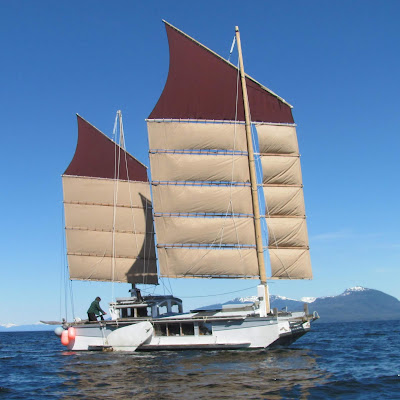
Cat Ketch WAYWARD's Prototype Split Junk Rig


S/V WAYWARD

Photo by John Herschenrider


In theory, theory and practice are the same.

In practice, they are not.

— Benjamin Brewster


It may work in practice;

But does it work in theory??

— Unknown


Cat Ketch WAYWARD's Prototype Split Junk Rig


General Approach


WAYWARD ex T32ft x 8ft x 1.25ft, is our box barge / scow, sailing live-aboard home. My wife, Anke Wagner and I sail engine free, year round in the archipelagos of SE Alaska.


Oh. And we’re lazy sailors.


Our cruising grounds are haunted by williwaws (sudden, fierce, katabatic or downdraft winds that roll off snow and glacier fields), and strong tidal flows that often entail sailing at night. Short, steep seas with plenty of fetch are common, as are swathes of water which can erupt on short notice into ‘dancing water’ riptides. ‘Haystacks’, fortunately, are rare. 


Long, narrow straits and ‘canals’ generally align the wind and seas.  Thus, we are usually sailing directly into it or with it. We find ourselves mostly close-hauled or broad reaching (to comfortably quarter seas).


Ultra-shoal draft, enginelessness and proclivity have us frequently sailing the poorly drawn and often rocky fringes of the chart. In these places, maneuverability and flexibility are much more important than optimal windward ability.


To meet these conditions, we have come to prefer a rather snug, Cat Ketch Junk Rig, ‘dumbed down’ to its bare essentials. 


We like ketch rig for its handiness. Its large sails toward the ends of the hull have several practical advantages:


  • Each sail strongly affects its end of the vessel, both while drawing and backwinded... this lets us turn on a dime in our own length, adjust balance and total CE as we please and sail backwards with ease.

  • Sliding backwards with mizzen backed and rudder reversed, we can reliably come to our chosen tack... this is useful sailing off close quarters anchoring, tacking or drifting (bow on), in about half a boat length, in all winds. Greatly reduces pucker factor!

  • The mizzen can be sheeted close or flat to hold the bow toward or into the wind… this is useful for treading water for a break, maneuvering or allowing traffic to pass.

  • Main sheets are clear of the cockpit and companionway… neither are swept when tacking or jibing.


  • Both masts are clear of the interior… elbowroom, and the bunk to ourselves!

  • The rig is redundant... Should we lose a mast, we can sail under main or mizzen alone (proven by experience), and jury rigging possibilities are much improved.

  • Each mast can be used as a crane for raising / lowering the other… this is very handy for hoisting one’s own petard.

  • Two masts can load cargo or an MOB at either end of the vessel… and we have holds at each end to match.

  • Two masts give a great place to hang a hammock...  8)


For years, we’ve flown flat cut, modified Hassler/McCleod sails. If twist is controlled to allow more in light airs and less in heavier winds, they performed quite reasonably well. We do need to sail somewhat broad on the wind when close hauled in order to sail well.


In our last boat, we reduced the HM upper panels to a single, mostly triangular panel with a deeply hollowed leech, emulating one of the many Polynesian crab-claw styles. 


These flat cut sailforms develop camber from their conic section under press of wind.. 


Pronounced leech hollow brings that panel’s CE (Center of Effort) toward the mast, easing weather helm. As the last sail standing in heavy going, this is an important feature (this will be enhanced by SJR’s greater balance).


Since the two sails enable adjustment of their total CE, there is no need to reposition either. This has a number of simplifying consequences.


  • Standing yard and batten parrels are sufficient to hold and position each sail on its mast. 


  • Our only running lines are one sheet and halyard per sail. 


The benefit is that we eliminate running yard-, luff- and boom hauling parrels, tack and sail downhauls. This significantly reduces handling, and minimizes potential fouling from loops of slack line when reducing sail. 


Sheets are single, aft led running lines of 6 and 5 part. Both are led to the cockpit from forward (we can maintain our forward lookout while handling all lines). Good mechanical advantage means no sheet winches necessary.


We sometimes clip temporary downhauls to batten parrels during heavy winds or special situations. The forward lift is running - to lift the forward end of the sail for visibility or drip control - and tied off on the boom, but is seldom used and may be considered standing for normal use.


In considering SJR and/or cambered rig, we were primarily hoping to improve our performance to windward, while staying within the same profile and priority on handling simplicity.


S/V POPPY

Photo from Slieve McGalliard

JunkRigAssociation.org


Split Junk Rig


Slieve McGalliard developed the Split Junk Rig (SJR).


In his approach, the balance of a junk sail (area forward of the mast) is ‘split’ from the remainder by a vertical gap. Forward are the ‘jibs’, and aft are what I’ll call ‘after panels’.


Upper panels may or may not be split.


All panels are generally cambered for improved aerodynamic lift. Camber is designed with an eye to, “a large entry angle to help produce high lift and a low exit angle to produce low drag” [from C and SJ by Slieve McGalliard]. 


In particular, jib panels are shaped especially full at their leading edges, achievable with the ‘angled shelf method’. 


Additionally, each jib airfoil is shaped with a lofted in sheeting angle relative to battens and after panels. This emulates the set of Bermudan style jibs.


The yard is generally drawn at a low angle, reducing vortex drag near the peak and stresses throughout the rig. The halyard and uppermost batten parrel fixes the upper panels’ position on the mast, letting the lower sail hang vertically.


Handling is limited to halyard, sheet and downhaul adjustment.


An early sketch with ‘vanity panel’ (didn’t make the cut)

 and triangular main heads’l...


Dumbing Down SJR for WAYWARD


We chose to test retaining a) flat cut upper panels (‘crab claws’), and b) a flat cut mizzen. 


Respectively, these likely, and surely detract from SJR and cambered performance enhancements. Yet for our situation, we consider the compromise to be attractive.


Flat Cut Mizzen (vs. Cambered Mizzen)


Flat cut sails are taut across their panels, so transfer stresses vertically along the whole panel, and do not allow diagonal movement. In contrast, cambered sails are slack across their panels, so transfer stress vertically along luff and leech (via roping) and allow diagonal movement.


Flat cut sails on canted battens develop positive batten stagger (upper battens overhang lower battens at their aft ends). Cambered panels have neutral stagger.


Flat cut sails do not flog when slack in the wind. Cambered sails do. When the vessel is tossed from side to side (e.g., when caught in a windless rip tide), cambered sails can ‘pop’ loudly from side to side.


Flat cut sails, when backed, get an immediate ‘bite on the wind’. In cambered sails, we suspected, the forward camber does not engage as soon when backed (later confirmed when backing the main), so require more deflection for a given effect.


In a flat cut mizzen, we value:


  • Extreme ease of construction with very little lofting… large spaces out of the weather are hard to come by and are usually only available for very short windows.

  • Positive batten stagger… this virtually eliminates sheetlet/block fouling. As our mizzen battens end flush with the transom and rather high, this feature is very helpful.

  • No flogging or popping… flogging is hard on the sail, our wa, and interferes with communications between crew. Popping is merely annoying as heck (to be fair, so are all the other aspects of being tossed about; that’s just one more).

  • Quick bite sail backing… small inputs to back mizzen and push the stern to port or starboard simplify and quicken maneuvers, which contributes to safety in tight quarter sailing.


Given where and how we sail, these features are worth quite a bit of enhanced, windward performance. Nevertheless, we prepared to experiment with a shaped mizzen.


All of these considerations apply to the main, as well, but for various reasons don’t weigh in as heavily. Flogging is only briefly tolerated, popping is further from the cockpit, fouling is more safely handled from the deck and backing of the main is seldom necessary.


Flat Cut Upper Panels


WAYWARD’s upper panels (‘crab claws’) raise the yard at a steeper angle than SJR standard. But their flat cut fabric transfers load along their entire run, from the yard to the uppermost batten.  


From There the lower sail (cambered portions) hangs vertically, supported by roping along fore panels’ luff (their leech is not roped) and after panels’ luff and leech.


We hoped, in effect, that yard, panel and batten work together as a very large ‘head board.’ 


As mentioned, the upper panels are the last sail standing. Their amount of camber can be reduced, when strapped down in heavy going, develop low but definite camber while completely avoiding flogging.


NOTE: This can be augmented by a temporary tack downhaul, working against the halyard to flatten the sail. To date, we’ve not felt the need.


Rigging


In most respects, we were able to rig as we have been doing (described above in ‘Background’).


To help top up the aft end of the yard, and encourage the forward swing of the sail, we placed the sling point slightly aft of center. 


Forward movement of the yard is limited by a short, standing yard parrel, which fetches up snug against the aft side of the mast, and runs long on the forward side.


Sail rotation is limited at the uppermost batten by a short, standing batten parrel. It fetches up snug on the aft side of the mast and short but loose ahead. In addition, this limits aft movement of the sail - even when deeply reefed - replacing a running yard hauling parrel.


Once the upper panel is in position, we tie short parrels at each batten. They may be short but loose as there is no apparent batten stagger whatsoever; once the upper panel is positioned correctly, reefing and set are purely vertical affairs. Their sole functions are to keep battens from blowing away from the mast, and as clip points for temporary downhauls.


NOTE: Most analyses of JR sail set focus on limiting sail position via the yard (sling point + yard hauling parrel) and the boom. This still allows the mid sail to rotate forward, which motion is often controlled by luff hauling parrels. It seems to me that limiting rotation at the uppermost batten of the parallelogram (rather than at the boom), controls the ‘high ground’. Everything hangs and mostly behaves below that point.


NOTE: There is a definite but finicky, optimal sling point… too far forward and the yard’s aft end sags; too far aft and the forward end dips below the sail bundle on lowering, presenting a danger to anyone on the foredeck. Look for that Goldilocks point!


NOTE: We had originally thought to hinge the yard and uppermost batten at their forward ends (see drawing, above). Together they would form a strut for better control of upper panel position, and yard dip when lowering. A model looked promising, but we decided to limit the number of new things we were trying at one time, and went with a more standard separation between the two.


Our Theory of Operation of SJR Main and Flat Cut Mizzen


In theory, a flat cut mizzen doesn’t point as high as SJR (or cambered).


This means that, if we point up to the SJR main’s optimum, we’ll pinch the close-hauled mizzen and lose its contribution to overall power. 


Alternatively, we can sail at the mizzen’s optimum and ease the main to match. This swings the main’s force vector forward, improving drive and reducing leeway, without sacrificing mizzen power. In effect, the main will be drawing on a close reach, while the mizzen is drawing close hauled.


Since our pointing was always acceptable to us, improved footing would be pure gravy. 


I’ll note again, however, that we have likely traded away potential performance for what we deem to be flat cut mizzen advantages for our situation.


Prototype Sails


We anticipate a three part main. Upper crab claws, stack o’ jibs and stack o’ after panels, each laced independently in place. But for the prototype...


We built our upper, crab claw panels as final. We laced them to yard and uppermost batten with marline hitches.


Materials are 8ozTopNotch for the upper panels (and eventually, final sails), and 8oz Weathermax. In retrospect, we would like to have made jibs and all lower panels from a lighter nylon, but TopNotch is already purchased and on hand. So it goes.


We increased the proportion of jib to after panels at 1:2 (balance =  33%), adjusted for our deck plan. This further eases sheet loading, and reduces both twist and weather helm when sailing off the wind. I suspect, it increases ‘clean air’ lift and drive from the jibs, as well. 


NOTE: This is in accord with Slieve’s recommendation after having sailed POPPY’s rig at about 1:3 (balance = 25%).


We didn’t anticipate experimenting with the jibs beyond Slieve’s initial specs, so linked them into a vertically contiguous stack of panels (rather than tied and individually adjustable).


The main after panels and mizzen’s panels were built as identical parallelograms (no rounding). 


We lashed the main’s panels Thai-style, but with lashing length varied to induce camber (simulating rounding). We made up a ‘tick board’, marked for distances every foot  from edge-of-cloth to batten for cambers of 4%, 8% and 12% of chord, and began with 8%.


NOTE: 8% camber is a moderate amount which appears to be favored by many offshore cruisers. Many inshore cruisers prefer more. Our inshore cruising seems to have more in common with offshore conditions (SE AK sea and weather conditions, engineless, liveaboard and on the move), so we started there. In particular, we are often tossed in  ‘slop and bobble’ rip-tides, in which cambered sails ‘pop’ annoyingly from one side to the other. 8% has been recommended by several experienced sailors as a tolerable maximum.


NOTE: Lashings were made of three round turns of tarred nylon seine twine, ending with opposing clove hitches around all turns, at cloth’s edge. This let the remainder rotate freely around battens. 


We laced mizzen panels flat and close against the battens. Only if the flat mizzen failed in sea trials did we intend to lash and play with camber options.


NOTE: If they had been available, we would have preferred doubled hook-and-loop strips on a heavy backing, as more quickly and easily adjustable.


Note the wide angular difference between main and mizzen!
Also, that we are still pointing rather high on the wind.


Sea Trials


Questions we hoped to answer in sea trials under prototype included the following: 


  • Is the anticipated gain from shaped sails worthwhile in our situation?

  • Can the flat cut mizzen ‘keep up’ with the SJR main?
    Will it draw at all when close hauled and pointing higher and/or footing faster?

  • Are the amount and distribution of camber too much or too little?

  • Are our dumbed-down rigging arrangements up to the task?


We sailed the prototype for over a year, across a route upwards of 500nm (as the Orca swims… not counting tacks, jibes and side trips). We sailed in estuarial, tight and open waters, flat waters to ‘Chatham chop” to about 15ft swell, against and with the wind from calm to about 55kts (we only tried beating into about 40kts sustained).


Results


Theory panned out!


The ‘head board’ idea seems to have worked out very well. As goes the headsail, so goes the rest.


Sailing ‘close hauled’ (mizzen close hauled; main sheeted high on its close reach; upper panels assuming varying degrees of conic section) we pointed several degrees higher than with both sails cut flat, and footed faster.


We clearly improved our windward performance. 


Off the wind, any gain wasn’t particularly noticable, but no complaints. 


NOTE: We weren't able to replicate the broad reach advantage Slieve reports. Our main luffed well before his when wung out so far. Possibly, this is due to our sheeting arrangement which has not yet been implemented to help eliminate twist? It would mean that, broad reaching, our boom would be oversheeted when the upper sail is drawing well; the lower sail would contribute less drive. At any rate, shaping did no harm, and additional performance with the wind has very low priority for us.


Tacking, including in tight quarters in flukey winds was reliable.


NOTE: Initially, in heavier winds of around 25+kts kicking a short, steep sea, we missed tacks. Turns out that we were strapping the main in a skosh too tight… once we learned to slightly ease the main, tacks became reliable.


Our ghosting was not noticeably affected. Our concern that unfilled, shaped panels would spoil our acceptable ghosting was unfounded. A ghoster, might still be in our future.


The broad set of the main (close reach) preserves a wider margin of effective sailing above our optimal course (i.e., while pinching). In tight quarters, this reduces demands for attention, handling and pucker factor. It’s the difference between sailing toward the upper end of capability, rather than at the upper edge.


NOTE: We could get the same effect with more drive by easing both SJR main and cambered mizzen in tight quarters. But given that we want a flat mizzen for other reasons, this was an unlooked-for gravy point.


The amount of camber (8% of chord) felt about right to us, and we felt no need to reduce camber from bottom to top. It’s ‘popping’ wasn’t too uncomfortable when misbehaving in a toss. It filled out in lighter breeze than the 12% panel, which on the whole felt like diminished returns for our style of sailing.


The only extra handling the SJR main incurred was the occasional clearing of fouled sheets. We didn’t dock the aft end of the lower panel, but plan to in the final sails which should ease fouling.


We sometimes tidy the reefed jibs into the forward lift (if gathered a little off, they can block the forward view under the boom… a better lift lead may fix this).


Conclusions


We’re very pleased with the results.


For our purposes, the SJR main and flat cut mizzen appear to work well enough together for our purposes, significantly improving our windward performance.


Handling remains simple.


Despite what I’ve written about the attractions of a flat cut mizzen, we’re still considering cambering it. Doing so can only further improve performance by empowering our laggard mizzen.


Cambering the mizzen would give us a chance to experiment with a flattening scheme in which brailing lines gather rounding along the battens when drawn up. This would likely be seasonal, set for the blustery months when a flat mizzen is most appreciated


So many possibilities; so little time!


ADDENDUM:


Since writing this, I’ve become aware that there is some concern regarding overbalance in SJR sails with balances nearing the top end of what Slieve McGalliard considers possible (35% of sail chord).


Overbalance, as I understand it, is too much sail area forward of the mast. The overbalanced whole may fail to weathercock (align with the wind) when sheets are let run. A tendency to failure would mean power cannot be reliably dumped in this manner, and rounding up may not be possible.


At 30.5% our SJR balance is nearing that top end, but is not yet extreme?


We can report absolutely no hesitation in weathercocking when sheets were let run beyond normal friction from the blocks. We noticed no difference in sheet responsiveness from our previous (flat cut) main, which had considerably less balance.


Relevant differences between typical SJR and ours include the following:


The higher peaked yard moves the CE of the uppermost panel aft, improving weathercocking.


Our sheets are six part vs. the more usual three, which induces more friction, impeding weathercocking.


Opened by Thai style lashings, our after panels had gaps running along each batten. As their maximum point of camber (and therefore of gap) was 33% of panel chord, I suspect the after sail’s CE was moved aft to some small extent. This would improve weathercocking.


Thursday, April 15, 2021

Optimal is Not Optimal: The Sweet of Suites

Heh. Clever. But I believe...
A generalist knows more and more about more and more
until eventually s/he knows something about everything.


A human being should be able to change a diaper, plan an invasion, butcher a hog, conn a ship, design a building, write a sonnet, balance accounts, build a wall, set a bone, comfort the dying, take orders, give orders, cooperate, act alone, solve equations, analyze a new problem, pitch manure, program a computer, cook a tasty meal, fight efficiently, die gallantly. Specialization is for insects.
-- Robert A. Heinlein

If one's only tool is a hammer, every problem looks like a nail.
-- The Law of the Hammer

Avoid optimization; Learn to love redundancy.
-- From Nassim Taleb's Phronetic Rules


Optimal is Not Optimal: The Sweet of Suites

Let's get it said, upfront. I'm a Generalist. Jack of Many Trades. Proud Master of None.

I'm much less drawn to Rules than to Rules of Thumb. I admire precision, but prefer the loose fit. I'll take one-size-fits-most over tailor-made any day of the week. 

So here's the problem with Optimal. It is by definition the very best solution for a particular problem. Often very particular problem. A problem one can foresee with great confidence and specificity. A can opener. A mouse trap. A barrel bolt. These things have solutions that are pretty durned optimal and are notoriously hard to improve upon.

But problems abound, and each has its own, special way of driving us bugnutz.

Generalized (sub-optimal) tools and approaches cover a much wider range of problems. So wide that they often spill over into other whole species of problem. A suite of generalist tools - especially those which work well together - cover a very wide range indeed.

In discussions I read on the subject, Specialized vs General evaluations tend to measure in degrees of Success (often vs Failure). For example, a Specialized tool has a high degree of success, but only at a narrow task. The Generalized tool is assessed at some lower degree of success, but over a swathe of loosely related tasks. Most such writers argue for the General.

What I think is often missed is that Efficiency is a much better standard. The Generalized tool will succeed... it just takes longer for a small fraction of that range. That it does so over a wider range of problems is a better measure of its advantage over Optimal. It is less efficient at one particular task, but more efficient overall.


Veritas rabbet planes


Consider the Rabbet Plane vs the Chisel.

I'm not knocking the Rabbet Plane. This one by VERITAS is a well designed thing of beauty and a boon to the task. If your life calls for a lot of rabbets, it may pay its way. But it's not happy performing most of the other chores one asks even of a plane. Very bottom line, it's a specialized Chisel.

But which fits better into a limited space toolbox? Which is less expensive to purchase? To replace or repair? Can it do any single thing a chisel cannot? No. Can a chisel do things it cannot? Let me count the ways... (okay, I won't... you get the picture).

Another important consideration is reliability. Given quality components, this is the product of simplicity (less to go wrong) and imprecision (loosely 'coupled' components).

Okay, I once said, I get KISS. But imprecision is a virtue??? 

Turns out that precise, tightly coupled systems are prone to failure. The kind of failure that chewing gum and baling wire can't fix. A little sand in the finest Swiss watch and it will drop to merely semidiurnal success. But one can make a sundial with a stick stuck into sand. If it gets kicked over, stick it again and recalibrate. [We can also use that stick to lean on, plant a seed, pry a up a rock, bind a tourniquet, whack a mole...]

Efficiency, as I mentioned, is a factor here... that sundial has its limitations in this regard. Cost / benefit analysis is the guide. That stick is very efficient, in its modest way.

A final point I seldom if ever see discussed is how well tools (or approaches) work together in suites (combinations). What I call the sweet of suites.

Simple, generalized tools can join forces to accomplish almost anything! Their areas of efficacy overlap, affording redundancy and  choice. A heavy screwdriver can be a prise bar can be a chisel can be a lever can be a...

NOTE: We are strictly warned against abusing a tool beyond its designed purpose. HA.

A sweet suite of tools, skills, approaches, methods, guidelines... what-have-you... covers the ground. Covers it better, to my mind, than any ungainly heap of one-shot wonders.

Sweet.


NOTE: I realize that all this is, in fact, a spectrum. At the KISS extreme, brain + opposable thumbs are as simple as it gets, and all the others are to some degree specialized. The kind of optimal we look for will always be the happy middle ground.


Wednesday, April 14, 2021

OVERVIEW: Being Mortal by Atul Gawande


Words to live by.
Words to die by.

Really, what's the difference?

Being Mortal by Atul Gawande

See also this review by Maria Popova

All boldface below are quotes from Dr. Gawande's book.

In Being Mortal, Dr. Gawande writes:

This is a book about the modern experience of mortality -- about what it’s like to be creatures who age and die, how medicine has changed the experience and how it hasn’t, where our ideas about how to deal with our finitude have got the reality wrong.

Our main take-aways from the book:

Quality of life is preferable to mere quantity for the vast majority of us.

Care should be determined - in discussion with one’s family, doctors and care-givers - by asking...


  • What is our understanding of the situation?

  • What do we fear?

  • What do we hope for?

  • What are the trade-offs we are willing to make?

  • What are the trade-offs we are not willing to make?

  • What is the best course of action which serves this understanding?

Consider, answer and communicate, if possible, before the onset of care…

  • Do you want to be resuscitated if your heart stops?

  • Do you want aggressive treatments such as intubation and mechanical ventilation?

  • Do you want antibiotics?

  • Do you want tube or intravenous feeding if you can’t eat on your own?


Hospice approaches and attitudes appear to serve the terminal patient much better than standard medical interventions.

In the Epilogue, Dr. Gawande writes:

We’ve been wrong about what our job is in medicine. We think our job is to ensure health and survival. But really it is larger than that. It is to enable well-being. And well-being is about the reasons one wishes to be alive. 


Those reasons matter

not just at the end of life,

or when debility comes,

but all along the way.


Friday, February 12, 2021

Love Among Mortals

Photo by Silke Schmidtchen


You think you have time.

-- From Buddha's Little Instruction Book by Jack Kornfield


Love Among Mortals

Facing Death is transformative.

Somewhere, in the back of our minds, we all know - in a general kind of way - that we are mortal. But then a moment comes when we look Death in the eye and know it for ourselves... for our Beloved... and that knowledge becomes both specific and immediate.

For me, such a moment marks the very beginning of our One Precious Life. 

As sailors in a wild and wooly place, Anke and I live with perhaps a closer view of Death than many. We often sail near the edge, and far from any hope of help should we fail dangerous.

This last autumn, we had a wild passage, where Death was grinning over our shoulders right along, breathing down our necks. It started with a small thing - a jammed block. So many deadly outcomes are the end of a series of small steps inching, then leaping toward disaster. We were able to manage our issues and all was, in the end, well.

But it was another reminder that - even in the mundane day to day - Death can come for us.

And now Plague walks all the lands of the world.

A time of pandemic binds us all in a moment of the awareness of our mortality. The last century has brought humanity a growing understanding of disease in its causes and cures. Yet we remain stubbornly mortal, and a tiny molecular machine - devoid of hope or malice - reminds us collectively of that fact.

For some, inevitable Death sucks all meaning from Life. For others - count me among them - Death is that dark background against which all life is luminous. It's proximity reminds us to live. NOW.

And what is the one thing worthwhile? That one thing to pursue with all the resource of our One Precious Life?

If you ask me, it's Love.

Power? Pffffft. Fame? Sic transit. Stuff? Can be useful but can also own us and weigh us down. Wealth? You know what it can't buy. 

We think we have time... let's assume we don't, and start living. Start loving.


Happy Valentines Day, all ye Young Lovers! 

(And that includes you, my fellow Elder Farts!)

Saturday, January 23, 2021

When Panic Rears Its Ugly Head

 Cartoon by Gary Larson 


The way the mind will lean under stress is strongly influenced by training.
-- From Frank Herbert's Dune

Don't Panic. 
-- Printed in large, friendly letters on the cover of The Hitchhiker's Guide to the Galaxy by Douglas Adams


When Panic Rears Its Ugly Head

Panic is one of the very worst dangers sailors face.

Panic may paralyze us. It may send us into a frenzy of useless or even detrimental action. It may benumb the mind or send it reeling.

Panic, more often than not, is a far greater danger than the conditions which invoke it. Indeed, it can strike in a total absence of danger if the situation is misread.

An instinct to freeze in the face of danger might 
sometimes help prey animals survive. Panic adrenalized flight might have helped our ancestors live to fight another day.

But panic on board – whether of captain or crew – is not our friend. 

It can overwhelm anyone, but favors the unprepared. It's contagious and can debilitate an entire crew. At worst, those caught in its grip are a danger to themselves, the crew and the vessel.

Fortunately, we can reduce its onset with training, and break its grip with breathing and focus.We are none of us immune to panic, but neither are we its helpless victims.

Panic - and climbing out of it - is serious business, for which it is well to be prepared.


It was a dark and stormy night. 

Well, not stormy, yet, but one was bearing down on us. And it was dark... that nebulous kind of dark where even silhouettes are blurred and indistinct.

We had fetched the reefbound entrance to a fjiord. Just the sort of place that wind, when it hits, funnels together and venturies itself into a rage (vent = wind + furies?). But we were ahead of it and dropped anchor close in the lee of a sheltering island.

Before we could set the anchor, however, the first lick of squall pounced on us and stripped it, blowing us back into exposed water, embayed by rock and reef, lost in blinding rain and intensified dark. 

This is not as dangerous as it sounds, but calls for close sailing in tight quarters, with strong, confused winds. It was just a matter of navigating between the lighter water smudges bracketing the island, visible at either end of our tacks. Round up and stall in the blackouts. Work our way into the inky lull between them and anchor on soundings. Not an everyday occurrence, but we've practice aplenty.

Anke went forward to haul the anchor, while I raised sail, an operation that briefly fouls the deck with loops of halyard. Normally this is cleared at leisure as each sail is raised. But, with trouble close to leeward, there was no time for niceties. Sails and anchor up, we set course close-hauled, intending to tack back into our island's lee.

Anke returned to the cockpit and took the helm while I set about clearing the decks by feel. Despite the fact that I couldn't see any of the lines, by habit, I put my head down for a moment. A side gust hit, and we heeled hard and SLACKTIDE rounded toward it in a swoop, dumping power and regaining her feet.

As my head came up, I found that I'd lost my bearings. Neither wind nor the sketchy blots of black fell into a pattern I could recognize. Which way to turn and how long before burning up scant searoom? Panic clamped down hard. Heart pounding, mouth gone dry, knees weak and knocking, mind clutching wildly at any purchase within that churning darkness. 

Breathe x four, and my mind began to work again. Still disoriented, but ready to do the sensible thing... ask Anke what's where. 

And she soon set me straight.
Panic took me in its vice that night. It happens. And if we don't get a handle on it, it'll run us under.


Note: If we'd both been lost, an unpanicked assessment would quickly reveal standard options; heaving to or dropping anchor till bearings were regained. If we drag, we can row out another, or dredge downwind (dragging anchor acting as a drogue to keep head up; back sails to skin through breaks in the reef (clearly visible for ultra-shoal draft as patches of smoother water between breaking water). If a lee shore (no breaks), ground out and step ashore if and when we must. The first happens now and then, the latter two once or twice.

*****

So here are some tools we've found useful. While they don't all address panic itself, together they lower the odds that panic will take over. And once your mind is your own again, you're ready to take on trouble.


Preparation

Take care of yourself – Dress appropriately for conditions. Get adequate rest. Eat and drink well (never alcohol, however, while at risk).

Outfit yourself – Reliable gear that works well together across real and anticipated scenarios gives you the physical basis to deal with emergencies.

Train yourself – Develop skills before you need them, and practice them in increasing conditions. If nothing else, imagine scenarios and response in detail.

Drills help immensely. But a word of caution... skills are most powerful when seen as modular – useful separately or in combination with others. Seen thus, they empower improvisation. Overfocusing on set drills can leave us unprepared when the real world deviates from the 'script'. I seen it happen!

Orient yourself
 – At all possible moments, know where you are. Where are your fall-backs? What is your fail-safe strategy? What is the path of least resistance?


In the Moment

Breathe! -- First thing you'll need is oxygen. Adrenalin kicks us into high gear and we start burning through O2 reserves like wildfire, and we need to up our intake.  


I like the 'fourfold breath'... enough air to supply the brain, and counting helps focus and bring me back. Consciously use feature to ease yourself down. Four quick breaths are not enough to hyperventilate or delay your recovery. But do take more if you need to. 

TIP: If you are in the grip of panic, it may help to close your eyes for this step... this shuts out alarming visuals which, at this point, you are in no shape to process. Benefit varies from one individual to the next, however.
NOTE: I've since read of a technique use by US Navy Seals called square breathing. In 4 seconds, hold 4 seconds, out 4 seconds, hold 4 seconds. Repeat. Long story, but this helps bring O2 and CO2 into balance.
DO NOT PROCEED until panic ebbs... until you do, your actions are unlikely to be helpful and may cause harm! Our best shot is to keep with it until we have ourselves in hand. Note the distinction between panic and merely being afraid. You can function with the latter.

To captains:
 If you allow your personal panic to persist, both ship and crew are as though rudderless. Your calm and confidence aid the crew to deal with their panic. You may have to relieve crew who cannot control their panic before it spreads lest 
they endanger the ship or themselves with panicked mis-actions.

Assess, Address, Appraise – What are the dangers and/or damages? Options? Resources? Priorities?  What is your plan? Are your actions producing their intended effect? What must be done to remedy, if not? Don't hesitate to trade up one plan for a better one, where possible. We need to home in on effective address, pronto.

To captains: This is your responsibility. If time allows, consider consulting with knowledgeable crew. Consider staying in the moment... what came before or comes after is likely irrelevant in the crisis.

Communicate – Make sure everyone involved knows their job. If time permits, fill them in on the situation and the why of what they're told to do. This helps them deal with their panic. Help them with that process where time allows. 

To crewmembers: Consider that the skipper may not have time to fully brief you. This is the time to 'put your head down' and perform each assigned task to the best of your ability. If you observe something urgent, report it, but consider that the skipper must rank that information into priorities to which you may not be privy. S/he may have you abandon your assigned task in favor of another as plans change rapidly. Resist the urge to act without instruction (at least such actions as dropping or raising sail). 

Buy time – Actions which buy you time – to think, orient, improvise, etc. - can be invaluable, even when they don't directly improve your situation. Make the most of the time you've bought!


Afterwards:

Attend to the ship –  Damage assessment and control that hasn't been addressed during the emergency. Make all gear ready to run. Get to shelter, if necessary. Initiate repairs, if necessary.

Attend to the crew -- All present and accounted for? Any trauma or medical issues? Apply first aid, if necessary. Get help, if necessary.

ReAssess – What went well? Not so well? What could be improved? Has training adequately prepared each for their role? Was the ship's outfit up to snuff? 

Fix what's broke.
NOTE: As with any debriefing session, this is not a blame game. That someone panicked and/or was unable to to climb out from under it is not  reprehensible, but rather grounds for further training. This includes everyday and emergency seamanship AND in techniques for ending panic.


*****


Bonus Feature

In the following scene, from the movie Flight, involves a flight crew's response to mechanical failure.

I admire this depiction of the captain's expertise and handling of the situation and crew. He is decisive and proactive in both respects. He plays a large role in keeping his crew from panic and moving toward a solution.


NOTE: This scene focuses on what happens in the cockpit but includes asides depicting physical trauma to crew in the cabin. It was loosely inspired by a real life incident (Alaska Airlines flight 261) in which all passengers and crew perished)

Though ultimately unsuccessful, by not panicking, threal-life cregave themselves and their passengers the best chance of survival. They were posthumously awarded the Airline Pilots Association Gold Medal for Heroism.
Please view with discretion.


From the movie, Flight, starring Denzel Washington


Thursday, December 24, 2020

Storm Tactics: Inshore

Carved handrail from S/V TANTRA
by
Ried Stowe


You can't stop the storm, so stop trying.
What you can do is calm yourself.
The storm will pass.

-- Timber Hawkeye


If you think it might be time to reef, it's time to reef!

- Sailor's Wisdom


Storm Tactics: Inshore

In life and sailing, storms overtake us.

Most often, if we pay attention, we have some warning before their onset. In rare cases, they pounce like a cat upon a mouse. We're the mouse, at least in scale. Unlike mice, we have a range of tools to meet the storm.

NOTE: When I say storm, I'm speaking of high winds in general. Our standing policy is to NOT be on the water in full storm conditions or worse. Despite this, we occasionally find ourselves caught by surprise.


Foundation

These are things I recommend which underlie a successful response to storm conditions:

  • Prior Knowledge... Knowledge and skills acquired ahead of crisis are priceless!

    Learn what you can before exposing yourself to storm...

  • Trained Crew... and train up all who sail with you.

  • Sound Vessel... Robust construction and maintenance, uncluttered decks, capable and easily reefed rig, good anchors with ample rode.

    Without these, any ship is at risk in any weather. When Storm comes with its long boots on, meet it with all head and hands on a stout deck!
 
 
Rules of Thumb

We use a small heap of rules-of-thumb to help us along our way:
  • Fail Safe vs. Fail Dangerous
  • Preserve Options
  • Layer Redundancies
  • Maintain Margins of Safety
  • Act Decisively
  • Develop Standard Operating Procedures
  • Develop Communication Protocols
  • An Ounce of Prevention is Worth a Pound of Cure
  • Get Out of the Wind, Stupid!
  • Avoid Smug
  • Manage Fear and Panic
I go into these at more length here.


Storm Tactics

  • Batten Down - Secure your gear inside and out, dog down hatches, dress for the weather and clip in. MOB (Man Over Board) in storm conditions is a very long shot, no matter how well drills have gone. Stay aboard!

    NOTE: Make sure your harness clips are short enough to keep you out of the water. The USCG warns that a person being towed in the water cannot clear their head to breath from their own bow wake from about 4 knots. We lost an acquaintance that way... his crew didn't know to round up and stop the vessel.
     
  • Reef Early - Reduce power before you are over-powered. Sail handling is easier and you'll be more comfortable and safer on deck.

  • Reach or Run for Shelter - Shelter ranges from protected coves, to the lee side of islands or points, to mere outcroppings that break wind and especially waves. Consider heading into the best shelter available before conditions deteriorate.

    It's important to note that, while wind can be unnerving, it is wind-driven water - weighing a ton per cubic yard/meter - which can toss your boat dangerously. Interruption of seas driven over a long fetch (open stretch to windward) will give your anchors the best chance of holding. Reefs, spits, and even thick kelp beds can provide effective shelter even as the wind whips over them.

  • Consider Quartering the Seas - Quartering (angling across them at about 45deg) gives a much easier ride in large or closely spaced waves, both for boat and crew. This generally means sailing close-hauled or broad reaching.

  • Consider Heaving-To, Sailing Backwards and/or Drag Devices - These are more often used offshore, but they have their place inshore. They help keep the bow up to wind and waves. You can adjust position to a degree by crabbing (backing or balancing sail to edge to port or starboard) without re-establishing full sailing trim.

  • Look Around and Enjoy the Storm - I mean, they are magnificent! As long as we're fool enough to be caught out in one, we may as well enjoy it.
 
It Was a Dark and Stormy Night

We've just completed a winter passage - under press of calendar obligations - that pretty well kicked our butts and tried our mettle. So all this is pretty fresh.

A mere 80ish nautical miles as the fish swims, we started out with winds which, unforecast, edged into gale force. Turns out that our main halyard had jumped a sheave and jammed... we could neither raise nor lower sail. 
 
Fortunately, it jammed in deep reef position... low gear, as it were.
 
Unfortunately, before we had reached a place to pull in, the wind first died to nothing, then turned foul. 

Fortunately, we had shelter behind us and ran for it.

Unfortunately, that shelter had its own katabatic blowing from it over the ebbing tide with river outflow... with our short sail we couldn't sail in.

Fortunately, after heaving-to in a lee all night, the wind returned in our favor, and we again sailed for our destination.

Unfortunately, the forecast called for gale with storm force gusts due before we could possibly arrive.

Fortunately, there was a small hook of shelter right at hand. We know it from years back and call it Whoa Nellie Nook (Nooks protect from North). It has a good lee, a protecting reef and good holding. So we sailed in, set anchor and got our sail (mostly) working again.

Unfortunately, our lee was SO good that a back-eddy of breeze blew us toward the beach as we slept (contrary to the wind that was howling about four boat-lengths from our position)... we whunkered down onto a rocky bottom as the tide ebbed.

Fortunately, the rocks were pretty round. We buffered with some wood cut ashore and lifted off again after several hours and re-anchored.

Unfortunately, the next morning's wind was blowing into our nook (the opposite was forecast).

Fortunately, there was a bit of sand off our protecting reef and we could kedge out and sail on.

...

That was two nights and three days of a five week passage. I won't subject you to the rest, but will merely note that we only got two full nights of good sleep in peace and quiet in all that time.

Looking back in appraisal, we find the following:
  • We need to ditch time-bound commitments, especially in spring, fall and winter.

    Each time we commit to some deadline (for a job, for instance) our decisions become influenced by calendar pressures. We're reluctant to back-track and give back hard-won miles. We trim our margins of safety and head out into smaller, less reliable windows. We push fair winds, tides and daylight hours, which can erode our rest and recovery. All together, we take on higher risks to honor our commitments.

  • We need to increase redundancies in some areas.

    For instance, we have a spare block with halyard on our mizzen, but haven't yet arranged one for the main. This turned out to be an ELE (Exctinction Level Event) on this trip (the jammed halyard could possibly have set off a lethal string of consequences).

  • We need to be more skeptical of weather forecasts in high wind seasons.

    Time and again, we sailed or anchored in conditions which proved contrary to the forecast. In one case, this could have cost us the boat (our sheltered anchorage became dangerously exposed in a 180deg mis-forecast blow).

    Area forecasts cover large areas, and 'predominant winds' is a squishy concept. Worse, we were mostly sailing between one weather system that reaches up into the Yukon (Canadian) interior and another that opens on the Gulf of Alaska. We're learning to look up and take the whole chain into consideration, rather than rely on more local forecasts. This is especially true when updating forecasts flip-flop in wind direction and/or strength.

    NOTE: To be fair, SE Alaska is made up of what we call geographical wonders (local places which alter, amplify or diminish weather patterns). Forecasting the weather - both for pros and amateurs - is notoriously difficult.

    Weather data collection points are few and far between, and are often in sheltered or compromised locations (e.g., at points between two weather systems or in towns whose location was selected for sheltered weather). Models and forecasts based on these data are accordingly unreliable.


    Furthermore, a warming planet increases the discrepancies between models (based on historical data) and the real, emerging world. Winds are tending stronger and less predictable across the board. We need to increase our weather pessimism accordingly.

  • New technique for anchoring in marginal lees:

    Our problem at Whoa Nelly Nook was that, as the tide came in, our protecting reef covered and wrap-around waves sideswiped us badly. So we anchored in very close to the beach and ended up too close.

    The remedy for similar spots - now SOP - is to set two anchors aft against potential wind reversal and one or two high on the 'windward' shore. Tend the vessel with the tide to position close in the protected lee of wind and wave, then out as the tide falls and protecting reef uncovers.

    UPDATE: Given a more recent experience sheltering from Force 11 winds in which a backwind clobbered us briefly, we're now making sure to set our BEST anchors aft and lesser anchors/shoreties set into the lee!
     
  • We're approaching a decline in physical ability.

    This trip was physically demanding. Long hours on deck. Sails and (multiple) anchors up and down. Sculling long distances. Kedging. Swamped dory and recovery, and lots of bailing, often in rough conditions underway. Jury rigging gymnastics. And so on. Meanwhile, we're at the further end of middle age, and looking downslope.

    We're already planning a small, camper-cruiser for high mobility with less physical input. In coming years, we will be sailing WAYWARD less, and in less challenging windows. We are mulling adding an engine down the road (diesel/electric, possibly yawl-boat mount?).
*****
 
Sooo... we loved this trip for all its challenges. It kicked us hard, but there is no living like that at the edge in a gorgeous seascape of stormy wilderness. But all good things...

As Joan Baez sings the poem by Lord Byron:
 

So, we'll go no more a roving

  So late into the night,

Though the heart be still as loving,

  And the moon be still as bright.


For the sword outwears its sheath,

   And the soul wears out the breast,

And the heart must pause to breathe,

   And love itself have rest.


Though the night was made for loving,

  And the day returns too soon,

Yet we'll go no more a roving

  By the light of the moon.


Not there, yet, but we can see the storm ahead. Time to be thinking of shortening sail.

Tuesday, October 6, 2020

The View from Cold Mountain


Maddy's Camp 
from Cold Mountain, the movie


The mountains look in horror on the madness of the plains.

-- Roger Zelazny


You look at nature. Bird flies somewhere, picks up a seed, shits the seed out, plant grows. Bird's got a job, shit's got a job, seed's got a job. You got a job.

-- Maddy, from Cold Mountain by Charles Frazier


The View from Cold Mountain

Somewhere on the slopes of Cold Mountain, high above the madness of the plains, there lived from a wagon an old woman and her goats.

Or so goes a tale told of another time. Of another bout of madness.

A  refugee from that madness - dying by degrees from a grevious wound - is treated by her skill and kindness. He is set back on his road home with a chance to find and face what awaits him.

Had she lived below, among her fellows, that madness would have swept over her. Maybe she'd have been caught in it, and clamored for the blood of them others. Or maybe she'd have been overwhelmed by it, drowned in its flood or burned by its fire. Or maybe she would have kept her footing, surviving to see the bleak aftermath as the madness settled back to dark mutterings.

What did she feel, looking down from her height. Horror, certainly.

And pity, likely.

Were she younger, at least than she was, she might have felt a tug, too. To do something. To get in there and pull in some direction or another, shoulder-to-shoulder with others. To fight the good fight. To attempt change in whatever direction she felt was right.

But had she descended to the plains, she would have been swept by its madness. The good she was able to do in her story was only possible because she had kept far from the madness of crowds. 

I think it's no small question... what to do in a time of madness?

*****

Picture a river, a canoe upon it and all of us packed in. 

There's supposed to be a waterfall up ahead... stands to reason, but no one has seen it. Some say it's a hoax. Some that it's still many miles on. Some say they can hear it. Some try to warn their fellow passengers.

All the while, the river flows ever faster.

But resources are running low in the canoe, and squabbling for control of them has led to blows. Holes are being punched through the hull, if you can believe it! Few have ears to hear, or time to look up from the fray.

Let's say you are one who hears the thunder of the falls.

Do you do what you can onboard? Do you leap overboard? Do you bother to swim for some kind of shore?

If you stay aboard, surely, you will end up over the falls.

If you leap overboard and do not swim, your journey is over before its time.

But if you leap and swim, you may be ashore to help another from the water.

*****

Leap and swim... this has been our choice. 

Not a moral or courageous choice, nor yet a coward's. Merely one that follows from how we view the sweep of recent history. And I'm talking since agriculture.

Our cold archipelago is our Cold Mountain. Our boat is our wagon. The flora and fauna of these lands and waters our life bearing goats. We are gaining in knowledge and skills to share. And we love it. 

While we know that our bank may too crumble - that we are yet imperiled by the cataract. At least from here we can hold out a hand to those who get themselves in reach.

Do you hear the falls?