Please visit our home site at www.TRILOBOATS.com.

Anke and I live aboard WAYWARD, and wrote about it's design and construction at ABargeInTheMaking.blogspot.com.

Access to the net comes and goes, so I'll be writing in fits and spurts.Please feel free to browse the archives, leave comments where you will and write... I'll respond as I can.

Fair winds!

Dave and Anke
triloboats swirly gmail daughter com

Tuesday, March 8, 2022

A Rogues' Galley of Boat Recipes

Boat Soup


Boil, boil, toil and trouble,

Fire burn and cauldron bubble!

– From Shakespeare’s MacBeth


A Rogues' Galley of Boat Recipes


Once upon a time, we mixed our own. We mixed our puckies to fit the need at hand. It's a very personal process... secret recipies, undisclosed additives and esoteric procedures. Sound crazy? It was, and - be warned - some of the ingredients carelessly handled made more than a few adepts more than a little crazy-for-real.


Better-living-through-chemistry stuff was still in development and, if available, cost an arm and a leg. Slowly, the industrial materials got better and cheaper. Now, when I ask around, I find that it’s only a few old-timers and Luddites that still mix our own.


Not to disparage the new goods… quite the contrary. Adhesives can’t be matched by home-brew. Modern resins are ultra-versatile; a one-size-fits-most solution. Paints are hard to beat.


But where goes wood, there lies a spectrum of needs. Wood works and swells and shrinks and cracks and closes up again, as one expects of a once living material. To meet the needs of wood, a just-so solution is often the best fit, filling in the wishlist between the broad strokes of modern, industrial magic.


Using them sets you down a road less traveled. Insofar as they replace plastics, they might be considered ‘greener’ on the whole. Their half-life is certainly shorter. For ‘natural’ wooden boats to be maintained in the field, this approach has a lot going for it... while they must be renewed more often, thy can be applied piecemeal in very short weather windows.


All in all, I can’t generally recommend going back to them while modern methods are available, but they can be a good fit for many situations. They DO represent a set of alternatives, and set one to thinking along pathways now mostly overgrown.


The following amounts to a menu ingredients with various consistencies and properties. Being mostly oil-based, they can’t easily be painted over or adhered to, neither in the short nor long term. Their economy is outstanding.


Here’s what I’ve stumbled across from boatwrights and fishermen and women…


INGREDIENTS


The following include materials I’ve heard of as having been used. New stuff shows up all the time (can you say Buckyballs?). Mix, match, improvise and adapt!


Thick Stuff


  • Bees'- and Microcrystaline Wax - Great bases for filling cracks or waterproofing. Microcrystalline wax is superior… most toilet rings are high in it and cheap, or it can be purchased pure.

  • Asphalt - Fibered or not, is used for roofing. Messy but cheap and versatile.

  • Tar (aka Pitch) - This used to be common around boatyards. Have to heat it to melt.

  • Furniture/Car Wax -- This stuff is easy on and can be combined. Buff to a beautiful finish. Check for exterior rating if exposed to UV.


Oils


  • Pine Tar - A fave of mine. Anti-fungal. On the thick side.

  • Tung Oil - Reputed not to mold or mildew. Turns laquery black after long sun exposure.

  • (Boiled) Linseed Oil - Pleasant oil… ‘boiled’ has drying chemicals added.

  • Oil Sludges - Generally used crank-case oils.

  • Corn Oil - New to me via a young old-timer. Inexpensive base. Outdoor apps look great, several years down the road.


NOTE: All of these are prone to spontaneous combustion. Rags and brushes should be immediately burned after use or immersed in water in a closed, metal container. Do NOT leave rags in direct sunlight for even a minute! (Experience talkin’, here).


Solvents


  • Turpentine - Distillate of wood. I trust this one irrationally.

  • Mineral Spirits and Paint Thinners - Cheap and work.

  • Diesel - Ditto, but smells like you’d expect, and never quite goes away.

  • Gasoline - Careful with this one. Deep penetration, then evaporates.

  • Acetone - Ditto.


NOTE: All of these are rich in VOCs (don’t breathe them) and highly flammable to the point of explosive (no sparks or flame). Note and employ all pertinent safety precautions!


Thickeners (Thixotropics)


  • Wood Flours - Cedars are fungus resistant, as are select exotics.

  • Talc - Thickens without setting firm (sometimes used above the waterline).

  • Chalk - Thickens without setting firm.

  • Cement - Thickens, but also sets firmer (sometimes used below the waterline). Highly alkiline, it protects wood to some extent. Consider latex additives, fabric matrix and/or chopped fibers if using alone.

  • Plaster of Paris - Ditto.

  • Brown Paper Fiber - Special case additive to tar ‘ties the room together’.

  • Various Chopped Fibers - Glass, poly, dryer lint, hemp, oakum, etc..


Additives


  • Bottom Paint - Cheap copper bottom paint is antifouling for below waterline.

  • Cuprous Solutions - Used for toxifying wood in contact with ground (e.g., Naphtha and Cuprinol).

  • Cayenne and Paprika Powder - High BTU capsicum is anti-fouling. Added to exterior below the waterline. Might work in the interior, and seem to be much less dangerous overall than leads?

  • Varnish - This is a generic term… lots of proprietary varnishes with various properties.

  • Powdered Mica or other UV inhibitors - These help slow deterioration and oxidization.


  • Red and White Lead Powder - Formerly used in beddings and exterior primer coats. Work great, but are highly toxic, especially when in powder form (both applying and repairing/renewing). Available as pottery glaze. Many consider these off-limits… we prefer Pine Tar as our go-to anti-biotic, with copper or capsicum thrown in as needed.


Commercial Additives

These are a few commercial items that many have included in their brew:

  • Penetrol and Thompson's Water Seal -- Two particular commercial brands that can be useful in the mix for exterior uses. Both are thin liquids.

  • Naptha (Copper Napthanate) -- Very toxic liquid, now banned. For careful, external use only.

  • Creosote - Very toxic biocidal, tarry substance. Can be DIY. It was sometimes used under a copper bottom paint to double protection.

  • Polyethelene Glycol (Anti-freeze) -- The green, poisonous stuff (vs pink, safer polypropylene glycol) is highly anti-fungal. Hydrophilic (loves water), it can penetrate wet woods, but also washes out over time. Rumor has it, it penetrates paint without staining for easy application.

  • Borax -- Powder additive with antifungal properties. Water soluble, however, so needs renewal.


NOTE: Again, many powders and solutions are NOT to be touched, much less breathed in. Consider carving conspicuous warnings to boatwrights down the road who may wade in unawares.


RECIPES


Rogues’ recipes are fuzzy things, and tend to vary wildly from person to person. These proportions will vary in the real world, according to your choices and by ingredients’ specific manufacture. Consider the proportions given a rough starting point.


Get to know the materials and how they react in your environment. Consider your purpose, and select for the properties you desire (flexibility, reset in warm conditions, penetration, hardness, antifouling, etc.). Nuance one way and the other as you deem fit, adjusting for the properties of each ingredient.


Small batches and test samples are strongly advised until you get a feel for it. A graduated Liter makes for easy, proportional math. All recipe parts given by volume. While all can be combined at ambient temperature, most mix better when heated in a double boiler, then allowed to cool.


Feel free - very free - to  experiment, innovate and otherwise roll-yer-own. It’s kind of addictive, really!


Here are a small sample I’ve encountered… adjust, extend or modify as desired:


Bedding Compound -


  6 parts Thickener : 1 part Oil : Dash of Additive (anti-biotic)


  Talc is a common choice for Thickener, while Pine Tar is antibiotic. Adjust mix for consistency.


Radial Crack Filler


 1 part Pine Tar : 1 part Wax


 Thicken with more wax, thin sparingly with turpentine.


Seam Compound (below WL) - 


  2 parts Fibered Asphalt : 1 part Portland Cement : 1 part Cuprous Bottom Paint


  Stiffen with more Asphalt, harden with more cement, thin with more paint.


Canvas Waterproofing -


  1 part Wax : 1 part Oil : 1 part Solvent


  Consider reducing Solvent to effective minimum.

  Saturate warm cloth and roll to penetrate fibers. Maybe check YouTube for a range of ideas.


Wood Slurry (Sealer for horizontal exterior surfaces) -


  1 part Wax : 2 parts Oil (Corn Oil was suggested to me for this application)


  Apply on cooling wood. Scrape lightly smooth once cooled.


Wood Slurry (Sealer for vertical, exterior surfaces) -


1 part Pine Tar : 1 part Oil (:1 part Solvent)


Consider adding Solvent for the first coat and a little Wax for subsequent coats.


Wood Exterior Water-Resistant ‘Stain’ -


10 parts Heavy Solvent: 1 part Oil : 1 part Non-Fibered Asphalt Tar


More Tar darkens; less is lighter. Consider an inexpensive solvent (such as Diesel) that will evaporate.


NOTE: For exterior coatings aka ‘Log Oil’s, I remember seeing a US Forest Service recipe that added powdered Mica to reflect and protect against UV rays. Powdered Mica is widely available, but I’m not sure about effective proportions. One full recipe is cited in the Using Paint, Stain and Oil section, from Dovetails and Broadaxes: Hands-on Log Cabin Preservation by USFS, which I am unfortunately able to access presently.


Monday, February 14, 2022

Surrender


Photo from Everplans


Let us be lovers, we’ll marry our fortunes together.

– Paul Simon


Surrender n: The act of giving one’s self over to another.

– One among many meanings


Surrender


The act of giving one’s self over to another…


In the context of love, surrender is a mutual act of intramission based on trust. Of willing entanglement. Of choosing to turn toward as a way of being. Of letting go of the power of individuality for the greater power of loving partnership.


Surrender is also associated with a unilateral act of submission absent trust. Of unwilling engulfment. Of being forced to turn toward. Of yielding the power of individuality to conquest by a greater power.


The word is powerful and passionate in either sense.


Perhaps because the same word blares at full volume both meanings - will ye and nill ye - surrender is so difficult? 


By the time we find love, so many of us have surrendered in situations and relationships that have left us battered and scarred. We raise the walls and close the gates. We don armor and raise the sword by reflex. The gauntlet becomes as familiar as the backs of our own hands. The glaive becomes our hand.


But to surrender to one another… is there anything so sweet? To dismantle the walls and fling open the gates. To remove with love, patience and care each layer of defense. To win trust. 


To emerge together, hand in hand, to face the world?


*****


Surrender has a shipboard context, too, one which pervades the spectrum.


The ship surrenders itself to the sea. Um. Sort of. Certainly the sea has the first and last word in every discussion.


All aboard surrender themselves to the needs of the ship… as goes the ship, so goes its occupants.


The captain surrenders to a leadership role… one in which power is most definitely not unbridled or lacking in obligations. 


The crew surrenders their independence to the captain’s decision and command… ours is not to question why (at least in the crunch).


All more or less. Consent is nowadays much in vogue, but the heirarchy (sea, ship, captain, crew) doesn’t promote mutuality. Yet neither is it set in stone.


On a happy ship, we look to working with the sea  and not against it. We look to our vessels’ trappings and trim. We aspire to Cptn. Bligh’s ability, but eschew his HR. We jump to with a will when called to duty.


We surrender and sail on.


NOTE: We find that it’s good to recall that the role of Captain is just that; a role. We can and do trade off. Good for learning and a counter to hubris!


Tuesday, February 8, 2022

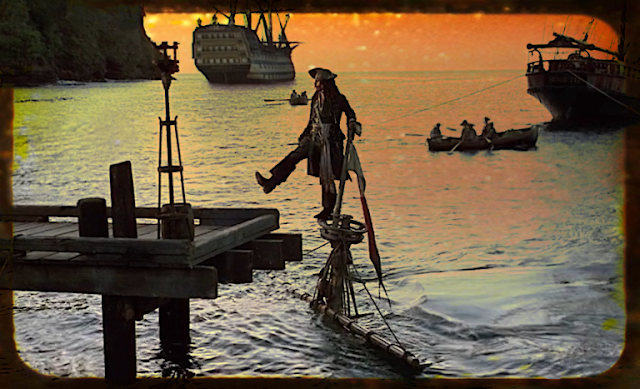
Feeling Buoyant


Don't let that sinking feeling get you down!
From Disney's Pirates of the Carribbean: Curse of the Black Pearl
via BroBible

You don't drown by falling into the water; you drown by staying there.

-- Edwin Louis Cole


Feeling Buoyant?


Here’ a tale of specific gravity I heard via Kevin Allred…


Seems a friend of his, living along one of the great sea-lanes of SE Alaska built him a small, open sailboat of cedar. 


For his first sail, he guesstimated what he’d need in ballast and accordingly threw a ten-count of sandbags onto the floorboards. Figgured he’d adjust as needed, then bolt in their equal in fixed, lead pigs sometime down the road.


Off he went, sailing along sweet as ya please, proud as punch of his new vessel.


Well, it was blowing pretty good and gustin’ up a little, but nothin’ to worry about. All the same, he made his sheet fast with a slipped hitch for easy let-go, just in case, which come along in due course. 


Up come a big gust. He gives the sheet a yank and whoops. The bight jammed. His new boat is knocked to her beam ends, throwing him overboard and cutting under sideways. He pops to the surface, sputtering and snatchin’ for breath (that cold water’s a shock, lemme tell ya!). He looks around and… no boat, with the shore a mile off! 


But waidaminit… there’s a few inches of vertical stick up and down a few yards away, which he recognizes as his masthead. Over he swims and is clinging to the very top of his rig, with - not much, but a little - time to think it over. But, y’see, he’s motivated. After due consideration…


Down his mast he shinnies, holding his breath and poppin’ his ears. He gets hold of a sandbag and heaves it over. Then another before he has to go back up for air. Gained him a few feet of mast!


Four trips and eight bags later, he’s bailing for his life and raises her up and high on her lines. Almost like nothin’s happened.


Straightaway he beelines it for shore and his last neighbor before a long, long downwind sail.


Neighbor hears a faint knock and goes to the door to find a jittery, blue apparition, soppin’ wet:


“Holy SMOKES! You okay???”


“C-c-c-c-c-c-old.”


*****


We get to see some principles in this story.


One, in small open boats - especially when gusty - hold the sheets in hand or wrap just enough turns to friction hold the load between gusts. 


A slipped hitch is better than a hitch, but no hitch (with ju-u-u-u-st right turns) is better than any hitch.


Two, positive buoyancy is a fine thing!


In boats, we think of buoyancy as one of negative, neutral or positive. Negative sinks. Neutral just hangs out (it may move up or down with momentum from wave action). Positive floats.


Those few inches of mast floating proud of the water mean there were just enough more floaty than sinky bits in the immersed portion ofboat to support the weight of protruding mast. A matter of a few pounds transformed this potential tragedy into comedy.


The moral? The more positive buoyancy, the merrier.


  • Keep sinky bits to the practical minumum (i.e., functional plus safety margin).
     

  • Add as much floaty stuff as is practical, preferably stowed so it can’t float away if immersed.

  • The goal is to float crew and maybe decks clear of the water when awash.


Think positive!


PS… Anke hears the yarn part of this post and says to me, “You don’t talk like this!” She’s referring to the many colloquialisms, such as, “Up come a big gust.”


On examination, it turns out, I DO talk this way, when relaxed, just not so ‘cogently’.


Mine is the local vernacular style on our waterfront, and I’ve spoken it all my life. Mixed with some East Coasterisms I’ve absorbed from nautical readings and songs along with other flip and foolery from over the course of 40-some years. Along with turns of phrase that resonate with me. Gordon Boklets, among others.


If I’m writing for technical clarity, however, as now, my training kicks in. Highly edited, fairly grammatical sentences are more common, though I hardly stick to Turabian. Not always successful, I know, but it’s my best shot.


What I’m not so good at is telling a story both verbally and well. What I hear in my head is soooo much better than what comes out of my mouth. But tongue pulls ahead of brain. Detours. Red herrings. Lost threads. Dead ends.


However, I’m a slow typist, and my brain can spill at that rate. Stories come out as I think them, for better or for worse. I only ever lightly edit this stuff. This is why what I write doesn’t always sound like me to Anke.


You’re getting my Voice, such as it is.


Umm… you’re welcome?

Tuesday, February 1, 2022

Winter Sailing

Think it's gonna snow?


Hope ain’t a tactic.

– From Deepwater Horizon (the movie)


Winter Sailing


Winter covers a lot of ground. Pretty much a whole hemisphere at a time. Arctic sailing techniques and equatorial call for radically different sets of tools!


Our home waters are the islands of the Southeast Alaskan archipelago. Very roughly from 55 to 58 degrees North. At this latitude, daylight hours grow short and the nights long.


We’re warmed by the Japanese current, which keeps our temperatures moderate relative to continental cold air masses. But this thermal energy, exacerbated by pressure gradients between offshore lows and continental highs, makes for some mighty winds. Worse, they can huff up from nothing at a moment’s notice. They can hurl down-slope from icefields and on high. They might blow out quickly, or they might settle in till spring.


We can get a lot of early snow, then warm abruptly with copious rain, causing flooding and freshwater outflows over the surface of denser, salt-water tidal movements. Things get lumpy.


Cold snaps can freeze any surface water holding still. Or can blow freezing spray which can cripple and sink the unwary. Lines can freeze stiff, refusing to run and resisting any handling, while strength drops to the snapping point. A warming turn can cause ‘break up’, which can strip anchors and carry a vessel from shelter. Skim ice can slice a boat along its waterline, clean through the hull.


And, y’know, it’s cold!


Winter Tactics


Winter sailing can be a different kind of a beast anywhere outside the tropics. All the hard stuff is harder. More fail-dangerous. More apt to sap our energy and mental acuity. Ice and snow are strident factors.


Warmer, moist maritime air carries a load of heavy water vapor, which packs a whallop; as much as X times the force in the sails. Cold, dry interior air has less of a punch, but dries and freezes exposed skin, even at low speeds. Both can lead quickly to hypothermia and bad decisions. Protect yourself!


Here’s a handful of the things we do in the face of winter. These are all considerations (despite all the DOs and DON’Ts)... they’re stated as imperatively as we observe them:


Clothing and personal gear:


  • Layer Up – Moisture wicking near the skin, then thinnish, lofty (air trapping) layers until warm, topped off by a waterproof layer (PVC isn’t breathable, but it’s impermeable). Have lots of standby clothes to trade out if they become wet or damp, and don’t put off getting dry!

  • Headgear – Lotsa heat leaves via the head. Hats, balaclavas, neck gaiters, scarves… these help keep it in.

  • Gloves and Mittens – Rubber gloves with inserts keep hands warm and dry while getting under way, but then sweat and chill. We switch to mittens, ASAP, so our fingers can huddle together.

  • Insulated Boots – Felt lined rubber boots are great for cold weather. They’re fully waterproof and, like PVC, non-breathing. Slipping plastic bags over (the first layer of) socks still gives damp feet, but preserves outer insulation for warmth.

  • Goggles – These warm your eyes and keep snow, ice and slush out of them. A swipe with mittens clears them pretty well, unlike glasses.

  • Sailing Harness with Lanyard, Clips and Jackline – A little insurance for slippery decks and surging hulls. We like our lanyards short with a quick release shackle inboard and caribiner to the jackline. Short enough to keep us bruised but on deck, should we stumble, rather than drowning in our own bow wake alongside.

    We like inflatable vest/harness combos with whistle, survival kit and strobe light attached.


A Hole in the Weather


  • Warm Interior – We like to keep our fire going for winter sailing. We trade off frequently and get warm below. A hot water bottle in the foot of a sleeping bag helps with toes.

    NOTE: Make sure ahead of season that the smokehead draws well in all winds and at all angles of sail!

  • Warm Food and Drink – Making up a stew ahead of sailing and keeping our vacuum bottle topped off lets us keep hot energy flowing.

  • Hot Stones – Warming in the oven, these make great hand and pocket warmers. Watch out for any that are too hot, and wrap as necessary. A larger, flat stone works great for feet. Water bottles work, too, but they're a little harder to keep renewing underway.


Weather and Sea States


  • Check the weather before heading out! – Forecasts are fairly accurate for big winds, but diminish proportionally. In winter, anything up to Force 5 could be from about anywhere. But check.

    And use our own eyes and knowledge! We are privvy to local knowledge the forecasters and their models can only infer. Doesn’t matter what the forecast tells us if actual conditions are shouting otherwise.

  • Avoid (Strong) Wind or Surface Outflows against Tides – These conditions cause the seas to stack short and sharp. Hard on us and our gear. Whatever else is going on is that much harder to handle.

  • Don’t head out into rising conditions – In winter, things that are getting worse don’t know when to stop. Even when the forecast calls for a moderate pick-up, things can get carried away. ‘Course, a calm going light gives some margin of error… I’m thinking more of 15 going to 25kts… we might well get 40kts!

  • Don’t head out into freezing spray – Of all the dicey conditions, freezing spray gives us the willies. A little can be tolerated; a lot can roll us under. But which it’ll be is a crapshoot.

  • Don’t anchor in the mouth of vertical valleys, avalanche chutes or off of windbroken trees – Williwaws and avalanches are no joke! Consider a topographical map (e.g., the state Gazetteers) to help spot wind holes.

  • Don’t Sail through Skim Ice – Our copper plating gives a big margin of safety, but ice is patient. Be aware that, if sculling, even a little ice will stop you in your tracks.

  • IceUp Calls for High Alert – We try to keep an ice free moat around the hull with breakout to the point our anchor lines intersect the water/ice. If possible, we neap out above the worst of it.

    Once the weather warms (or melt begins from below), we set a watch, and start breaking things up as soon as possible.

    Worst comes to worst and we are dragged out of shelter (never happened, but it could) prepare to sail. Run for shelter as soon as free of ice. Maybe even before?


Frozen Lines


  • Make Sure Sheets and Halyards are Running Free – This is tricky. If it’s very cold and dry, often iced lines will more or less sublimate free (solid ice evaporates with no intermediate liquid), aided by beating and working. Tails can often be brought below to thaw and dry. We don’t set out until we can raise and lower all sail. If in doubt, stay put when possible. If not, keep working on them once underway.

We start working the lines free as soon as it gets cold enough, even if we’re not planning to sail. It’s a slow process, and ya never know.

  • Install (Temporary) Downhauls – Sometimes our best efforts fall short, and a sail that can’t be lowered is positively dangerous. Downhauls are good insurance. We can usually haul a reluctant sail down by hand, but our winches are handy in case we need more pursuasion.

  • Anchor Lines – these are a skosh more forgiving… In our self-bailing anchor locker, they can be swashed down with seawater before deploying (salt water has a lower freezing point than fresh). Usually, this is a little less time critical, as they have no blocks to run and are gravity assisted. Still, take a look to check they’re not a block of ice before we set out.

  • Dock Lines – Double them up and use wider angles than usual. Where possible, get them working together, rather than one by one, to share loads. Try to minimize shock loading from a surging hull by reducing slack.

  • Fenders – Double them up, too (they can get brittle) such that, should one fail, the hull is still fended off. Consider some non-inflatables such as tires or rope fenders. Consider an off-haul system (anchor set abeam or strut ties).


NOTE: Recently, I’ve seen a type of loosely braided, synthetic line being used for docklines in winter conditons… It shrugs off water so doesn’t freeze so remains pliable and presumably retains strength. Haven’t yet been able to research. Might it be fit for sheets and halyards?


Rules of Thumb


  • Throw Away the Calendar – Scheduled sailing is dangerous any time of year. In winter, it can be deadly. Having to be somewhere pushes us to sail when we shouldn’t. Sailing when we shouldn’t can lead to pushing daisies.

  • Await the Opportune Moment – Wait for a fair wind, in fair amount, over a fair sea, with a fair prospect. This is our best shot at getting on down the road safely. Don’t fight conditions… long money’s on them!

  • Increase All Margins of Safety – Maintain more than ordinary room to deal with trouble. We’ll likely need it. Consider a winter set of heavier anchors.

  • Move in Short Hops – Winter windows are short and snap closed fast… go from one secure situation to the next with dispatch. Don’t long haul for distant shelter or dawdle daylight away.

  • Prepare for Night Sailing – Chances are, we’ll end up in the dark. Be ready with navigation, information, skills and lights.

  • Have Fall-backs and Be Ready to Engage Them – Should conditions change, be prepared to change with them. Even if it means giving up a whole difficult day to run back to where we started or worse. Better safe in a downwind anchorage, than caught out in a rising, night-time gale!

  • Be Prepared to Hunker Down – If we get weathered in, we want to have all the wherewithal to stay for an extended period. Like maybe the rest of the winter? Food, water, books. Some winters, may be best to catch up with friends in a town.


All this is on top of having our selves, vessel, gear and outfit in fine fettle. Winter is no time to let things slide. Of course, knowledge is imperfect so we can and will encounter the unexpected. But we do what we can…


... and don’t sail on hope.


Related Posts:


Tired is Stupid

Night Sailing


Sunday, January 23, 2022

Time in Town


Mainstreet Tenakee
by Ari Snider

You are summer to my winter heart.

-- Gemma Troy


Time in Town

It’s been a while since we’ve sailed into a town from out there. Could be we’re a little ‘bushy’.

We sailed into Tenakee Springs - our home port - in mid-December after three years sailing the wide waters between the communities of SE Alaska. Or not sailing, but hunkered down in the early pandemic. Or not hunkered but building a micro-cruiser. Or none of the above, but just enjoying the shelter and bounty of a beloved estuary.

This is an ever more distinct pattern for us… ever longer stretches out punctuated by a relatively short while in

Town time is time to reconnect with friends we may not have seen for a decade or more. Most folks are pretty local. If we don’t see them in their town, we mostly don’t see them. While we’re out and about, they and their communities interact and continue forward together. 

Our view is something like a series of snap-shots… string ‘em together and it can be a rather jerky, (non)stop-action story of entropy and renewal.

Children leap into adulthood; many moved away. Some have newish children for us to meet; from babes-in-arms to fully formed little individuals with strong opinions of their own. Young adults are now pillars of community. The middle aged are gone gray. Elders become old or have crossed the bar.

It’s a like a chronic case of Rip Van Winkle syndrome, who slept a hundred years and woke to an unfamiliar world, but in smaller naps.

Our town has grown smaller. It’s winter population is down to about 80 souls (a half from when we first arrived, a quarter century back). The handful who share the chores of community are that much more attenuated. The vacation homes of those who live elsewhere are shuttered and dark, affording no entry for the new blood of young arrivals.

We pitch in as we can.

In the coming decades our trend will reverse, and our range will contract. This inlet and town will slowly become our extent, with fewer forays into the wider world. We’ll localize. A process we accept as natural, and hope to keep joyous.

This winter’s time in this town is for the pleasure of friends, old and new. To knit our various lives a stitch closer. A time for music and good cheer among more than ourselves. A chance for re-supply. For maintenance. For communication. For rest.

An investment in both our present and our future.